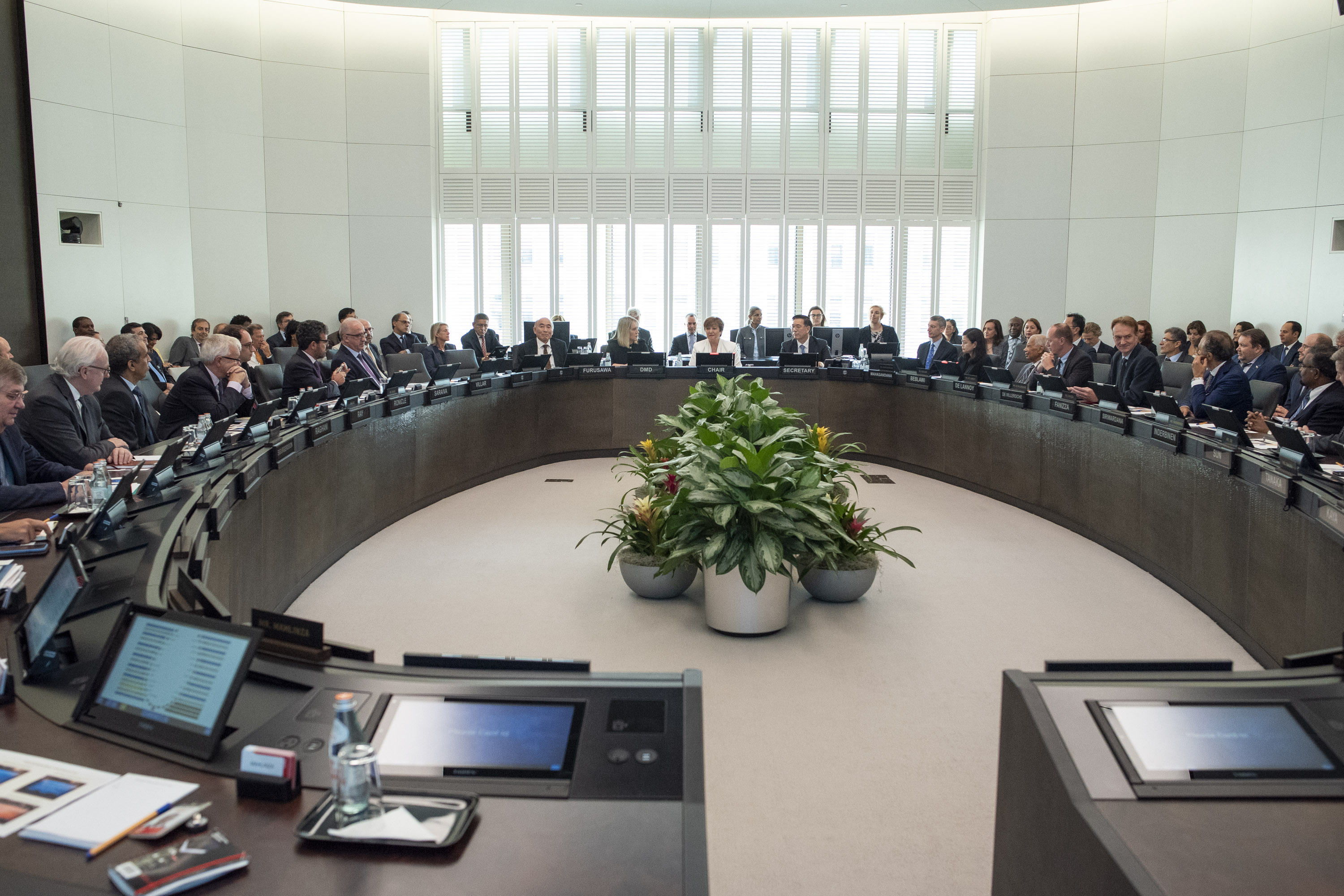
IMF Executive Board Completes the First Review of the Arrangements Under the Extended Fund Facility, the Extended Credit Facility, and the Resilience and Sustainability Facility for Senegal
IMF News, December 13, 2023
Source details
- Canonical URL
- IMF Executive Board Completes the First Review of the Arrangements Under the Extended Fund Facility, the Extended Credit Facility, and the Resilience and Sustainability Facility for Senegal
Other formats
Bibliographic details
- Published: December 13, 2023
Review completion and financing
- The Executive Board completed the first review of Senegal’s economic program under the EFF, the ECF, and the RSF.
- The completion enables the immediate release of about US$ 214.86 million (SDR 161.82 million) under the combined ECF/EFF.
- The completion enables the immediate release of about US$ 64.45 million (SDR 48.54 million) under the RSF.
- The Executive Board provided the country with access to SDR 210.36 million (about US$ 279.31 million).
Economic outlook and risks
- Near-term growth for 2023/24 was revised downward and near-term inflation was revised upward due to materializing downside risks.
- Medium-term prospects are favorable conditional on appropriate policies and the start of hydrocarbon production in mid-2024, but remain subject to uncertainty with risks tilted to the downside.
- Identified shocks and risk factors include:
- the halt of the cereal export agreement between Russia and Ukraine;
- the recent imposition of restrictions on rice exports by India;
- the appreciation of the U.S. dollar;
- increasingly stringent regional and global financial conditions;
- instability in some neighboring countries;
- the possibility of a protracted war in Ukraine;
- an exacerbation of the conflict in the Middle East;
- higher commodity prices;
- tighter financial conditions;
- heightened political instability and increased political polarization ahead of the presidential election;
- vulnerability to the impacts of climate change.
Program performance and structural reforms
- Performance under the ECF/EFF/RSF was assessed as satisfactory.
- All quantitative performance criteria and indicative targets but one for end-June 2023 under the ECF/EFF were met.
- Four out of six structural benchmarks for the first review of the EFF/ECF program have been implemented; the remaining two were implemented with small delay.
- Authorities are implementing agreed structural reforms, including:
- steps to strengthen revenue administration and public financial management;
- measures to enhance governance and improve anti-corruption frameworks;
- reforms under the RSF to build resilience to climate change, implemented steadily.
- The authorities are advancing reforms to enhance governance of public funds, increase transparency, and step up their anti-corruption framework.
- Urgent attention recommended to rectify deficiencies in the AML/CFT framework to minimize risks to the financial sector and facilitate an exit from the FATF's grey list.
- Recommendation to address weaknesses in the financial sector to foster more inclusive and private sector-led growth.
Fiscal policy, revenues, and debt sustainability
- The 2024 budget law aligns with an agreed-upon deficit target of 3.9 percent of GDP.
- Fiscal consolidation strategy aims for a fiscal deficit of 3 percent of GDP by 2025.
- The budget law embeds:
- an increase in tax revenue to 20 percent of GDP by 2025;
- a gradual phasing out of untargeted energy subsidies with a commitment to limit them to 1 percent of GDP in 2024.
- Policy recommendations on public finances:
- Accelerate the medium-term revenue strategy, including reduction of tax expenditures and broadening of the tax base.
- Gradually eliminate untargeted energy subsidies while protecting the most vulnerable and strengthen the institutional framework for setting energy prices.
- Prudent public debt management and restrict borrowing capacity of public sector entities beyond the central government.
RSF and climate-related reforms
- Performance under the RSF arrangement was satisfactory.
- Authorities should maintain reform momentum and continue to strengthen climate mitigation and adaptation policies to catalyze new investments from donors and the private sector.
Executive Board statement (Kenji Okamura, Deputy Managing Director and Acting Chair)
- Despite multiple shocks, Senegal’s performance under the ECF/EFF and RSF arrangements was satisfactory.
- Materialization of some downside risks led to downward revision of near-term growth and upward revision of near-term inflation.
- Containment of growing debt vulnerability and establishing a downward trajectory for public debt hinge on successful implementation of the fiscal consolidation strategy targeting a 3 percent of GDP fiscal deficit by 2025.
- Emphasis on revenue mobilization, expenditure reprioritization, energy subsidy reform, institutional strengthening for energy pricing, prudent public debt management, governance, transparency, business environment improvements, and AML/CFT remediation.
Key statistics and projections (selected figures preserved exactly as in source)
- Immediate financing releases:
- US$ 214.86 million (SDR 161.82 million) under combined ECF/EFF.
- US$ 64.45 million (SDR 48.54 million) under RSF.
- SDR 210.36 million (about US$ 279.31 million) access provided.
- GDP at constant prices (annual percent change) — selected years:
- 2021 Act.: 6.5
- 2022 Est.: 4.0
- 2023 IMF CR 23/250 Proj.: 5.3
- 2024 Proj.: 4.1
- 2025 Proj.: 10.6
- 2026 Proj.: 8.3
- 2027 Proj.: 10.2
- 2028 Proj.: 5.2
- 2029 Proj.: 5.1
- Consumer prices (annual average):
- 2021 Act.: 2.2
- 2022 Est.: 9.7
- 2023 Proj.: 5.0
- 2024 Proj.: 3.9
- Exports, f.o.b. (CFA francs) — selected entries:
- 2021 Act.: 26.3
- 2022 Est.: 25.5
- 2023 Proj.: 15.7
- 2024 Proj.: -1.2
- 2025 Proj.: 25.6
- 2026 Proj.: 31.5
- 2027 Proj.: 24.8
- Imports, f.o.b. (CFA francs) — selected entries:
- 2021 Act.: 17.1
- 2022 Est.: 42.4
- 2023 Proj.: -3.2
- 2024 Proj.: 0.7
- 2025 Proj.: 6.7
- Broad money (changes in percent of beginning-of-year broad money):
- 2021 Act.: 15.4
- 2022 Est.: 21.6
- 2023 Proj.: 20.0
- 2024 Proj.: 17.0
- 2025 Proj.: 10.7
- Central government operations (percent of GDP):
- Revenue: 2021 Act.: 19.5; 2022 Est.: 19.9; 2023 Proj.: 21.5; 2024 Proj.: 21.2; 2025 Proj.: 21.8; 2026 Proj.: 22.0; 2027 Proj.: 22.5; 2028 Proj.: 23.3; 2029 Proj.: 23.4
- Total expenditure: 2021 Act.: 25.8; 2022 Est.: 26.4; 2023 Proj.: 26.1; 2024 Proj.: 25.7; 2025 Proj.: 26.0
- Net lending/borrowing (including grants): 2021 Act.: -6.3; 2022 Est.: -6.6; 2023 Proj.: -4.9; 2024 Proj.: -3.9; 2025 Proj.: -3.0
- Primary fiscal balance: 2021 Act.: -4.3; 2022 Est.: -4.4; 2023 Proj.: -2.2; 2024 Proj.: -2.3; 2025 Proj.: -1.5; 2026 Proj.: -0.7; 2027 Proj.: 0.0
- Current account balance (official transfers included):
- 2021 Act.: -11.2
- 2022 Est.: -19.8
- 2023 Proj.: -13.3
- 2024 Proj.: -14.5
- 2025 Proj.: -6.1
- 2026 Proj.: -8.9
- 2027 Proj.: -4.8
- 2028 Proj.: -4.6
- Gross domestic investment (percent of GDP) — selected entries:
- 2021 Act.: 35.4
- 2022 Est.: 46.6
- 2023 Proj.: 42.5
- 2024 Proj.: 44.2
- 2025 Proj.: 36.4
- Gross national savings (percent of GDP) — selected entries:
- 2021 Act.: 24.3
- 2022 Est.: 26.9
- 2023 Proj.: 29.2
- 2024 Proj.: 29.7
- 2025 Proj.: 30.3
- Total public debt (percent of GDP) — selected entries:
- 2021 Act.: 73.3
- 2022 Est.: 76.0
- 2023 Proj.: 77.7
- 2024 Proj.: 79.6
- 2025 Proj.: 73.2
- 2026 Proj.: 72.5
- 2027 Proj.: 67.4
- 2028 Proj.: 67.2
- 2029 Proj.: 67.0
- 2030 Proj.: 65.5
- Domestic public debt (percent of GDP) — selected entries:
- 2021 Act.: 16.1
- 2022 Est.: 19.6
- 2023 Proj.: 18.5
- 2024 Proj.: 20.8
- 2025 Proj.: 16.8
- External public debt (percent of GDP) — selected entries:
- 2021 Act.: 57.2
- 2022 Est.: 56.4
- 2023 Proj.: 59.3
- 2024 Proj.: 58.7
- 2025 Proj.: 56.5
- 2026 Proj.: 55.7
- 2027 Proj.: 52.7
- 2028 Proj.: 51.4
- 2029 Proj.: 49.8
- 2030 Proj.: 47.1
- Total public debt service (percent of revenue) — selected entries:
- 2021 Act.: 28.6
- 2022 Est.: 30.7
- 2023 Proj.: 32.5
- 2024 Proj.: 32.2
- 2025 Proj.: 27.4
- 2026 Proj.: 31.8
- 2027 Proj.: 31.7
- Memorandum items:
- Gross domestic product (CFAF billions) — 2021: 15,288; 2022: 17,268; 2023: 18,770; 2024: 18,930; 2025: 21,176; 2026: 21,258; 2027: 23,886; 2028: 25,624; 2029: 27,473; 2030: 29,835
- Share of hydrocarbon in total GDP (percent) — selected entries: 4.7; 2.5; 4.8; 3.4
- National currency per U.S. dollar (average): 554
- WAEMU gross official reserves (billions of $US) — selected entries: 24.2; 18.4; 15.5; 19.0; 22.2
- WAEMU gross official reserves (percent of broad money) — selected entries: 34.1; 24.9; 18.7; 16.9; 17.6; 19.2; 20.6
- WAEMU gross official reserves (months of WAEMU imports of GNFS) — selected entries: 4.2; 3.0; 3.1; 3.3
Source: Senegal authorities; and IMF staff calculations.