For better or worse?
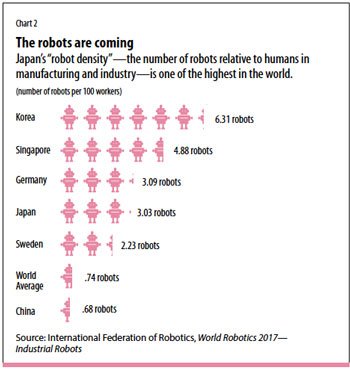
Japan’s progress in automation, use of robots, and integration of artificial intelligence with daily living is likely to move at a faster pace than in many other advanced economies for several reasons:
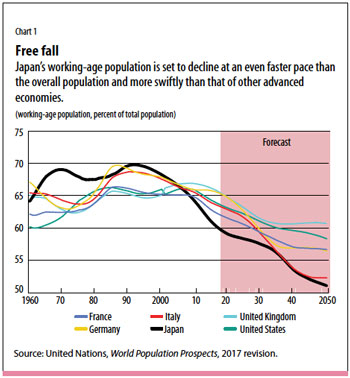
Shrinking population and the more rapidly shrinking workforce: As noted above, the constraint on productivity implied by a secular decline in the labor force will effectively push many industries to invest in new technology—as appears evident in Japan now, including among small and medium-sized enterprises, which have a more difficult time attracting and retaining labor. Japan is not alone in this demographic trend, but is well ahead of other advanced economies.
Aging population: The aging of Japan’s population—
the so-called baby boom generation will reach 75 in just a few years—is creating substantial labor needs in health and eldercare that cannot be met by “natural” workforce entrants (that is, natives). As a result, the proliferation of robots will extend well beyond Japanese factories to include schools, hospitals, nursing homes, airports, train stations, and even temples.
Declining quality of services: Surveys support the view that both the volume and quality of services in Japan are in decline. Recent work by the research arm of Japan’s Research Institute of Economy, Trade and Industry (Morikawa 2018) shows that the quality of services is eroding as a result of labor shortages. Most critically affected are parcel delivery services, hospitals, restaurants, elementary and high schools, convenience stores, and government services.
These same factors may explain why—in model-
based simulations—Japan could experience higher and more immediate gains from the continued advance of robotics and artificial intelligence in the economy. Looking at data across the Group of 20 industrialized countries, a simulation prepared by the IMF staff points to the risk of declining labor shares, income polarization, and rising inequality. This assumes substantial transition costs (unemployment, lower wages) as increasing automation substitutes for and displaces existing human labor.
However, applying this same approach only to Japan yields some very different results. Specifically, with a shrinking labor force, even fully substitutable automation could boost wages and economic growth. In other words, with labor literally disappearing and dim prospects for relief through higher immigration, automation and robotics can fill the labor gap and result in higher output and greater income rather than replacement of the human workforce.
These positive results notwithstanding, Japan is not immune from societal and welfare risks linked to increased automation. Polarization of the labor force, in which a relatively small proportion of workers have the training and education needed to fully leverage productivity from robotics, is always a social risk. Research suggests that the female labor force, which has swelled in the past five years, is particularly vulnerable to displacement, given the heavy concentration of women in nonregular jobs (that is, temporary, part-time, or other positions outside the mainstream of Japan’s lifetime employment system), whose tasks are more susceptible to automation (Hamaguchi and Kondo 2017).