


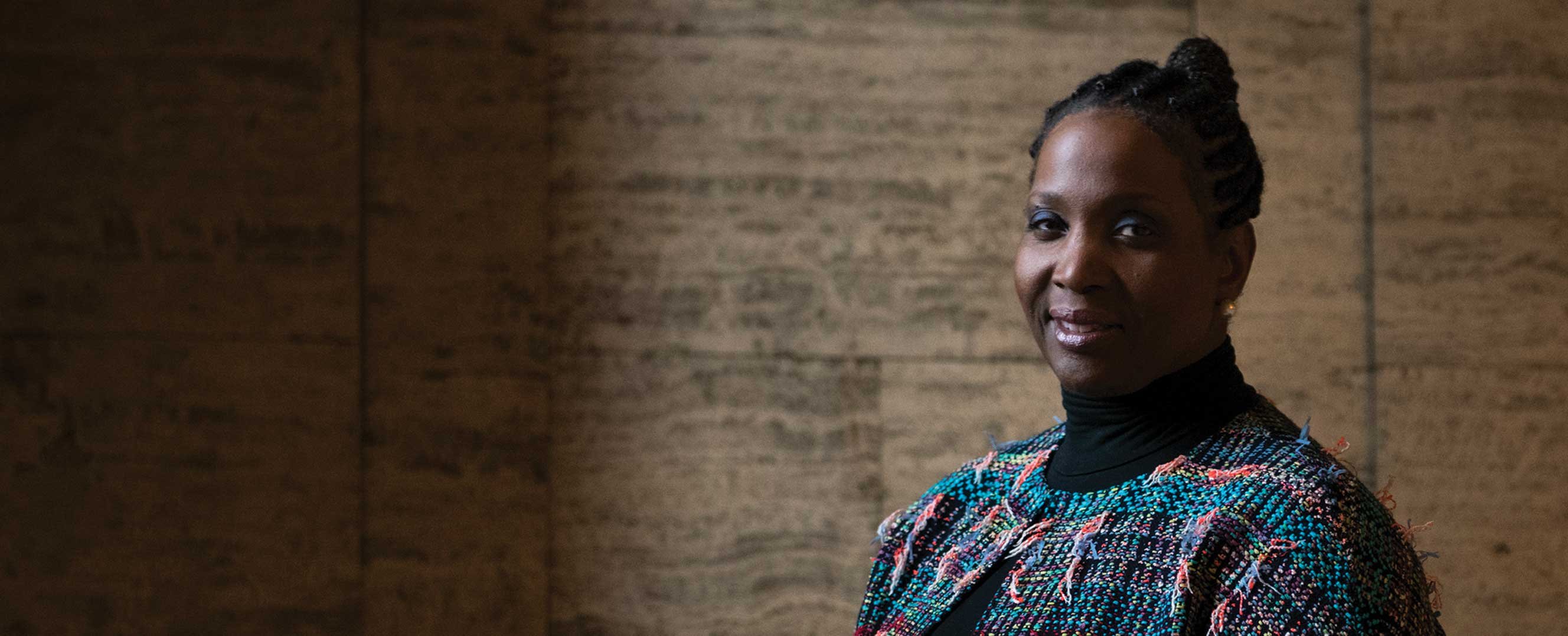
Michigan State University’s Lisa D. Cook shows how racism and sexism hurt us all
Lisa D. Cook was two or three years old when the issue of race first hit her—literally. Kids at her Georgia nursery school called her a racial epithet and attacked her, leaving a lifelong scar above her right eye.
“It wasn’t until much later that I understood that that word was associated with violence, with racial violence, and its true history,” says Cook. Since then, the economist has embraced the issue of race to pursue research at the intersection of the African-American lived experience and macroeconomics.
In a profession lambasted for its sexism and racism, Cook stands out for her gender, her ethnicity, and her chosen areas of research. Among her conclusions is that racism and sexism create a huge drag on the world’s largest economy.
Against the backdrop of the Black Lives Matter and #MeToo movements, her findings have forced the issues of race and gender higher up the economics agenda, challenging a profession under fire on both scores. She has also become known for her work on development, financial institutions and markets, and economic history.
“Lisa has been willing to take the risk of not getting the professional plaudits she deserves by pursuing research in areas that have not been plumbed by anyone yet,” says William A. Darity Jr., a professor of economics and African American studies at Duke University in Durham, North Carolina. “People are now acknowledging the significance of her contributions.”
Now a professor of economics and international relations at Michigan State University in East Lansing, Cook has published papers on subjects ranging from the impact of lynchings in slowing overall economic activity, to how having a distinctively black name positively affects longevity, to the economic loss of excluding African Americans and women from the innovation process.
Her academic background includes a bachelor’s degree from the historically Black Spelman College in Atlanta, Georgia, a second bachelor’s as a Marshall Scholar from Oxford University, and coursework toward a master’s in philosophy from the Université Cheikh Anta Diop in Dakar, Senegal. She earned her doctorate in economics at the University of California, Berkeley.

Earlier this year, speaking via video link during protests following the death of George Floyd at the hands of police, Cook considers whether this year’s events will differ from previous, successive protests.
“It possibly could, because of the strange confluence of events, and serendipity,” she says. “Because people are locked down, they have had to pay attention. So I think this time is different.”
Desegregating Georgia
Cook knows a lot about protest and pushing for change. She remembers letter-writing sessions organized by her father, a Baptist chaplain at the local hospital, to protest segregation. An uncle and a cousin were college classmates of Martin Luther King Jr. and joined the civil rights movement he led. The young Lisa learned from their example.
“I organized a protest every single year” at Spelman, she says. Her campaigns included demands that the college divest itself of assets in South Africa, objections to curfew, and protests against the lack of vegan and vegetarian options in the school cafeteria.
Cook and her two equally high-achieving sisters—both trained lawyers—were born into a middle-class family in the historic town of Milledgeville, Georgia. The state capital for the first half of the 19th century, antebellum Milledgeville attracted money and power from the surrounding countryside, which was developed by enslaved peoples, many of whom were bought and sold in the town square to work on cotton plantations.
Cook grew up in a South still struggling with the tortuous, sometimes violent process of desegregation. When the local swimming pool was ordered to open to Blacks, officials filled it with concrete, rather than comply. Cook recalls that the only place in town where her family could eat out was the canteen at her father’s workplace.
Her father, Payton B. Cook, was the first Black chaplain at the state’s central hospital. He was probably descended from enslaved peoples in Georgia, the family says. Her mother, Mary Murray Cook, a nurse, was the first African American professor at Milledgeville’s Georgia College, and recruited to set up its nursing program.
Violence and economic growth
Cook’s past, together with her racial identity, have converged with the ambition of any self-respecting economist to maximize utility and foster growth. Underlying much of her work is the understanding that inequality produces market distortions that inhibit growth.
One of her seminal papers demonstrates how violence against Black Americans has hindered broader economic activity, specifically innovation, the key to long-term growth. In her research, Cook adopts commercial patents as a tangible measure of, and proxy for, economic activity.
Drawing on social and economic history, she investigates how segregation, lynchings, and race riots during the tumultuous period 1870–1940 reduced the total number of patents filed. Until 1900, patent filings by Black inventors were moving in the same direction as those of White innovators. Then, as the effects of violence took hold, the rates began to diverge and slow overall. The pace of patent filings by Black inventors topped out in 1899 and didn’t exceed that year’s level until 2010.
“Conflict can have lasting and persistent effects on economic activity,” says Cook.
She estimates that in the absence of that violence, there might have been 1,100 more patents—roughly the number that might be filed in a medium-sized European country in the same time period.
The answers lie in economics
Economics might have missed out on Cook’s contributions had it not been for a serendipitous meeting with a stranger. She fell into conversation with a Cambridge-trained economist during an ascent up the base of Mount Kilimanjaro after her master’s program in Senegal.
While studying in that country, Cook had become consumed by questions of development. “Why are some countries rich and others not?” she wondered. During the five-hour hike up Kilimanjaro, her companion—whose name has now faded from her memory—convinced her that the answers lay in economics.
The result of the chance encounter was enrollment in a doctoral program in economics at Berkeley. But en route to her first semester, Cook was involved in a head-on car crash that temporarily left her in a wheelchair with multiple fractures in her legs. Despite the urgings of her father and elder sister, she refused to return to Georgia and instead doggedly pursued her studies.
Some of her fellow students “sort of wrote me off,” she recalls.
“She’s got that resilience, that grit, that determination,” Cook’s older sister Pamela Cook says. “People perceived her differently coming in a wheelchair. She proved them wrong.”
Cook’s PhD dissertation looked at how the absence of property rights in czarist and post-Soviet Russia led to underdevelopment of the banking system. Her thesis supervisor at Berkeley was Barry Eichengreen, who says he was struck by the breadth and scope of her interests, ranging from Russian economic history and Africa’s development to issues centered on race.
“Before she had her papers published, people would wonder, ‘How serious can you be if you’re skipping between different issues?’” Eichengreen says. “Now she has established that she’s very serious indeed.”
While Cook was conducting research in Russia, contacts would lament to her the lack of innovation in the country. According to the prevailing economic orthodoxy of the time, if government enforced intellectual property rights, innovation would flow.
But Cook believed that this overlooked critical preconditions to innovation such as the rule of law and personal security. Testing her theory would require a sample group of people who were subject to violence, and had few or no legal protections, and a control group whose members enjoyed justice under the law and had few fears about personal security. US inventors—Black and White—living at the turn of the 20th century provided the ideal data set.
Discouraged from economics
Despite receiving backing for her research from renowned economists including Milton Friedman, the resulting key paper in Cook’s career took nearly a decade to be published. Senior economists discouraged her, saying it would derail her ambitions for tenure.
“Nobody wants to hear about women, and they sure don’t want to hear about Black people, they said.”
Journals to which she submitted her work said her findings were specific to one group—African Americans—at one point in history; they suggested that her research held no broader relevance.
Cook’s co-author Trevon Logan, professor of economics at Ohio State, says the myopia extended further. He and Cook were grilled by skeptics who challenged the validity of their subject.
“Why are you looking at African Americans?” they were asked. “What’s unique about this particular circumstance? Why would we want to know about Black people?”
“Which is interesting,” Logan says, “because we never ask that question about White people.”
This dismissive attitude was not new to Cook. She remembers the responses of professors and peers while she was touring top graduate schools.
“Most graduate students were male, and they systematically discouraged me from doing a PhD in economics,” she says. At two separate dinner parties for prospective students, she was challenged to demonstrate her mathematics ability.
An exception was the encouragement she received from Donald J. Harris—the first Black scholar to earn tenure in Stanford University’s economics department and the father of US Vice President–elect Kamala Harris.

Today Harris remembers, “I was impressed by her eagerness to learn, her strong motivation for successful performance in graduate school, and her maturity of vision about career goals.”
‘You can’t be what you can’t see’
Cook, who was elected to the Executive Committee of the American Economic Association in 2019, acknowledges serious shortcomings within the profession.
“If economics is hostile to women, it is especially antagonistic to Black women,” Cook wrote last year in the New York Times. She cited the association’s own survey of over 9,000 of its members in which 62 percent of Black women economists reported experiencing racial discrimination, gender discrimination, or both.
In the survey, only 3 percent identified as Black, compared with 13 percent of the US population; 47 percent of those respondents reported experiencing discrimination in economics; and fewer than half of respondents, regardless of race, said they thought non-White economists were respected.
“The only way we’re going to remain a competitive, energetic, knowledge-creating profession is to incorporate as many and as different ideas as we can, and leverage those ideas,” she says. “We’re gonna die otherwise.”
Cook is passionate about building a future pipeline of more diverse economists. She serves as director of the American Economic Association’s summer program, recruiting members of underrepresented groups and often acting as mentor. One recruit was 24-year-old Ghanaian-born American Anna Gifty Opoku-Agyeman, who co-wrote the New York Times op-ed with Cook and says she is inspired by her example.
“I think that her being a Black woman is everything,” says Opoku-Agyeman. “If she were a White guy, I’d be, like, ‘meh,’ but it wouldn’t hit the same way. ‘You can’t be what you can’t see,’” she says, quoting the American children’s rights activist Marian Wright Edelman.
Maximizing opportunities
One of Cook’s most startling findings is that the exclusion of Black and female Americans from industries that drive technological innovation wipes out almost $1 trillion a year from the US economy. She estimates that the United States forgoes as much as 4.4 percent of GDP per capita each year. The loss from excluding women alone is 2.7 percent.
For Cook’s admirers, her work is not only original and risk-taking but has much to say to a United States currently struggling with its history of racial violence and injustice.
But her conclusion raises the question, Why would those who enjoy advantages by virtue of their identity voluntarily surrender those privileges? Cook’s response: because it is ultimately in their interest too.
A refusal to embrace the very best thinking—wherever it may originate—and denying opportunities to sizable segments of the population results in a loss to the privileged, too.
Cook illustrates her point with a scene from the 2016 Hollywood film Hidden Figures. The plot centers on three Black female mathematicians who worked at the National Aeronautics and Space Administration (NASA) during the space race of the 1960s between the United States and the Soviet Union.
In one scene, astronaut John Glenn directs NASA to “get the girl to check the numbers.” The “girl” was African American Katherine Johnson, dubbed a “human computer” within NASA’s Flight Research Division. The astronaut—recognizing Johnson’s unique skill—was staking his life on her double-checking the capsule’s trajectory.
Cook recalls the scene: “So this is John Glenn saying, ‘I trust you, you’re the one who knows how to do this.’ He relies on a Black woman to get him to the moon over her White male counterparts.”
The conclusion of Cook’s research is a clarion call to integrate not only diversity of thought, but also diversity of lived experience—to integrate them not only into economics, but also the world beyond. Failure to do so, she suggests, will cost us all.

HYUN-SUNG KHANG is on the staff of Finance & Development.
Opinions expressed in articles and other materials are those of the authors; they do not necessarily reflect IMF policy.


