

Finance & Development, December 2018, Vol. 55, No. 4 PDF version
A New Social Contract
Overcoming fears of technology and globalization means rethinking the rights and obligations of citizenship
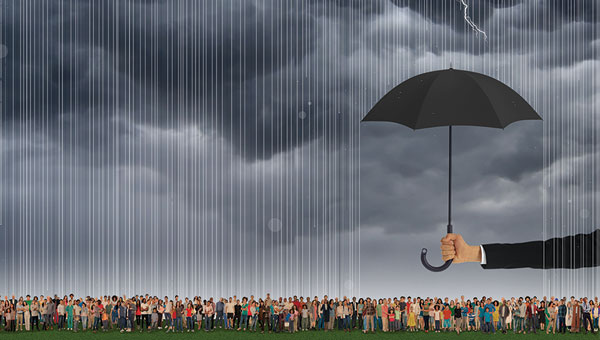
We are living in an age of insecurity. Increasingly, the values of liberal democracy, liberal economies, and a rules-based international system are being repudiated—even though they have delivered progress for the vast majority of people. Discontent has been fed by fears over slowing economic progress, especially in advanced economies, flatlining productivity and social mobility, and concerns about the future brought on by shifts in demography and technology.
We see this expressed in our politics. Popular anger and distrust of elites, compounded by the financial crisis, have led to growing support for nationalist and illiberal politicians. We see it in the mounting evidence of declining perceptions of well-being and trust in many countries. While the causes of our discontent vary, they all point to the need to revitalize our politics, economics, and social contract to provide citizens with a greater sense of security and confidence in the face of impending changes.
Why are so many people in some of the more successful countries in the world so unhappy? Inequality is a major cause, as is fear about future prospects caused by automation and aging. While the world has become more equal between countries, there have been different effects on income distribution within countries. The middle class in emerging markets and the richest 1 percent globally have benefited enormously, while the middle class in advanced economies has suffered. And parents in many countries worry about their children’s prospects in the face of the high costs of education and housing, alongside low-quality jobs with poor benefits.
Protectionist calls
Many blame globalization and technology, but I would focus more on the failure of our social contract to manage properly the consequences of both. Our social contract—by which I mean the rights and obligations of citizenship—has frayed as a result of hyper-globalization and the austerity that followed the financial crisis. The advance of automation and intensifying global competition have driven down the wages of less skilled workers. As a result, many call for more protectionism or blame immigrants. But the answer is not to deglobalize and revert to our national silos, but to rethink our social contract to heal these tensions and help people adjust.
All this has been compounded by sluggish growth since the Great Recession. A recent study of 25 advanced economies by the McKinsey Global Institute found that 65 to 70 percent of households (or 540 million to 580 million people) experienced flat or falling incomes before taxes and transfers from 2005 to 2014. When growth is slow, people become less generous and less tolerant.
To be sure, fiscal policy reduced this decline to 20 to 25 percent in terms of disposable, or after tax, incomes, according to the 2016 McKinsey study "Poorer Than Their Parents? Flat or Falling Incomes in Advanced Economies." Safety nets worked particularly well in the United States, turning a 4 percent drop in market incomes into a 1 percent gain in disposable incomes over time. This 5 percentage point change was helped by the Obama administration’s stimulus plan, which transferred more than $350 billion to households in the form of tax relief and assistance to workers affected by the downturn. In France, the safety net raised median disposable income by 3 percentage points above median market income, while in the United Kingdom, transfers fully offset the decline in market incomes.
Future shock
While these redistributive policies softened the blows dealt to lower-income households by the Great Recession, they also contributed to a massive accumulation of debt driven by the direct and indirect costs of the crisis. To reduce it, many countries later resorted to welfare cuts that unleashed social grievances, with communities feeling they were being left behind and individuals experiencing a loss of dignity and sense of control over their destiny. In the United Kingdom, for example, Fetzer (2018) argues that welfare cuts took the biggest toll in regions that ended up voting for the populist UK Independence Party and in favor of Brexit. The combination of globalization, the financial crisis of 2008, and the austerity that followed meant that many people faced a massive shock with a very thin safety net to support them.
Fear of future prospects is another source of discontent. This fear is largely rooted in expectations that automation will eliminate many types of routine and repetitive work while creating more demand for highly skilled labor. Compounding the anxiety is the rise of precarious work at low wages with minimal or no benefits. While some people find advantages in these more flexible work arrangements, others experience serious economic insecurity. Precarious employment reduces both physical and mental health as individuals lose a sense of agency over their own lives.
Furthermore, there is a risk that automation will further bifurcate labor markets in favor of the highly educated. The US Bureau of Labor Statistics predicts that for every highly paid job in software development, there will be six new low-paid jobs for personal care and home health aides between 2014 and 2024.
These anxieties have found their expression in the political arena. In the United States, for example, Delsman (forthcoming) finds that 21 of the 22 states where jobs were most vulnerable to automation voted for Donald Trump in the 2016 presidential election, while all 15 least vulnerable states backed Hillary Clinton.
Division of responsibilities
The backlash highlights the need for a new social contract, one that adapts to changed economic realities and better manages the social implications of globalization. The social contract includes the payment of taxes in exchange for public goods, and the way that society looks after the old, the young, the infirm, and those who have fallen on hard times. Because the social contract is fundamentally values-driven, solutions will vary across societies.
Even so, every society will have to think of who benefits from its social safety net, which is the mechanism through which we pool risk and offset, to some extent, the impact of luck on life chances. Every society will also have to make choices about the division of responsibilities between the family, the voluntary sector, the market, and the state. This is essential since the welfare state is also the mechanism for ensuring the equal standing of all citizens so that they can participate fully in public life.
There are fundamental questions to answer, which have grown more complex in more heterogeneous and globalized societies. Whom do we feel obligations to take care of and share risks with? What responsibilities go along with those obligations? How much do obligations extend beyond families to communities or other regions? What about poor people in other parts of the world? Are we obliged to leave future generations at least an equivalent endowment of physical, social, and natural capital as we were given?
As part of the new social contract, we may need to reinstate the reciprocity and insurance element in welfare provision. There is a toxic perception that there are "hard-working people" and "welfare scroungers" when in fact, as John Hills at the London School of Economics (LSE) has shown for the United Kingdom, the vast majority take out (in the form of education, health care, and pensions) broadly as much as they put in (in taxation when they are working) over the course of their lives. The rich pay more tax but tend to live longer, so they benefit more from pensions and health care in old age.
Universal benefits?
Perhaps we need to revisit the political and social advantages of universal benefits, which are better for getting political buy-in and ensuring quality. The founder of the welfare state in the United Kingdom, the LSE’s William Beveridge, intended it to be based on the concept of universal social insurance. That link was lost as the social safety net increasingly was funded through general taxation and some citizens opted out through private provision. Richard Titmuss, the pioneering British social researcher, noted that "separate discriminatory services for poor people have always tended to be poor quality services." Keeping the better-off engaged with public services sustains a sense of mutual obligation and maintains pressure to uphold standards.
How would a new social contract address inequality? In the medium term, so-called pre-distribution policies are key—education, social mobility, infrastructure investments in poorer regions, and spreading productivity improvements to the frontier. Countries with greater social mobility grow faster because they more effectively match people to the right jobs, generating higher productivity. The best way to raise innovation and productivity may be to provide opportunity to the "lost Einsteins" who are disadvantaged by the circumstances of their birth (Van Reenen and others 2018). Greater investment in equalizing education opportunities and outcomes would have a high payoff and enhance confidence in the fairness of the system.
Old and young
We also face huge issues of intergenerational fairness. Many aging societies now spend more on the old than the young. Data from the Organisation for Economic Co-operation and Development show that as the age of the median voter rises by a year, public spending on pensions goes up by 0.5 percent of GDP (Ebbinghaus and Naumann 2018). Older people vote and are very effective at protecting their interests—the young should do the same. But older people should care, not just about their own children and grandchildren (who can be supported through bequests), but about others’ too, since they will inhabit the same society. One solution is to give young people entitlements that they can use to improve skills over the course of their lives. Under such a social contract between generations, young people would repay the investment with higher future taxes that could finance care for the elderly.
Intergenerational fairness and social mobility are issues that will take time to address; in the near term, some degree of redistribution is essential. Tax systems have become less progressive as advanced economies lowered corporate taxes and top rates on personal income in the 1980s and 1990s and raised value-added taxes. This is especially problematic given widening inequality in market incomes. And because wealth has grown even more unequal than income, we should explore taxing wealth such as inheritance, land, and real estate. Recent IMF research shows that greater equality boosts growth, so such reforms may also help revive sluggish economies (Ostry, Berg, and Tsangarides 2014).
Another way to address inequality would be to put a floor under incomes, which would help ensure that even low-wage earners can enjoy a reasonable standard of living. I am not a proponent of universal basic income except in poor countries that lack the capacity to manage a welfare state or where it would substitute for an even worse policy, such as energy subsidies. In most middle-income and advanced economies, universal basic income would be expensive and inferior to a properly functioning welfare state. It also risks undermining the widespread view that anyone who can work should, and it does not take adequate account of the importance of meaningful work to well-being. Better solutions include wage subsidies, earned income tax credits, and higher minimum wages, combined with access to services such as education and healthcare.
Labor flexibility
The spread of low-quality jobs with few benefits and the impact of automation are sources of insecurity that must be addressed. To make a successful transition to digital economies, governments must make it easier to switch jobs and guarantee workers a fair share of the benefits from this transition. Potential solutions include ensuring a level playing field in wage negotiations, profit sharing, and cooperatives. Otherwise those left behind will keep voting for policies such as restrictions on trade or labor mobility that thwart modernization of the economy.
Firms should have flexibility to hire and fire workers as the economy changes but then provide generous unemployment benefits, training, and job placement. "Flexicurity," as it is called in Denmark, is just such a system. It relies on firms’ willingness to pay higher taxes and to engage with social partners on skill needs in exchange for more flexible employment rules. Unfortunately, spending on worker education and training has been declining across most countries, and firms have less incentive to spend when employee turnover is high. Investment in training and transitional support must be raised to facilitate the transition to the labor markets of the future.
As countries get richer, people work fewer hours, and automation will accelerate this trend. It will be important to use productivity gains from automation to eliminate routine and repetitive tasks and make time for more meaningful work and leisure. Giving part-time and temporary workers (who tend to be lower skilled and lower paid) more rights to pensions, paid leave, and training has been a positive reform in countries like Denmark, Germany, and the Netherlands.
Income shift
As technology advances and populations age, working lives will be longer, and people will need to retool several times in their careers. Abolishing mandatory retirement ages and removing age limits for student loan eligibility, as the United States and United Kingdom have done, are a good start. Linking eligibility for pensions to life expectancy, as the Netherlands has done, is an even better way to adjust workers’ expectations.
At a global level, we also must find a way to redress the massive shift in income from labor to capital. A first step would be to remove policies that tax labor more heavily, although issues of international tax competition make this difficult. An international effort to ensure that capital is taxed where the economic activity takes place, rather than in offshore havens and various "tax efficient" structures, would go a long way toward restoring a sense of fairness in the world economy.
In sum, we need a new social contract to create a sense of security in our globalized and fast-changing economy. The social contract is about how we pool our resources to provide the public goods we agree are needed and how we support those affected by adverse shocks. While different societies will make different choices, we have all arrived at a crossroads: we must renegotiate choices we made in the past because they no longer fit current circumstances, much less those of the future. A new social contract is essential to restoring a sense of security and sustaining political support for open economies and societies.
References:
Delsman, Ben. Forthcoming. "Automation and Populist Vote Share." Cited in The People vs. Democracy: Why Our Freedom Is in Danger and How to Save It , Yascha Mounk. 2018. Cambridge, MA: Harvard University Press, 158.
Ebbinghaus, Bernhard, and Elias Naumann. 2018. "The Popularity of Pension and Unemployment Policies Revisited: The Erosion of Public Support in Britain and Germany." In Welfare State Reforms Seen from Below, edited by Bernhard Ebbinghaus and Elias Naumann, 155–86. Basingstoke, United Kingdom: Palgrave Macmillan.
Fetzer, Thiemo. 2018. "Did Austerity Cause Brexit?" Warwick Economics Research Paper Series 1170, University of Warwick, United Kingdom.
Ostry, Jonathan, Andrew Berg, and Charalambos G. Tsangarides. 2014. "Redistribution, Inequality, and Growth." IMF Staff Discussion Note 14/02, International Monetary Fund, Washington, DC.
Van Reenen, John, Alex Bell, Raj Chetty, Xavier Jaravel, and Neviana Petkova. 2018. "Lost Einsteins: Who Becomes an Inventor in America?" CentrePiece 23 (1): 10–13.
Illustration: Michael Waraksa
Opinions expressed in articles and other materials are those of the authors; they do not necessarily reflect IMF policy.