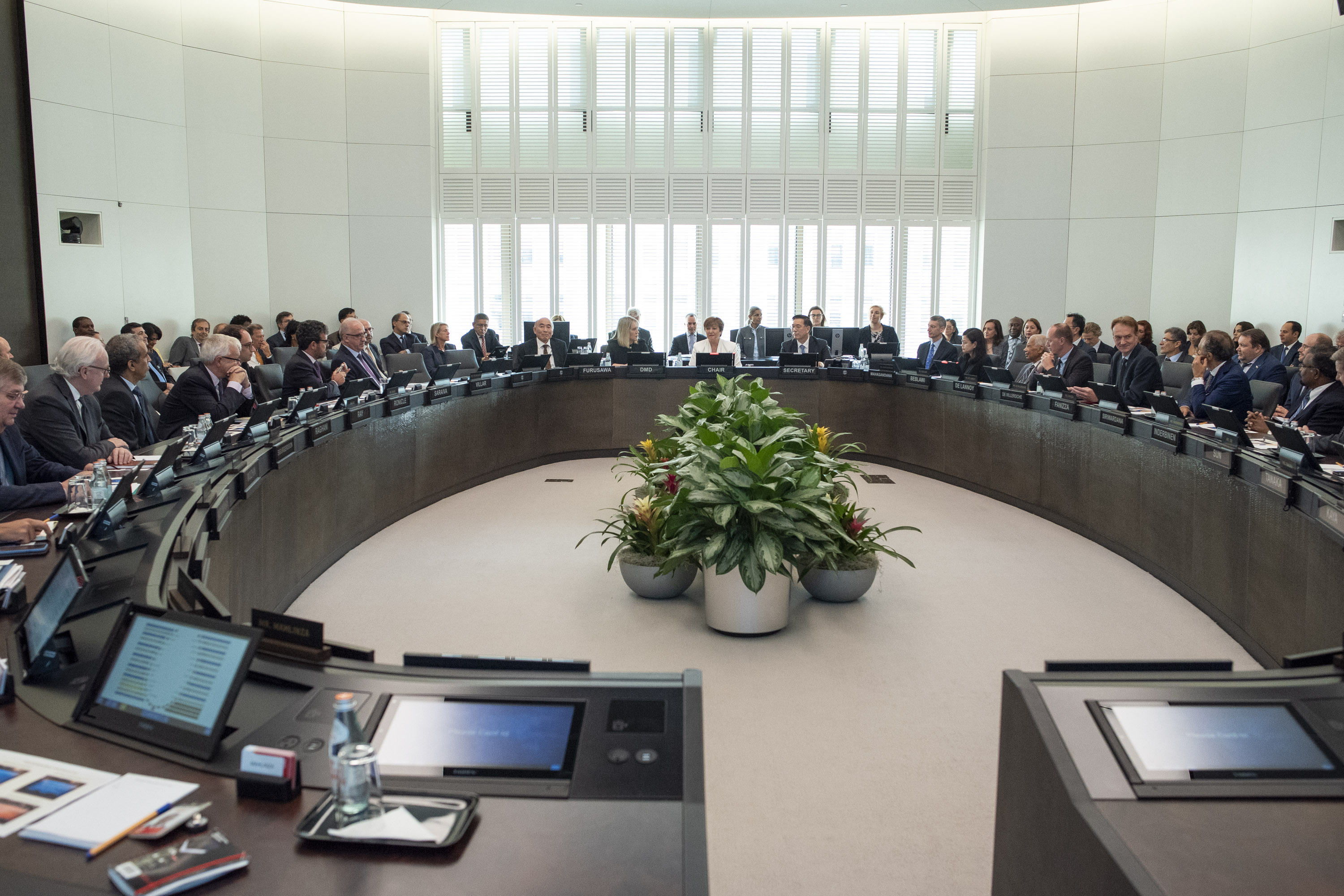
IMF Executive Board Concludes 2019 Article IV Consultation with the People’s Republic of China
IMF News, August 9, 2019
Source details
- Canonical URL
- IMF Executive Board Concludes 2019 Article IV Consultation with the People’s Republic of China
Other formats
Bibliographic details
- Published: August 9, 2019
Macroeconomic outlook and near-term projections
- GDP growth slowed to 6.6 percent in 2018, driven by necessary financial regulatory reforms and softening external demand.
- Growth is projected to moderate to 6.2 percent in 2019 as the planned policy stimulus partially offsets the negative impact from the US tariff hike on US$ 200 billion of Chinese exports.
- Headline inflation rose due to rising food prices and is expected to remain around 2½ percent.
- The current account surplus fell by around 1 percentage point, to 0.4 percent of GDP in 2018 and is projected to remain contained at 0.5 percent of GDP in 2019.
- Net capital outflows declined sharply from around $650 billion in 2015 and 2016 to $30 billion in 2018.
Financial sector, debt, and credit dynamics
- Strengthening of financial regulations and control over off-budget local government investment reduced the pace of debt accumulation and helped contain the build-up of risks in the financial sector.
- Credit growth slowed through 2018 but began to pick up in 2019.
- Corporate deleveraging partially offset government and household debt accumulation, but total nonfinancial sector debt still rose faster than nominal GDP growth.
- The deficit of the general government sector (including estimated off-budget investment spending) was estimated to be around 11 percent of GDP in 2018.
- Directors stressed the importance of staying the course on deleveraging and financial de-risking, including:
- continuing financial regulatory reforms while strengthening bank capital;
- developing a clear resolution regime for banks;
- containing vulnerabilities from rising household debt;
- reducing implicit guarantees for state-owned enterprises to improve credit allocation.
Structural reforms, opening up, and external engagement
- Opening up continued with decreases in tariffs, passage of a new foreign investment law, and revisions to the negative list for foreign investment entry.
- Progress on SOE reforms was mixed; Directors emphasized the need to increase the role of the market, reduce dominance of the public sector, ensure fair competition, accelerate opening up to the private sector, and intensify SOE reform.
- Directors welcomed the authorities’ commitment to multilateralism and a rules-based trading system, urging constructive engagement with trading partners and a comprehensive agreement with the United States to avoid undermining the international system.
- Directors recommended further opening up and other reforms that enhance competition and noted China should continue to upgrade its external lending framework to foster greater coordination, transparency, and debt sustainability.
Fiscal policy and medium-term fiscal reforms
- Directors underscored the importance of structural fiscal reforms that can enhance medium-term growth.
- If trade tensions escalate further and put at risk economic and financial stability, additional stimulus, mainly fiscal, would be warranted and should be targeted.
- Directors highlighted the need to address the misalignment of center-local fiscal responsibilities and to make the tax system more progressive to boost consumption and reduce inequality.
- To help boost consumption and reduce inequality, Directors urged continued progress on reforms to enhance the social safety net.
Monetary, exchange rate, and external sector recommendations
- Directors concurred that greater exchange rate flexibility and deeper and better functioning FX markets would help prepare the financial system for greater capital flow volatility.
- Greater exchange rate policy transparency would be important; some Directors also called for disclosure of FX interventions.
- Directors stressed moving to a more price-based monetary policy framework.
Data, governance, and other priorities
- Directors stressed the urgent need to address China’s macroeconomic data gaps to further improve data credibility and policy making.
- Directors emphasized continued financial regulatory reform, stronger bank capital, a clear bank resolution regime, and managing household debt vulnerabilities.
- Directors urged plans to reduce implicit guarantees for state-owned enterprises.
Selected economic indicators (annual percentage change, unless otherwise indicated)
- Real GDP (base=2015): 2014: 7.3; 2015: 6.9; 2016: 6.7; 2017: 6.8; 2018: 6.6; 2019: 6.2; 2020: 6.0; 2021: 5.7; 2022: 5.6; 2023: 5.5.
- Total domestic demand (annual percentage change): 2018: 6.1; 2019: 5.8.
- Consumption (annual percentage change): 2018: 8.0.
- Investment (annual percentage change): 2018: 4.8.
- Total capital formation (percent of GDP): 2014: 46.8; 2015: 44.7; 2016: 44.1; 2017: 44.6; 2018: 44.8; 2019: 42.9; 2020: 42.2; 2021: 41.6; 2022: 41.1; 2023: 40.5; 2024: 39.8.
- Gross national saving (percent of GDP): 2014: 49.0; 2015: 47.5; 2016: 45.9; 2017: 46.3; 2018: 43.4; 2019: 42.5; 2020: 41.8; 2021: 40.4; 2022: 39.7.
- Consumer prices (average): 2014: 2.0; 2015: 1.4; 2016: 1.6; 2017: 2.1; 2018: 2.2; 2019: 2.4; 2020: 2.8; 2021: 2.9; 2022: 3.0.
- Total social financing (annual percentage change): 2014: 14.3; 2015: 12.4; 2016: 16.7; 2017: 13.4; 2018: 10.5; 2019: 10.0; 2020: 9.5; 2021: 9.2; 2022: 8.7.
- Total social financing (in percent of GDP): 2014: 190; 2015: 198; 2016: 216; 2017: 224; 2018: 226; 2019: 232; 2020: 238; 2021: 242; 2022: 245; 2023: 247; 2024: 249.
- Total nonfinancial sector debt (annual percentage change): 2014: 17.1; 2015: 15.4; 2016: 19.9; 2017: 11.0; 2018: 10.4; 2019: 11.6; 2020: 11.7; 2021: 10.3; 2022: 9.9; 2023: 8.8.
- Total nonfinancial sector debt (percent of GDP): 2014: 207; 2015: 222; 2016: 253; 2017: 257; 2018: 266; 2019: 275; 2020: 282; 2021: 288; 2022: 293; 2023: 295.
- Household disposable income (percent of GDP): 2014: 60.4; 2015: 60.5; 2016: 61.0; 2017: 60.0; 2018: 59.8; 2019: 59.4; 2020: 58.9; 2021: 58.1.
- Household savings (percent of disposable income): 2014: 38.0; 2015: 37.1; 2016: 35.5; 2017: 35.4; 2018: 33.0; 2019: 31.5; 2020: 30.3; 2021: 28.9; 2022: 27.3; 2023: 25.4; 2024: 25.0.
- Household debt (percent of GDP): 2014: 35.8; 2015: 38.7; 2016: 49.7; 2017: 54.0; 2018: 56.2; 2019: 59.1; 2020: 61.1; 2021: 63.2; 2022: 65.4; 2023: 67.9.
- Non-financial corporate domestic debt (percent of GDP): 2014: 113; 2015: 121; 2016: 136; 2017: 130; 2018: 124; 2019: 122; 2020: 120.
- BIS credit-to-GDP gap (percent of GDP) (latest observation is for Q3 2017): 21.1; 20.8; 18.2.
- General budgetary government net lending/borrowing (Percent of GDP, consolidated): 2014: -0.9; 2015: -2.8; 2016: -3.7; 2017: -3.9; 2018: -4.8; 2019: -6.1; 2020: -5.7; 2021: -5.6; 2022: -5.5.
- Revenue (percent of GDP): 2014: 28.1; 2015: 28.5; 2016: 28.2; 2017: 28.3; 2018: 29.2; 2019: 28.8; 2020: 29.1; 2021: 28.0.
- Expenditure (percent of GDP): 2014: 31.6; 2015: 33.2; 2016: 33.9; 2017: 34.7; 2018: 36.9; 2019: 37.7; 2020: 36.5; 2021: 35.7; 2022: 35.2; 2023: 34.3.
- Official government debt (percent of GDP): 2014: 38.6; 2015: 36.4; 2016: 36.7; 2017: 36.8; 2018: 37.9; 2019: 40.3; 2020: 43.1; 2021: 45.5; 2022: 47.6; 2023: 49.4; 2024: 51.0.
- Current account balance (percent of GDP): 2018: 0.5.
- Trade balance (percent of GDP): 2018: 4.1; 2019: 2.5.
- Services balance (percent of GDP): 2014: -2.0; 2015: -1.9; 2016: -2.1; 2017: -2.2.
- Net international investment position (percent of GDP): 2014: 15.2; 2015: 14.9; 2016: 17.4; 2017: 15.9; 2018: 15.6; 2019: 14.8; 2020: 13.9; 2021: 12.9; 2022: 12.0.
- Gross official reserves (bn US$): 2014: 3,899; 2015: 3,406; 2016: 3,098; 2017: 3,236; 2018: 3,168; 2019: 3,167; 2020: 3,174; 2021: 3,177; 2022: 3,179; 2023: 3,182; 2024: 3,189.
- Nominal GDP (bn RMB): 2014: 64,718; 2015: 69,911; 2016: 74,563; 2017: 81,526; 2018: 88,702; 2019: 95,539; 2020: 103,084; 2021: 111,560; 2022: 120,546; 2023: 130,318; 2024: 140,613.
- Augmented debt (percent of GDP): 2014: 52.3; 2015: 56.6; 2016: 62.0; 2017: 67.3; 2018: 72.7; 2019: 80.2; 2020: 86.2; 2021: 91.1; 2022: 95.6; 2023: 99.3; 2024: 101.5.
- Augmented net lending/borrowing (percent of GDP): 2014: -7.2; 2015: -8.4; 2016: -10.4; 2017: -10.8; 2018: -11.2; 2019: -12.7; 2020: -12.2; 2021: -11.9; 2022: -11.6; 2023: -11.5; 2024: -11.4.
Executive Board assessment and key policy recommendations
- Directors commended the authorities’ recent reform progress, particularly in reducing financial sector fragilities and continuing opening up of the economy.
- Directors noted the highly uncertain external environment and emphasized that successfully shifting from high-speed to high-quality growth requires continuing with deleveraging and strengthening rebalancing efforts while adjusting macroeconomic policies to respond to rising trade tensions.
- Directors agreed that the announced policy measures are sufficient to stabilize growth in 2019 provided there are no further increases in tariffs, and that additional stimulus and excessive credit growth should be avoided.
- If trade tensions escalate, Directors agreed additional stimulus, mainly fiscal and targeted, would be warranted.
- Directors emphasized:
- continuing deleveraging and financial de-risking;
- structural fiscal reforms to enhance medium-term growth;
- reforms to enhance the social safety net and make the tax system more progressive to boost consumption and reduce inequality;
- greater exchange rate flexibility, deeper FX markets, and greater policy transparency.
IMF Executive Board Concludes 2019 Article IV Consultation with the People’s Republic of China — Press Release No. 19/314 (August 9, 2019).