Loading component...
2015 Article IV Consultation with the United States of America-Concluding Statement of the IMF Mission
June 4, 2015


A Concluding Statement describes the preliminary findings of IMF staff at the end of an official staff visit (or ‘mission’), in most cases to a member country. Missions are undertaken as part of regular (usually annual) consultations under Article IV of the IMF's Articles of Agreement, in the context of a request to use IMF resources (borrow from the IMF), as part of discussions of staff monitored programs, or as part of other staff monitoring of economic developments.
The authorities have consented to the publication of this statement. The views expressed in this statement are those of the IMF staff and do not necessarily represent the views of the IMF’s Executive Board. Based on the preliminary findings of this mission, staff will prepare a report that, subject to management approval, will be presented to the IMF Executive Board for discussion and decision.
Webcast of the press conference  |
The 2015 U.S. Article IV Consultation was focused on the prospects for higher policy rates and the outlook for, and policy response to, financial stability risks. In this, the work of the mission integrated the findings of the IMF’s latest Financial Sector Assessment Program for the U.S. The main policy messages were:
The Macro Outlook
1. Growth prospects. The U.S. economy’s momentum in the first quarter was derailed by unfavorable weather, a sharp contraction in oil sector investment, the West Coast port strike, and the effects of the stronger dollar. These developments represent a temporary drag but not a long-lasting brake on growth. A solid labor market, accommodative financial conditions, and cheaper oil should support a more dynamic path for the remainder of the year. Despite this, the weaker outturn in the first few months will unavoidably pull down 2015 growth, which is now projected at 2.5 percent.
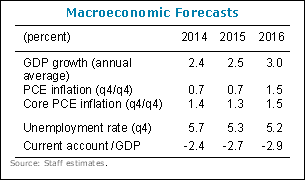
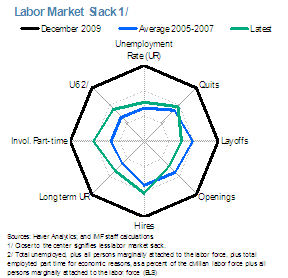
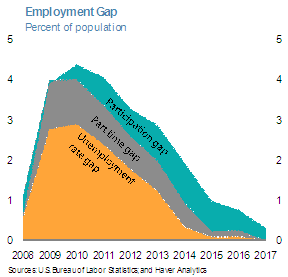
2. Jobs and inflation. Labor markets have steadily repaired over the past year and several indicators suggest a jobs outlook that is returning to pre-crisis norms. However, long-term unemployment, subdued participation, and high levels of part-time work point to remaining employment slack. Wage indicators on the whole have shown only tepid growth. When combined with dollar appreciation, falling global prices of tradable goods, and cheaper energy costs, core PCE inflation is expected to fall in the coming months, to 1.2 percent by end-September. Inflation should start rising later in the year but reach the Federal Reserve’s 2 percent medium-term objective only by mid 2017.
3. A stronger dollar. The U.S. dollar has risen 13 percent in real effective terms over the past 12 months. This move has been rapid and a product of cyclical growth divergences, different trajectories for monetary policies among the systemic economies and a portfolio shift toward U.S. dollar assets.
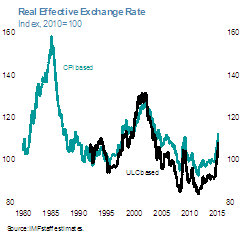
4. A moderately overvalued currency. At current levels of the real exchange rate, the U.S. dollar is assessed to be moderately overvalued. As a result, the current account deficit is expected to move further away from medium-term fundamentals, to more than 3 percent of GDP over the medium-term. So far, the global adjustment of exchange rates has represented a warranted shift of demand to those parts of the world economy that were being most threatened by deflation and stagnation. Nonetheless, the stronger dollar is impacting U.S. growth and job creation, as well as weighing on inflation. There is a risk that a further marked appreciation of the dollar—particularly one that takes place in an environment where policies to address growth deficiencies languish both in the U.S. and abroad—would be harmful.
Monetary Policy
5. An uncertain backdrop. The U.S. economy remains below potential, wage and price pressures are expected to remain low, and inflation expectations appear well-anchored. There are, however, significant uncertainties as to the future resilience of economic growth, the remaining distance to maximum employment, and the current level and future path of the “neutral” fed funds rate that is consistent with full employment and price stability.
6. Possibility of a less-than-smooth liftoff. The Fed’s first rate increase in almost 9 years has been carefully prepared and telegraphed. Nevertheless, regardless of timing, higher U.S. policy rates could still result in a significant and abrupt rebalancing of international portfolios with market volatility and financial stability consequences that go well beyond U.S. borders. Alternatively, even without policy changes, higher inflation numbers unaccompanied by better activity data could lead to a sudden upward shift in the yield curve or risk spreads. In either case, asset price volatility could last more than just a few days and have larger-than-anticipated negative effects on financial conditions, growth, labor markets, and inflation outcomes. Spillovers to economies with close trade and financial linkages could be substantial.
7. Complex policy trade-offs. Weighing the net benefits between raising interest rates earlier or later involves an evaluation of difficult and uncertain tradeoffs.
8. The case for a later liftoff. Given the balance in the likelihood and severity of these risks, as well as the significant uncertainty around inflation prospects, the degree of slack and the neutral policy rate, there is a strong case for waiting to raise rates until there are more tangible signs of wage or price inflation than are currently evident. Inflation inertia, firmly anchored expectations, Fed credibility, and a relatively flat relationship between inflation and slack suggest that a sudden acceleration in wages or prices is unlikely. Global disinflationary trends and the pass-through from the strengthening dollar are also likely to act as important dampening forces to inflation. A later lift-off could imply a faster pace of rate increases following lift-off and may create a modest overshooting of inflation above the Fed’s medium-term goal (perhaps up toward 2½ percent). However, deferring rate increases would provide valuable insurance against the risk of disinflation, policy reversal, and ending back at zero policy rates. If data evolves in line with the mission’s macroeconomic forecasts, and barring upside surprises to growth or inflation, such a policy would imply keeping the fed funds rate at 0-0.25 percent into the first half of 2016.
9. Effective Fed communication. As lift-off approaches, both public and market attention will shift to the pace of rate increases ahead. In this context, there remains merit in scheduling press conferences after each FOMC meeting and in publishing a quarterly monetary report that details baseline economic projections that are endorsed by the FOMC, accompanied by a snapshot of the range of FOMC views around that baseline.
10. Monetary policy and financial stability. At this stage, policy rates should not be used in an effort to reduce leverage and dampen financial stability risks. Efforts should instead be targeted toward strengthening the macroprudential framework, developing regulatory tools, and addressing gaps in regulation and supervision. There is clearly, though, an active debate on the role of monetary policy in addressing financial stability risks in both academic and policy circles. The authorities should give priority to understanding how this would apply in the context of the complex U.S. financial system, accelerating research on the theoretical and empirical nexus between interest rate changes and financial vulnerabilities and working to identify appropriate measures of the financial cycle.
Mitigating Financial Vulnerabilities
11. The state of financial stability. Much has been done over the past several years to strengthen the U.S. financial system and it will be important to ensure that this progress—including the legislative advances in the Dodd Frank Act—is not rolled back. However, there has been a search for yield during the prolonged period of low interest rates, assets in the nonbank sector have grown rapidly, and there are signs of stretched valuations across a range of U.S. asset markets. At this point, the data points more toward a system that has pockets of vulnerabilities rather than one with broad-based excesses. Nevertheless, there are potentially serious, macro-relevant sources of financial instability that include:
12. Further investments in resilience. Following the passage of the Dodd-Frank Act a panoply of measures were put in place to lessen the potential for financial sector vulnerabilities. These include enhanced capital and liquidity buffers, strengthened underwriting standards in the housing sector, and greater transparency to mitigate counterparty risks. To keep pace with a continuously changing financial risks profile, the deployment of additional regulatory and supervisory tools is necessary. There are five prominent near-term priorities:
• The Financial Stability Oversight Committee. Given the complexity of the U.S. regulatory system—including the number of agencies involved—the effectiveness of the FSOC in proactively identifying and addressing risks in a timely and assertive manner is critical.
• Data blind spots. Despite progress made by the work of the Office of Financial Research, the Fed, and other FSOC member agencies, the comprehensive information needed to fully assess and understand financial stability risks—particularly the channels for interconnections between different parts of the system—is not available. Data is compartmentalized with some agencies seeing part of the puzzle but none having a full picture. Evidently, such data collection and analysis will always be a work-in-progress. However, greater efforts are needed to overcome the legal, technological and other obstacles to providing the FSOC and the Office of Financial Research with the data it needs to have a comprehensive view and analysis of systemic risks. Continued and more expansive cross-agency collaboration to better understand specific vulnerabilities will also prove valuable.
• Insurance. The absence of national standards or consolidated supervision makes any assessment of risks in the insurance industry necessarily tentative and incomplete. There is significant scope to improve the institutional framework. Specifically, there is a need for:
• Asset Management. The U.S. system of regulatory oversight has not kept pace with the shift in the locus of systemic concerns toward nonbanks. The increase in assets held by high-yield debt funds and the liquidity transformation undertaken by some asset managers creates a potential channel to amplify shocks through asset liquidation and funding channels.
• Money markets. Despite reforms, vulnerabilities (including the reliance on two clearing banks) in the triparty repo market remain large.
13. Improving the understanding of interlinkages. Given the complexity of the system, the extensive use of derivatives to shift and hedge risks, and the significant role of nonbank entities, there is a clear need for a coordinated effort to better trace the interconnections and channels of contagion across the system. The regular Fed stress tests could be expanded to incorporate a deeper analysis and assessment of propagation effects via inter-institutional links.
14. Simplifying the institutional structure. Over time, the regulatory system should be made simpler, with fewer agencies, so as to lessen gaps and overlaps and reduce the potential for regulatory arbitrage. This would also make the FSOC’s coordination role easier.
15. Cross-jurisdiction resolution. The five largest banks in the U.S. account for 45 percent of banking system assets, twice the share of 10 years ago. As such, effective resolution and recovery plans for large banks are important to underpin a stable financial system. Existing plans should continue to be thoroughly assessed against severe contingencies that have a salient cross-border component. While cooperation agreements with relevant overseas authorities have recently been signed to manage the resolution of institutions that have a significant international presence, attention will need to be devoted to their implementation. Moreover, legislative changes would likely be needed to avoid undue ring-fencing and the subordination of foreign claimants.
Fiscal Policy
16. The current fiscal policy dysfunction. The inability of the Congress and the Executive Branch to collectively pass a budget and corresponding appropriations bills creates a level of fiscal uncertainty that is damaging to the U.S. economy. The potential for disruption from either a government shutdown or a stand-off linked to the federal debt ceiling represent important (and avoidable) downside risks to growth and job creation which could move to the forefront, once again, later in 2015.
17. Medium-term adjustment. Public finances in the U.S. remain on an unsustainable path. The federal debt and deficit are expected to decline during the next few years but under the current constellation of policies this downward trajectory will not last. By 2019, the federal debt will begin rising again as aging-related spending pressures assert themselves and interest rates move to more normal levels.
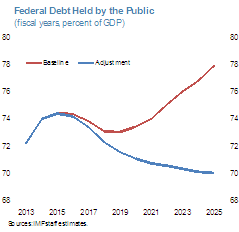
18. Near-term fiscal priorities. Tackling the longer-term fiscal challenges would provide scope to modestly expand the near-term budget envelope to finance supply-side measures that support future growth, job creation, and productivity. This would include front-loading infrastructure spending, raising labor force participation (e.g., through policies such as subsidized childcare assistance), incentivizing private innovation, strengthening education spending (including through apprenticeships and vocational training), and improving job search assistance programs. Creating a stable funding solution for the Highway Trust Fund that will prevent the need for continued stop-gap patches is an immediate priority.
Poverty, productivity and growth
19. The U.S. economy faces substantial fundamental challenges from demographic changes and an unfinished policy agenda. In tackling these, the advice from past Article IV consultations—summarized in Box 1—bears repeating.
| Box 1. Longstanding IMF Policy Advice |
|
Confronting poverty • Combine an expansion of the earned income tax credit (to workers without dependents, low-income youth, and older workers not yet eligible for social security) with an increase in the federal minimum wage. • Make permanent the tax provisions that are due to expire in 2017, including the extension of the earned income tax credit to larger families, the mitigation of the marriage penalty, and increase in the child tax credit. Raising productivity • Invest in infrastructure, particularly in surface transportation. Find a permanent solution to the funding of the Highway Trust Fund and expand sources for infrastructure financing. • Reinstate and make permanent the Research and Experimentation tax credit. • Support states in improving training programs and build partnerships with industry and higher education institutions for vocational training. Raise educational outcomes through better spending on early childhood education and support for science, technology, engineering and math programs. Increasing labor force participation • Improve family benefits, including childcare assistance for working families and modify the federal disability insurance to provide incentives for beneficiaries to work part-time. Immigration reform • Institute a comprehensive, skills-based immigration reform. Such a program would have a significant positive impact on growth and fiscal finances by increasing the labor supply (and thus future economic growth rates), strengthening productivity, and reducing the dependency ratio. Trade policy • Promote plurilateral and bilateral trade agreements with renewed efforts to advance the multilateral trade agenda. Housing finance reform • Lessen the government’s footprint and foster a greater role for the private sector by expanding the use of market transactions to transfer first-loss risks to private investors; establishing a single securitization platform; making GSE guarantee fees more risk-based; subjecting GSEs to similar regulatory requirements as other systemically important financial institutions; and lowering the ceilings for the size of mortgages that can be securitized by the GSEs. |
| Public Affairs | Media Relations | |||
|---|---|---|---|---|
| E-mail: | publicaffairs@imf.org | E-mail: | media@imf.org | |
| Fax: | 202-623-6220 | Phone: | 202-623-7100 | |