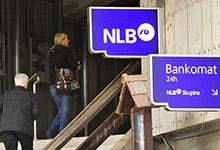
Couple enters NLB bank building in Krško, Slovenia. Slovenian banks underwent
stress tests in 2013 (photo: Srdjan Zivulovic/Reuters/Newscom)
Slovenia’s Economy
Slovenia’s recession—one of the deepest in the euro area—continued
in 2013, driven by a sharp credit crunch, corporate distress, and necessary fiscal
consolidation. However, there are now some signs of stabilization of economic activity,
coinciding with the gradual improvement in the broader euro area dynamics.
“Bank recapitalization that took place in December has reduced uncertainty,”
said Antonio Spilimbergo, IMF mission chief for Slovenia. “Still, domestic
demand is likely to remain weak, as the corporate sector remains overleveraged and
consumers remain cautious. The economy is likely to contract in 2014 as well—though
at a more gradual pace—and signs of a recovery may appear in the second half
of the year.”
Speaking to IMF Survey, Spilimbergo discussed Slovenia’s economic outlook,
the most pressing issues, and the policy actions needed to help foster economic
growth in the country.
IMF Survey: What are the main policy priorities that would help improve
the economic situation in 2014 and beyond?
Spilimbergo: The asset quality review (a comprehensive and independent evaluation
of the value of the banks’ assets) and stress tests (an evaluation of the
banks’ ability to withstand losses in an adverse scenario) were completed
in 2013 in order to determine the health of Slovenian banks. Now that the results
are public, indicating that banks are adequately capitalized, it is important to
turn promptly to addressing the underlying weaknesses that created the financial
sector problems in the first place. Only a restructuring of the corporate and bank
sectors, including via a thorough clean-up of banks’ balance sheets and privatization
thereby reducing the role of the state in the economy, can create the conditions
needed for durable economic growth. It’s also going to be important to continue
fiscal consolidation to restore public debt to more moderate levels, identifying
new measures as necessary.
IMF Survey: Slovenia has already undertaken measures to help it get
a handle on government debt, including some tax increases and spending cuts. What
else needs to be done to ensure continued progress is made?
Spilimbergo: Slovenia undertook a significant amount of fiscal consolidation
in a time of recession. Looking forward, it’s very important not to waver
once growth recovers and as borrowing costs come down. As for specific measures,
the introduction of a broad-based property tax for 2014 was a good step. Also on
the revenue side, there is a need to broaden the corporate income tax base. But
we think there is a compelling case to focus mostly on the expenditure side in the
period ahead: we favor measures to contain the public sector wage bill and reform
social benefits to make them better targeted to those most in need. Further difficult
but critical reforms are necessary to contain the rising costs of the pension system
in the medium term, as well.
IMF Survey: You mention the need to strengthen the financial sector.
What is happening in that sector and how will the proposed policies result in improvement?
Spilimbergo: The most critical weakness was that markets had suspected the
banks had inadequate provisions and capital for losses that had already occurred
but had not yet been realized on banks’ balance sheets. The asset quality
review and stress tests have now given us a snapshot of the banks’ balance
sheets, and the government has moved quickly to replenish capital as identified
in these tests. The urgent issue is out of way, but the task is far from over. The
ultimate goal is for banks to resume financial intermediation, that is, to provide
fresh credit to good companies. For this, you want banks not to waste their efforts
on managing old, nonperforming assets, something that is better handled at a central
level. The bank asset management company—that was created by the authorities
a few months back—is in place for this purpose, and we think that problem
assets need to be sold to this entity as much as possible so that banks can concentrate
on making sound loans to profitable enterprises. But of course, this can only happen
if there are creditworthy companies to which the banks can lend. Slovenia has companies
with strong underlying business operations, but many of them are financially overleveraged
and managerially overextended. These are the ones in need of corporate restructuring,
be it through debt-equity swaps, asset spin-offs, or simply debt write-offs.
IMF Survey: Why are labor market reforms so important for Slovenia?
What progress has been made so far?
Spilimbergo: Slovenia’s labor market regulations are mostly in line
with euro area norms, and its unemployment rate is actually lower than the euro
area average. The main problem we see in the labor market, however, is a segmentation
between a group of workers with relatively secure jobs and benefits entitlement,
and another group, disproportionately young, that can only find work through short-term
contracts, and is thus always first to be let go when things are bad. This is both
unfair and inefficient. The recent labor reform helps in that regard by making employment
protection standards closer in the two types of contracts. But more effort would
be needed to bring young workers into employment earlier and in a more secure fashion
so that they build skills and experience in a timely manner.
IMF Survey: Finally, you served as Slovenia mission chief for a number
of years, but are now set to relinquish these duties. Looking ahead, what do you
see as the main issues facing the country?
Spilimbergo: Four years to be exact, and it was really an immensely enjoyable
assignment for me. I like to ask Slovenians what they think the “original
sin” of the country was, that is, why a country which was leading the transition
twenty years ago ended up being the country with one of the deepest recessions in
Europe. There is probably more than one sin, but, at a very general level, the way
the economy had been functioning in the past led to well-connected people enjoying
profits and control in good times without the expectation that they would be asked
to share with others the burden of a downturn. This may have led them to engage
in behavior that was far from optimal for the broader wellbeing of the country in
the longer term. In addition, the easy initial success after independence may have
led to some complacency. What I suspect we’ll see in the future is a move
towards less state control of the economy, more competition, and greater openness
to foreign investment. Slovenia is in a key geographical position as the EU expands
to the Balkans and has yet to play that card.