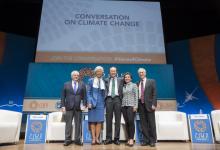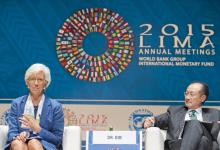
IMF Managing Director Christine Lagarde and World Bank Group President Jim Yong
Kim discuss challenges of climate change and importance of reducing carbon emissions—one
of the many topics discussed in the Program of Seminars (photo: IMF/Stephen Jaffe)
2015 IMF-World Bank Annual Meetings
The Meetings brought together around 13,000 participants, ranging from finance ministers,
central bank governors and officials from the IMF’s 188 member countries,
to financial sector participants, parliamentarians, civil society organizations
and journalists. Against the backdrop of a more uncertain global outlook, the wide-ranging
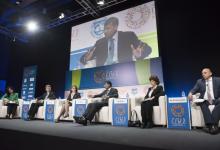
program of seminars—featured here—discussed the major economic transitions
in the world economy and the biggest risks to global growth.
Youth Dialogue: Bridging the Unemployment Gap through Education and Inclusion | Join
the conversation via #imfyouth
Unemployment remains high in many countries, with youth making up about 40 percent
of the world’s unemployed. The session brought in youth leaders from
around the globe to share their views and personal experience on the role education
plays in addressing youth unemployment. The panelists agreed that governments can
play a key role towards finding global solutions through greater investment in education
and infrastructure adding, “it is not about making it easier for young people,
it is about making opportunities accessible,” said João Felipe Scarpelini,
Youth Advisor for UN Somalia. The IMF can support reducing youth unemployment through
its work with governments in the provision of sound institutions and by continuing
to provide forums for people to connect globally.
Read more in the IMF Survey Story and watch the Youth Dialogue 2015 Seminar.
Stronger Institutions, Stronger Growth: Capacity Development in Latin America and
the Caribbean and the Way Forward
Panelists discussed the role of institutional and capacity development—including
through training and technical assistance—in fostering growth-friendly economic
policies in Latin America and the Caribbean. They agreed that having stronger economic
institutions is essential for macroeconomic stability and sustainable growth. Countries
can then seize opportunities and become more resilient to shocks, especially when
dealing with external challenges such as a downturn in commodity prices, stagnant
global growth, volatile financial flows, climate change, and lack of technical training.
Going forward, panelists emphasized the importance of tailoring capacity development
programs to country needs. For the Caribbean, Brian Wynter, Jamaica’s Central
Bank Governor, suggested exploring different backstopping mechanisms, such as promoting
financial inclusion and addressing money laundering. For Laura Alfaro—Warren
Alpert Professor at Harvard Business School—a strong education system is key.
Luis Miguel Castilla, Peru’s Ambassador to the U.S., suggested focusing more
on “investing in the quality of our economic institutions,” and having
“more civil service reforms to train human capital globally.” The panelists
also agreed on the importance of expanding training beyond finance ministries and
central banks. Watch the discussion.
Bridging the Pacific: Harnessing the Benefits of Rising Trade and Financial Integration
between Asia and Latin America
Focusing on the present and future pattern of trade between Asia and Latin America,
the panel discussed the impact of the decline of commodity demand from China; the
role of trade agreements; diversification of Latin American production; and policies
needed to promote innovation and greater dynamism. “This discussion comes
at a very good moment,” said First Deputy Managing Director of the IMF, David
Lipton. “Emerging markets will need to be the engine of growth in the future;
and this is the moment for Latin America to diversify,” he added. Greater
trade and financial integration can provide a framework for structural reforms.
“Integration requires a country to open its markets, and adopt international
best practices,” said Yi Gang, Deputy Governor of the People’s Bank
of China.
On the potential benefits of the recently ratified Trans-Pacific Partnership (TPP),
Caroline Atkinson, U.S. Deputy National Security Advisor for International Economics,
said that the agreement provided a template going beyond providing tariff breaks
to setting new international standards. “This agreement sets up high 21st
century standards in 30 sectors beyond market access, including labor standards,
environmental protection, intellectual property, and regulation of state-owned enterprises,”
she said. Watch the webcast.
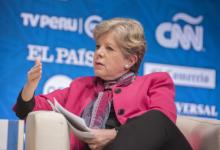
Climate Change: Low oil prices create historic opportunity #Voices4Climate
Panelists participating in a seminar on the challenges of climate change noted that
the sharp drop in energy prices offered a window of opportunity for measures, to
help generate revenue that can be used to mitigate the effects of climate change.
“Fossil fuel energy is cheap, so it is just the right moment to introduce
a carbon tax and just the right time to eliminate energy subsidies,” Christine
Lagarde, IMF Managing Director, said. In view of the different starting points and
specific circumstances, panelists agreed that each country needs a unique strategy
to reduce its carbon emissions.
Watch the discussion and read the Survey Story. An IMF Blog outlines why energy subsidy reforms are essential
in many countries.
Energy Pricing: Getting it Right
As an essential component to effect climate change policy, the panelists discussed
the opportunities and challenges that come with trying to get energy prices right.
In recent years, a proliferation of carbon pricing schemes has emerged in different
guises across advanced and developing countries, and national and sub-national governments.
The panelists agreed that designing energy prices to meet climate change objectives
is an important albeit difficult task for policymakers. “[Getting energy prices
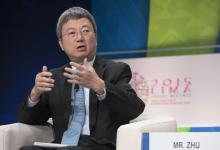
right] is a process,” said IMF Deputy Managing Director, Min Zhu. “We
have to start today in a practical way with carbon pricing and subsidy reform,”
he added. The IMF and other multilateral organizations can play a crucial role in
advising countries on best practices however, there needs to be a common understanding
on how much carbon emissions should be reduced.
More generally, carbon pricing is an important component of a broader set of reforms
needed to ensure both supply costs, and other environmental costs (e.g., air pollution)
are reflected in energy prices. In fact, mispricing of energy is quite pervasive
across advanced and developing countries alike—thus further emphasizing the
importance of international cooperation. The panelists agreed that the Paris Climate
Change Conference in November 2015 offers an opportunity to provide consistency
on both global and national plans. “Let’s not concern ourselves with
getting energy prices perfect,” Mary Polak, British Columbia’s Minster
of Environment stressed, “let’s concern ourselves with trying and learning
from it.” Learn more about the discussion.
Financial Inclusion: Rewards and Risks #FinInclusion
This year’s post-2015 Development Agenda squarely puts financial inclusion
as a key objective for United Nations member countries. Despite progress, large
gaps remain in financial inclusion: across regions, income, gender, and many other
dimensions. The panelists explored these issues as they discussed the macroeconomic
effects of financial inclusion and its contribution to growth.
The IMF’s latest study on financial inclusion—greater access to financial
services throughout a country’s population—was the starting point for
their discussion. “Countries with commitments to financial inclusion have
economies that have grown stronger than those that don’t,” said Alfred
Hannig, Executive Director of the Alliance for Financial Inclusion. He added, “countries
with financial inclusion targets have grown 13.4 percent between 2011 and 2014,
compared to 8.5 percent for those without.”
In many countries, historical discriminatory forces have meant that women cannot
legally hold collateral, or do not have formal identification, which has prevented
their access to financial services. “The concept of financial inclusion is
evolving all the time,” said IMF’s Deputy Managing Director, Min Zhu.
While originally thought of as expanding peoples’ access to credit, it now
also includes payments, savings, and investment.
New technology is both the boon and bane for the expansion of services and products,
as well as risks. So how do policymakers keep an open mind to innovation, and regulate
these new services to preserve financial stability? “Let a variety of players
enter, and ban only those we are certain will do harm,” said Raghuram Rajan,
the Governor of the Reserve Bank of India and former IMF Chief Economist. Watch
the seminar.
New Challenges for Central Banking in Latin America
Discussing key challenges confronting monetary policymaking in five Latin American
countries—Brazil, Chile, Colombia, Mexico and Peru—was the focal point
of this seminar. While noting that many Latin American central banks had established
inflation-targeting frameworks, panelists emphasized that these central banks are
now tasked to tackle new challenges—such as the impact of imminent U.S. monetary
tightening, deteriorating terms of trade, volatile capital flows, and untested coordination
of monetary and macro-prudential capital policies across different institutional
arrangements.
Agustín Carstens, Chairman of the IMFC and Governor of Mexico’s Central
Bank, recommends that central banks “need to preserve clarity and transparency,
as well [to continue] the guiding principle of keeping inflation low and stable.”
The panelists agreed that this is the way forward to deal with multiple challenges
in the post-crisis world. The panelists also emphasized strengthening macroeconomic
frameworks to help cope with trade shocks. Learn more about the panelists’
discussion by watching the seminar.
Debate on the Global Economy #GlobalEcon
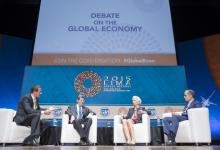
Asked by CNN's Richard Quest to name the biggest risks to global growth, Christine
Lagarde, IMF Managing Director, noted a lack of investment, a shortage of confidence,
and the uneven nature of the world's post-crisis recovery. Mark Carney, Governor
of the Bank of England, considered emerging market debt to be the biggest risk.
Joaquim Levy, Brazil’s Minister of Finance, recommended building infrastructure
because it is “a way to change how an economy operates.” He also noted
that making “infrastructure bonds a global asset class [is] the best way to
use excess savings from developed countries.”
Panelists agreed on the importance of using macroprudential policies for financial
stability, and—as pointed out by Carney—“acting on all fronts
in an unforgiving environment.”
On the positive side, Carney noted that policy responses are more resilient than
before, and the global financial system is much more diversified. Referring to the
Fed's expected interest rate hike, Lagarde repeated her message to wait for more
signs of recovery before tightening. Watch more of the debate.
Growth and Inclusion in Latin America: the Next Decade #EnfoqueLatAm
The seminar explored the region’s social transformation and strategies for
inclusive growth in the next decade. Helped by strong growth, social transformation
in Latin America over the past decade and a half has been impressive. The region
sharply reduced its poverty rate, cut extreme poverty in half, and income inequality
also fell. Going forward, the challenge is preserving and increasing gains in a
more difficult environment for growth, especially for commodity-exporting countries.
Panelists noted that social assistance programs in particular have contributed to
the impressive social progress of the region.
They also pointed out that Latin America has become a global leader in the use of
conditional cash transfers. Brazil and Mexico have two of the largest schemes, with
transfers contingent on requirements such as school attendance or vaccination records.
“Peru’s social programs seek to build capacity,” added Alonso
Segura, Minister of Economy and Finance of Peru.
As a way forward, the panelists recommended that the region build on the success
in pioneering new approaches to the design of social safety nets, including leveraging
transfers in order to increase household demand for, and access to, education and
health services, and enhancing access to financial services and participation in
formal labor markets, particularly by women.
Watch the webcast and read the Survey story to learn more economic growth prospects
for Latin America.
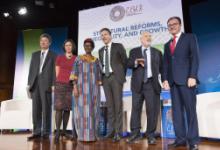
Structural Reforms, Inequality, and Growth
Panelists of a seminar on structural reforms, including IMF’s Deputy Managing
Director Min Zhu; Columbia University Professor Joseph Stiglitz; Mexico’s
Minister of Finance Luis Videgaray; Oxfam International Executive Director Winnie
Byanyima; and Eurogroup President Jeroen Dijsselbloem, discussed the appropriate
policy mix to strengthen growth and reduce inequality. “Structural reforms
promote growth, and in many ways can support lowering inequality—through reforms
in healthcare or education, for example,” said IMF’s Deputy Managing
Director Min Zhu.
“The effectiveness of structural reforms depends on how you design them,”
added Eurogroup President Jeroen Dijsselbloem. Professor Stiglitz, from Columbia
University, noted that while constraining growth had long been considered the only
way to reduce inequality, “we've now realized that appropriate reforms can
help both.” Oxfam International Executive Director Winnie Byanyima emphasized
that policymakers cannot “promote growth for growth’s sake.” She
further added that, “this ‘siloed’ approach to reforms will not
lift people out of poverty and inequality will increase.” The panelists agreed
that structural reforms encompass a broad range of policy measures and stressed
the importance of choosing reforms that achieve redistributive goals. Watch the
webcast of the discussion.
Managing the Volatility of Commodity Revenues: Fiscal Policy Responses
Commodity exporters have been facing considerable policy challenges arising from
the volatility of prices and production in recent years, and their effects on economic
activity. In opening the discussion, IMF Deputy Managing Director, Mitsuhiro Furusawa,
said negative commodity price shocks could have damaging effects on long-term growth
for commodity exporting countries. He noted, for instance, that many resource-rich
countries endured a long period of low or negative growth after the oil boom-bust
in the late 1970s, with, in some cases, per capita income in the 1990s below 1970
levels.
The panel members also focused on the key elements of a fiscal policy framework
that could help manage commodity price volatility and allow fiscal policy to play
a stabilizing role. They noted that fiscal rules—that encourage savings in
good times for use in bad times—and sovereign wealth funds can play an important
role in stabilizing fluctuations in the real economy arising from commodity price
shocks. Diversification of fiscal revenues away from commodity revenues is also
key. More broadly, panelists agreed that having a medium-term fiscal framework in
place is key to ensuring fiscal sustainability and macroeconomic stability over
the long run. Watch the webcast.
Ready for Takeoff: Implementing the Post-2015 Development Agenda #post2015
In a seminar on the newly adopted post-2015 agenda, national and international policymakers,
academics, and representatives from the private sector discussed how best to achieve
the Sustainable Development Goals (SDGs). Panelists stressed the importance of efforts
on both a national and collective level to mobilize revenues and facilitate the
economic participation of women. While there was agreement that private-public partnerships
are a key factor in low-income countries’ development, IMF Deputy Managing
Director Min Zhu pointed out that, next to external funding sources, “we need
to put more resources on the table to support members,” noting that the IMF
has devised a new “revenue gap analysis” tool. Watch the webcast and read the Survey Story.
Revisiting Monetary Policy Frameworks
Session 1—Monetary Policy and Financial Stability | Session 2—Monetary
Policy Frameworks in Low Income and Developing Countries
The global central banking community gathered to discuss key aspects of monetary
policy frameworks. Session 1 focused on whether monetary policy should explicitly
target financial stability. To lean or not to lean, that was the question posed
by many of session one’s panelists. Jaime Caruana—General Manager, Bank
for International Settlements—argued in favor of hiking interest rates to
support prudential policy when financial stability is at risk.
Other panelists generally leaned away from resorting to monetary policy. Session
2 reflected on monetary policy modernization in developing countries. Panelists
recommended different approaches based on countries’ political economy conditions.
The ‘just do it’ approach was considered possible only when broad-based
consensus and long-term commitment to the reform agenda exists across policymakers.
Otherwise, panelists emphasized that reform was easier said than done.
Webcast Session 1
Webcast Session 2
Individual Integrity in Public Sector Governance #EthicsinGov
This seminar moderated by the IMF’s General Counsel Sean Hagan, addressed
governance issues in the public sector, focusing on the long-term economic effects
of weak institutions and undue influence on laws, regulations, and policies by powerful
corporate interests. Daniel Kaufmann, President of the Natural Resource Governance
Institute, described the various dimensions of corruption, and suggested that countries
could triple per-capita income through good governance. Kaufmann also pointed out
that corruption was not confined to developing countries. Advanced economies had
corruption issues as well, in the form of excessive political influence over policy
making by wealthy individuals and special interest groups.
Sri Mulyani Indrawati, Managing Director and Chief Operating Officer of the World
Bank said, “corruption is the greatest obstacle for social and economic development.”
Peter Kok Song NG, Chairman of Avanda Investment Management in Singapore, described
corruption as a cancer. “If the cancer enters the system, whatever you try
to accomplish in terms of economic performance, will eventually crumble.”
Watch the seminar, listen to the podcast, and read the blog for more information on Public Sector Governance.
For more information, please visit the complete schedule of the 2015 Annual Meetings World Bank
Group and International Monetary Fund.