They are gaining in strength and prominence and helping the world recover from the recession that plagued advanced economies along with everyone else, according to the latest edition of Finance & Development(F&D) magazine
Analysis by Eswar Prasad of Cornell University and the IMF’s Ayhan Kose finds the economic ascendance of emerging markets such as Brazil, China, India, and Russia will allow them to play a significant role in global economic governance and take on more responsibility for economic and financial stability.
Emerging markets as a group weathered the global recession better than advanced economies. Many have seen growth bounce back during the past year, and they seem poised for high growth in coming years.
There was variation among regions, however. Emerging Asia saw the most favorable outcomes, with modest declines in growth. The emerging economies of the Middle East and North Africa (MENA) and those in sub-Saharan Africa also enjoyed only small declines in output, possibly due to their modest exposure to trade and financial flows from the advanced economies.
In contrast, emerging markets in Europe and Latin America suffered during the crisis because of their ties with advanced economies, though those in Latin America recovered relatively strongly.
The particular success of emerging economies in Asia, MENA, and sub-Saharan Africa was thanks to a combination of factors, including macroeconomic policies that brought inflation under control and limited public debt; reduced dependence on foreign financing; current account surpluses that insured against reversals of capital inflows; and diversification in production and exports.
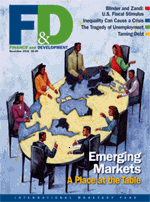
December 2010 issue of Finance & Development: Emerging markets are assuming a place at the table of global economics and finance.
Improved trade and financial linkages increased resilience, and rising incomes and a burgeoning middle class translated into growing domestic markets for emerging market economies, the authors say.
Different challenges
In coming years, emerging market economies will face challenges very different from those of the advanced economies. Rather than weak growth and deflation, emerging markets will need to guard against rising inflation, surging capital inflows and the associated risk of bubbles in asset and credit markets, and the threat of rapid currency appreciation.
Along with their increase in economic heft, emerging economies are playing a larger role in setting global priorities. The unofficial anointment of the Group of 20 large economies (G-20) as the major body determining the global economic agenda has given emerging economies a prominent seat at the table. And recent IMF quota reforms will mean a much larger say for emerging economies at the 187-member institution.
The authors conclude that emerging markets are in control of their own destiny, and are ready to assume greater responsibility for global economic and financial stability.
December 2010 issue of Finance & Development: Emerging markets are assuming a place at the table of global economics and finance.
China’s influence
In a related F&D article, IMF staffers Vivek Arora and Athanasios Vamvikidis present empirical analysis of how the positive impact of China’s growth now extends throughout the world—to neighboring nations in Asia, commodity-producing countries in Africa and Latin America, and major consumers of Chinese products like the United States. They find that China’s influence starts through trade but eventually moves to other channels. And that influence is significant: over the long term, a 1 percentage point increase in China’s growth translates into a 0.4 percentage point increase in growth in the rest of the world.
Global banks will adapt to the new international rules on capital and liquidity, but at possible cost to investors and the safety of the financial system