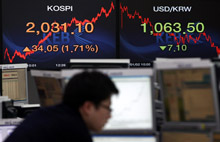
A trader at a bank in Seoul, Korea: the IMF plans to evaluate 16 countries’
financial sectors in 2013, including Korea (photo: Jeon Heon-Kyun/EPA/Newscom)
FINANCIAL SECTOR ASSESSMENT PROGRAM
The IMF plans to evaluate 16 countries’ financial health—ranging from
Italy and Poland to the Kyrgyz Republic and Guatemala—to spot any potential
trouble on the horizon (see box). These assessments are part of the IMF’s
Financial
Sector Assessment Program. In each case, the IMF produces a detailed report
that includes recommendations for the country on how to strengthen its financial
stability.
Jurisdictions the IMF plans to assess in 2013
Vietnam
Belgium
Italy
Austria
Poland
Argentina
Singapore
Republic of Korea
Canada
Democratic Republic of Congo
Barbados
Hong Kong SAR
Kyrgyz Republic
Switzerland
United Arab Emirates
Guatemala
With continued uncertainties clouding the global economic outlook, this list includes
seven jurisdictions with large, interconnected financial sectors, including some
Group of Twenty advanced and emerging economies, such as Canada, Italy, and Korea.
In addition, as Europe progresses toward closer financial integration, the IMF expanded
the exercise to cover European institutions with a financial sector assessment of the European Union as a
whole.
IMF focus on financial stability
The IMF’s
Financial Sector Assessment Program assesses three key components of financial
stability in all countries:
• the soundness of banks and other major financial institutions, including
through stress tests;
• the quality of financial sector supervision, including banking, securities,
and insurance, where the sectors are systemically important; and
• the ability of supervisors, policymakers, and financial safety nets to withstand
and respond effectively in case of a crisis.
The IMF tailors its work in each of these areas to a country’s individual
circumstances, and takes into account the potential sources of risk that might make
the country vulnerable, as well as policies to help make the system more resilient.
While the focus of the program is on systemically important countries, the smaller
jurisdictions the IMF plans to visit in 2013 face their own challenges. These include
establishing strong and adequately resourced financial oversight mechanisms, building
macroprudential frameworks, and developing deeper capital markets.
Given the growing reach of global banks, the IMF closely examines cross-border supervisory
cooperation arrangements. In countries where foreign-owned banks have a major presence,
it is essential that the host country supervisor has enough tools and good communications
with the parent banks’ regulators.
Strengthening oversight of systemic countries
Since 1999 the IMF has monitored countries’ financial sectors on a voluntary
basis through the Financial Sector Assessment Program. In developing and emerging
market countries, the IMF conducts these assessments in cooperation with the World
Bank.
In the wake of the global economic crisis, the IMF has strengthened its surveillance of systemic countries’ financial systems.
In September 2010, the IMF’s Executive Board agreed the world’s top 25 financial sectors would undergo a mandatory financial
check-up every five years. In 2013 the Executive Board will review the formula that
determines the classification of countries as systemically important.
By 2014, the IMF will have completed the mandatory review of almost all of the top
25 financial sectors.
“This is a tangible example of how the IMF has learned the lessons from the
crisis,” said Dimitri Demekas, an assistant director in the IMF’s Monetary
and Capital Markets Department, which manages the Financial Sector Assessment Program.
“We have strengthened and improved our oversight of the largest, most financially
interconnected jurisdictions.”
Specific recommendations call for action
The IMF’s financial assessments provide countries with specific, actionable
recommendations on how to reduce risks, improve supervision, and strengthen crisis
management. Each report has a table with key recommendations, and rates them according
to priority and time-frame for implementation.
Countries are free to implement or not, but the IMF follows up and monitors countries’
implementation.
Demekas said countries either fully or partially implement roughly 70 percent of
the IMF’s recommendations in the Financial Sector Assessment Program.
New methods for new risks
The IMF learned a number of lessons from the crisis that began in 2008. It has expanded
its risk assessments to cover a broader range of risks such as liquidity and sovereign
risk, and different forms of transmission of financial shocks across borders through
financial interconnections. The assessments focus on how problems in one country
can affect others, and on the connections between financial institutions. The IMF, among
others, is developing what are known as network models to try and understand how
events in one financial institution, market, or country will impact others.
The IMF has developed new tools for stress testing both solvency and liquidity risk. Stress
tests are hypothetical scenarios designed to find weak spots in the banking system
at an early stage, and to guide preventive actions by banks and those charged with
their oversight.
Also, stress testing is increasingly applied to financial institutions other than
banks, and models have been designed that can be applied consistently in all assessments
under the program. And the IMF has established seven best practice principles for the design and implementation
of stress tests.
“With the higher public profile of stress testing comes increased scrutiny
on methodologies and assumptions” said Demekas. “Given that we have
been using this tool for more than ten years all around the world, the IMF is best
placed to propose guidelines for stress testing in our own financial assessments
but also more broadly.”