



Youth who graduate in a crisis will be profoundly affected and may never fully recover
For the millions of the world’s young people who will survive the pandemic, there’s still truly difficult news ahead. Not only will the COVID-19 recession give new entrants to the job market a rocky start to their careers, it will also put them at risk to make less money for decades, commit more crimes, have less satisfying family lives, and maybe even die earlier than luckier job seekers.
That’s the bleak conclusion emerging from an expanding arena of research into the long-term effects of entering the job market in a recession. Researchers crunching decades of data on previous recessions have obtained a range of sobering findings for the United States. An increasing number of studies find similar results in Canada, Germany, the United Kingdom, Austria, Spain, Belgium, Norway, and Japan.
The plight of new high school and college graduates is starting to draw media attention. Tessa Filipczyk, a 22-year-old June graduate in marine and coastal science from the University of California, Davis, told Bloomberg News that she applied for jobs related to ocean conservation, marine plant research, and climate change advocacy. She planned to work for a year before starting graduate school. No job offers materialized, and she’s living with her parents.
“That all just got swept under the rug by COVID,” she said.
Jayden, a 17-year-old who was interviewed by the Atlantic , was hoping before the pandemic to learn to become a mechanic after finishing high school in eastern Missouri. She hoped to find a job in an auto repair shop, but that plan evaporated, leaving her working at a fast-food restaurant.
“I don’t want to work [in fast food] forever,” she said, “but I also don’t want to quit there if I don’t have a more career-based job.”
In recent work, we studied new labor market entrants through booms and busts in the United States over 40 years from 1976 through 2015. Our work was partly inspired by our observations of friends who completed degrees around the time of the Great Recession. Even after several years, we noticed a significant difference in the job quality and job satisfaction between those who entered the job market just before the recession and those who did so as it unfolded.
Based on our findings, we approximate that the roughly 6.8 million young US labor market entrants looking for their first full-time job in 2020 might give up about $400 billion in earnings over the first 10 years of their working lives. That projection is based on a swift economic recovery in 2021. If the pandemic-induced recession continues or deepens next year, 2020 graduates might fall even further behind, and an additional unlucky group of new entrants would face the same dire outlook in 2021.
Loading component...
As the world races to develop an effective vaccine, policymakers responding to the pandemic’s economic crisis need to address this group’s predicament. In the short term, responses could include job search assistance, incentives for part-time work, and payroll subsidies for newly hired workers. For the medium term, welfare and support policies need to account for lasting impacts, especially for the less educated.
And it’s important to inform young workers about the negative long-term impacts they face and their causes. Knowing that their challenges probably don’t reflect a lack of skills or personal failure can motivate those in less productive jobs to keep seeking opportunities and move to better jobs as the economy recovers.
Economists’ understanding of the long-term damage from starting a career in the face of a recession has deepened in the years since the Great Recession more than a decade ago. Traditionally, economists thought of economic booms and busts as temporary phenomena. But studies of large cross-sectional and longitudinal data sets around the world find persistent effects of downturns for those who enter the job market during a recession. Such long-term impacts have been found for MBA graduates, PhD economists, college graduates in general, and really for most groups across the demographic and educational spectrum in the United States and in other countries studied.
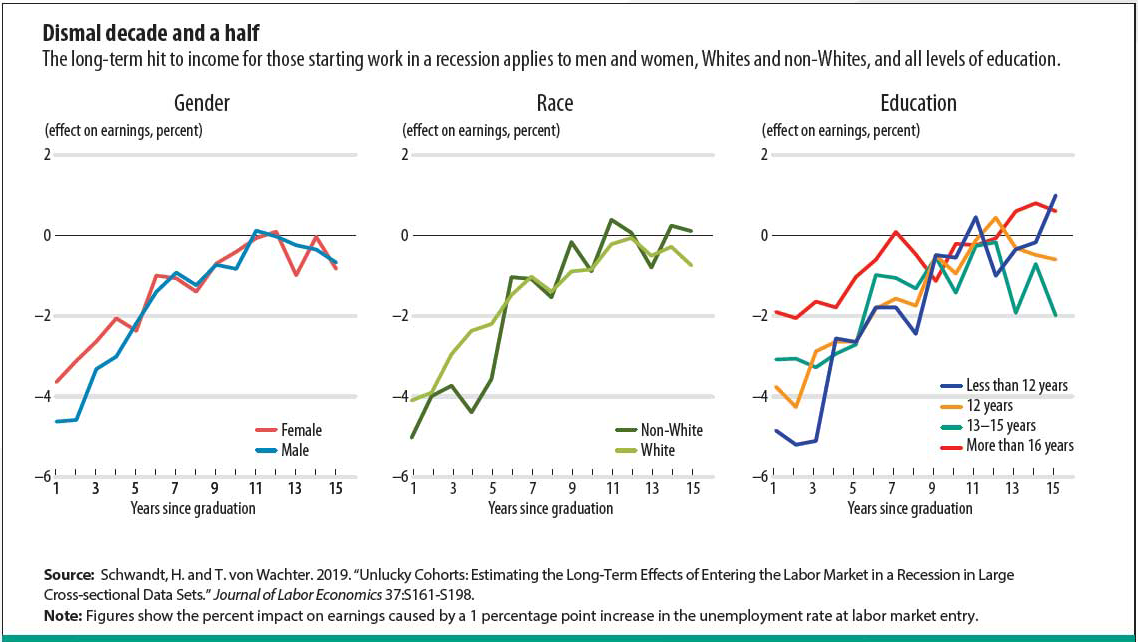
Those unlucky enough to start careers in a recession have been found to experience lower earnings for 10 to 15 years after graduation, or longer. Less educated and non-White workers experience prolonged episodes of unemployment and temporary increases in poverty. More highly educated workers take jobs with lower-paying employers and partially recover by switching to better employers. Studies have also found that those in this group are more likely to have lower self-esteem, commit more crimes, and distrust government.
We find qualitatively similar patterns for men and women, for Whites and non-Whites, and for high school dropouts, high school graduates, and college graduates (see chart). However, more vulnerable labor market entrants tend to suffer larger effects. For example, while those with college degrees suffer an initial earnings loss of about 6 percent when entering the labor market in a moderate recession, high school dropouts experience an earnings reduction of as much as 15 percent.
But the effects of starting a career in a recession are not limited to earnings, wages, or job quality. Researchers have documented a broad range of other economic, social, and even health outcomes. These are likely to feed back into a worker’s productivity, reinforcing the initial earnings impacts.
Lower earnings for individuals translate into lower family incomes, lower rates of home ownership, and—for lower-skilled entrants—higher poverty rates. This is also reflected in mating patterns: recession job entrants are more likely to end up in the arms of a spouse experiencing a similar recession-induced earnings reduction.
Social safety net programs such as the Supplemental Nutrition Assistance Program and Medicaid seem to buffer at least some of these adverse impacts. Yet researchers have found that recession job entrants report lower self-esteem, are more likely to drink to excess, and have higher obesity rates. If these social and health effects feed back into worker productivity, impacts on economic outcomes might also reappear in the longer term.
Loading component...
We dug into data from the US government’s Vital Statistics System, Current Population Survey, American Community Survey, and Decennial Census going back to the 1970s. We find that the negative earnings effects from entering the labor market never fully disappear. For a middle-aged worker, these losses settle at about a 1 percent earnings decline for every percentage point increase in the unemployment rate when they start working. With the unemployment rate in mid-2020 at about 10.5 percent, or 7 percentage points higher than in the months preceding the crisis, this suggests that by the time today’s young workers reach the age of 40, they’ll be making 7 percent less every year than if they had entered the job market last year.
Even more dramatically, we find that mortality rates of recession entrants start to rise in their early 40s compared with those in luckier groups. A 3.9 percentage point increase in the unemployment rate at job market entry—roughly the experience for 1982 recession entrants—decreases life expectancy by 5.9 to 8.9 months. For the class of 2020 entrants facing almost twice the jobless rate, we estimate that life expectancy will decline by 1 to 1.5 years.
While the average mortality impact is relatively modest for a given individual, it can be economically significant in aggregate, especially during large recessions such as the COVID-19 contraction. The long-term effects on mortality are mainly driven by disease-related causes—such as heart disease, liver disease, and lung cancer—which can be linked to unhealthy lifestyles and stress. There is also a smaller impact on drug overdose deaths, but no midlife effect on suicide, fatal accidents, or other external causes.
These negative long-term impacts on the health of recession job market entrants come with further adverse social and health outcomes. While members of this group have been found to be more likely to marry and have children at an early age, family outcomes are less favorable in the long term. By midlife, we observe lower marriage rates, higher divorce rates, and fewer children. Recession entrants further report higher rates of work disability and Social Security Disability Insurance, and they are more likely to be married to a spouse who receives disability benefits.
Bottom line: Entering the labor market in a recession is associated not only with significant income losses in the short term, but also with broad social and health consequences that persistently hurt household finances, family formation, and longevity. The evidence discussed here is from industrialized countries, where the data required to study long-term consequences of an unlucky start are more readily available. Yet unlucky cohorts might experience even larger or longer-lasting penalties in lower- or middle-income countries, where in addition young people are also at increased risk of dropping out of school. Given the unprecedented magnitude of the COVID-19 economic contraction, it is more important than ever to develop policies and individual-level strategies to lessen the lasting scars for these labor market entrants.

HANNES SCHWANDT is an assistant professor of economics at Northwestern University.

TILL VON WACHTER is a professor of economics at the University of California, Los Angeles.
Opinions expressed in articles and other materials are those of the authors; they do not necessarily reflect IMF policy.


