



Portraits show how these pioneering economists humanized and democratized development thinking
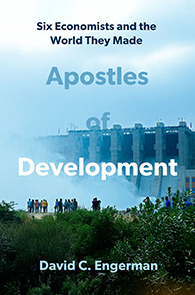 Apostles of Development: Six Economists and the World They Made
David C. Engerman
Oxford University Press
Oxford, UK, 2025, 576 pp., $39.95
David Engerman’s latest book is a thrill to read for any practitioner of development economics, but especially those who have studied or worked in South Asia. The Yale University professor of international history sheds light on the lives of economists who were the intellectual beacons of international development’s formative years. It’s a masterful intellectual and policy history, told through the lives and accomplishments of six South Asian economists: Amartya Sen, Jagdish Bhagwati, Manmohan Singh, Mahbub Ul Haq, Rehman Sobhan, and Lal Jayawardene.
Apostles of Development is much more than a historical treatise; it appears at a time of great tension in the global development system over who sets priorities, how ideas travel, and what “development” should mean in an era of inequality, debt, and climate crisis.
The “Apostles” pushed—often from within—to democratize the IMF and World Bank and to channel new resources to poorer countries. That push continues today in the debates over developing economies’ voice and voting rights at the Bretton Woods institutions, and over special drawing rights (SDRs), international reserve assets created by the IMF to supplement the official reserves of its member countries. The book reminds us that developing economies’ aspirations for a greater voice are not new but a continuation of an older struggle, led by figures such as Sen, Haq, and Singh.
Haq pushed for the World Bank to shift from a singular focus on GDP to a broader concept of human development, including poverty alleviation and human welfare. The Human Development Index (HDI), born of Haq’s and Sen’s collaboration, remains central to how the development community measures progress. The book reminds us that debates over the quality of growth—not just the quantity of finance—have deep historical roots. Measures like the HDI could inspire new metrics for climate equity or social inclusion today.
Engerman traces how Sen, Haq, and Sobhan shifted focus from national to global inequality—linking redistributive justice with reform of international finance. This echoes in current conversations about global inequality traps, debt justice, and the need for redistribution through SDRs or loss-and-damage funds.
Sobhan’s institution building in Bangladesh illustrates how Southern think tanks can improve the quality of domestic policymaking. His Centre for Policy Dialogue launched the Independent Review of Bangladesh’s Development in 1995 as a domestic counterweight to analysis produced by international financial institutions. The Delhi School of Economics, India’s leading postgraduate institution for the social sciences, where Sen and Singh served as faculty, strengthened Southern scholarship and trained cadres that later ran ministries and held senior positions at the IMF, World Bank, and other international institutions. This directly parallels today’s calls for “mission-oriented finance,” as advocated by economists such as Mariana Mazzucato, and human-centered investment frameworks in climate finance and social policy.
Finally, and perhaps most important, Engerman’s portraits of these economists show how they humanized and democratized development thinking—but also became part of a technocratic elite. This raises an important question: Who defines global development expertise today? Washington Consensus economists, or more dispersed local communities?
KALPANA KOCHHAR is director of development policy and finance at the Gates Foundation.
Opinions expressed in articles and other materials are those of the authors; they do not necessarily reflect IMF policy.


