Most countries around the world have rightfully taken a “whatever it takes”
approach to combating the COVID-19 pandemic. On the fiscal side,
extraordinary and far-reaching tax and spending measures have been
implemented to save lives, support individuals and firms, and set the stage
for recovery. It is still too early to predict an endgame for this crisis.
But once the virus is beaten back and the global recession bottoms out,
public finances will have to be put back in order, especially in countries
where debt was already high before the pandemic arrived. This will
inevitably raise questions about what taxes to increase and which spending
to cut, decisions that are politically unpopular.
Jean-Claude Juncker, the former president of the European Commission,
referring to the political obstacles facing those undertaking structural
reforms, famously remarked, “We all know what to do; we just don’t know how
to get re-elected after we’ve done it” (Economist 2007). One could
argue that this applies especially to fiscal consolidation. Among
consolidation measures, tax hikes are typically associated with higher
short-term growth costs than spending cuts (Alesina, Favero, and Giavazzi
2015). But does that mean governments always pay a price at the ballot box
for raising taxes?
While there is broad agreement on the economic benefits of fiscal
adjustments to reduce runaway deficits and debt, the political
ramifications are less clear-cut.
On the one hand, tax increases may generate gains for society as a whole
only in the longer term while inflicting short-term pain on certain
segments of society. Those affected may be highly vocal and well organized.
The rich and middle-class voters may also have very different notions about
which tax hikes are palatable (Alt, Preston, and Sibieta 2010). This
suggests that voters can penalize governments for undertaking actions that
go against their policy preferences and economic interests.
On the other hand, tax hikes may not be a deal breaker if voters themselves
are fiscally prudent and view them as being economically necessary. It
could also be the case that the electorate places relatively less weight on
fiscal adjustments—even when unpopular—if undertaken alongside other
beneficial reforms, or if they care more about other political attributes,
such as party ideology.
What, then, can be learned from past tax-based consolidations?
Tax reform and election outcomes
In a recent study, we sought to answer this question, using a newly
compiled database of tax-based fiscal consolidations for 10 advanced
economies (Dabla-Norris and Lima 2018). The database has comprehensive
information on a series of tax reforms, including their magnitude, precise
announcement and implementation dates, and the motivation behind each. We
looked at both direct (corporate and personal income tax) and indirect tax
(value-added tax and excises) reforms from 1973 to 2014. We then examined
electoral outcomes such as reelection of the incumbent government party,
its leader (usually the prime minister, or the president in presidential
regimes), or the percentage of votes the incumbent government party
received when reelected. We controlled for a wide range of other economic
and political factors (for example, government popularity at the time of
reforms, parliamentary support for the government), other country-specific
characteristics, and global shocks that could affect reelection outcomes.
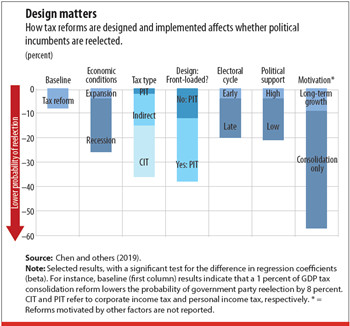
Voters indeed seem to punish political incumbents for undertaking tax-based
fiscal consolidation (see chart). The likelihood of reelection of the
incumbent government or its leader falls significantly after these
episodes. For example, 1 percentage point of GDP tax consolidation lowers
the probability of reelection of the government by about 8 percentage
points. The incumbent party is also likely to receive fewer votes than in
the previous election.
A political strategist in the United States once noted, “It’s the economy,
stupid.” This is not just a pithy catchphrase—prevailing economic
conditions do make a difference at the ballot box. Voters tend to penalize
the ruling party even more when tax reforms are implemented during
recessions. This is because when countries tighten fiscal policy during bad
times, the economy can contract even further, creating more short-term pain
than would otherwise be the case (Auerbach and Gorodnichenko 2012). When
voters are subjected to this additional pain, tax hikes become more
challenging politically.
Further, not all tax reforms are equal from an electoral perspective. On
the surface, voters appeared to penalize governments equally for
implementing direct and indirect tax reforms. But among direct taxes,
corporate income tax increases can exact a higher cost at election time
than personal income taxes. This is not entirely surprising, since
corporate income tax reforms affect more organized and politically
influential interest groups. By contrast, personal income tax increases are
more diffuse because they often include offsetting measures targeted toward
specific groups. For instance, higher tax rates for certain income tax
brackets are typically accompanied by changes to particular allowances and
deductions, tax credits, and special tax treatment for capital gains—all of
which tend to have a differential impact on taxpayers.
Reform design in terms of the timing of tax measures and the electoral
cycle can shape political costs. Voters tend to penalize governments more
for announcing front-loaded reform efforts that result in higher tax
payments immediately than for back-loaded measures that entail a gradual
increase in tax liabilities.
Does this indicate electoral myopia? Yes, but not entirely. While reforms
announced in the run-up to elections entail higher electoral costs, the
effect again depends on reform type. For example, personal income tax
reforms have virtually no impact on reelection odds when announced two
years before the beginning of the government’s new mandate but can exact a
heavy toll just before an election (the probability of reelection falls by
almost 15 percentage points). Politically influential corporate lobbies
that are narrowly focused on their interests, however, tend to be less
forgiving if corporate income tax reforms are implemented, irrespective of
the electoral cycle.
Ideology matters
A popular government that enjoys broad-based support for its policies, as
measured by the percentage of votes it received when first elected, is less
likely to be punished in subsequent elections for implementing tax reforms,
even politically costly corporate income tax hikes. Not surprisingly,
voters have no such reservations when it comes to governments with a weaker
political mandate, which invariably pay a price at the polls.
Interestingly, the political orientation of the incumbent government
matters for some tax reforms. Voters, on average, tend to punish right-wing
governments, which typically run on low-tax, pro-business platforms, for
implementing personal income tax reforms that lower the progressivity of
the tax system and—to a lesser extent—for raising corporate income taxes.
Finally, voters seem to care about the reasons behind the tax
consolidation. Contractionary tax measures aimed primarily at lowering
existing deficits and debt entail larger electoral costs than consolidation
measures aimed at improving long-term growth prospects. Examples of such
long-term growth reforms include measures announced by the Australian
government in September 1985 or the UK government in 1991, when some tax
rates were increased to finance long-term growth. This is because voters
care about their own long-term prospects or the well-being of future
generations. Or voters may perceive tax measures implemented to ameliorate
existing large deficits and debt as a signal of the government’s inability
to tackle economic problems.
Bottom line
Politicians may view the eventual consolidation of public finances from the
COVID-19 shock with some trepidation given the tough fiscal choices they
will inevitably face. But tax-based fiscal consolidation does not
necessarily have to be politically costly. Electoral costs can be avoided,
or at least significantly reduced, if economic and political considerations
are factored into policy design.