


Loading component...
2013 Article IV Consultation with Japan: Concluding Statement of the IMF Mission
May 31, 2013


Describes the preliminary findings of IMF staff at the conclusion of certain missions (official staff visits, in most cases to member countries). Missions are undertaken as part of regular (usually annual) consultations under Article IV of the IMF's Articles of Agreement, in the context of a request to use IMF resources (borrow from the IMF), as part of discussions of staff monitored programs, and as part of other staff reviews of economic developments.
The economic recovery is gaining traction, driven in large part by the adoption of the new Quantitative and Qualitative Monetary Easing (QQME) framework. To succeed in raising growth and inflation, a complete package of ambitious fiscal and growth reforms is also needed. The government intends to roll out initial plans in these areas this summer. These plans should include a confirmation of the consumption tax rate increase and concrete fiscal consolidation measures beyond 2015 to secure fiscal and financial stability. Growth enhancing structural reforms should include deregulation in agriculture and domestic services, greater reliance on market-based financing for small and medium-sized businesses (SMEs), and measures to raise employment and reduce duality in the labor market. Taken together, a complete package of reforms could generate powerful economic synergies, revitalize Japan, and benefit the global economy.
1. The authorities have embarked on an ambitious agenda to raise growth and inflation. The new policy framework (the “three arrows of Abenomics”) provides a unique opportunity to end decades-long deflation and sluggish growth, and reverse the rise of public debt. The rewards are potentially large. Higher growth and inflation would allow Japan to provide financial security for its aging population and rising incomes for the young. These benefits would also be felt abroad as concerns about Japan’s high debt would diminish and demand for imports would rise.
2. The authorities are well aware that the work has only just begun, with subsequent steps to be outlined in the coming months. With the economic recovery at an early stage and large scale monetary easing by the Bank of Japan (BoJ) underway, ambitious growth reforms are essential to generate a sustained rise of private investment, productivity, and wage growth. Equally important is the adoption of concrete medium-term fiscal reforms to contain risks from a sharp rise in risk premia on government bonds. A comprehensive effort is therefore needed to confirm the newfound optimism in the country.
3. The economy is expected to grow at a robust pace in the near term helped by the new policy momentum. Growth in the first quarter of this year rebounded strongly, led by consumption and net exports. This is an encouraging sign that the new policy framework is bearing fruit, although investment has yet to pick up. Growth in 2013 is projected at 1.6 percent and we expect activity to become increasingly private-demand driven, led by a recovery of exports and investment and a frontloading of domestic demand ahead of the 2014 consumption tax increase. Because of the rising impetus of private demand, growth in 2014 will slow only moderately to 1.4 percent despite fiscal consolidation resulting from the planned consumption tax increase and the unwinding of reconstruction spending.
4. Despite the strong start, there are considerable downside risks to the outlook. Disappointing growth reforms that fail to raise private investment and employment could weaken the recovery and slow the return to inflation. Lack of concrete fiscal measures to bring down public debt, or a delay in the consumption tax increase, could elevate risks of a rise in government bond yields, which would undermine fiscal and financial sector stability. External risks are also mostly on the downside and include a slowdown in emerging markets and protracted slow growth in Europe.
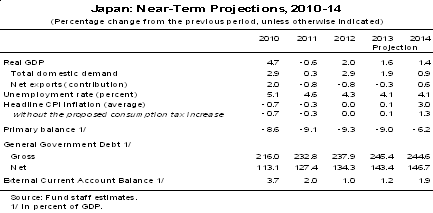
5. We fully endorse the BoJ’s objective to raise inflation to 2 percent and the sweeping enhancements to its monetary policy framework. Decades-long deflation has steadily weakened Japan’s economic dynamism and contributed to an unprecedented rise in public debt. By setting a clear time frame for achieving 2 percent inflation underpinned by a doubling of the monetary base through a large-scale expansion of purchases of JGBs and private assets (commercial paper, corporate bonds, exchange-traded funds, and Japan real estate investment trusts) the BoJ has taken the first step for raising growth and inflation. The BoJ has also significantly strengthened its communication including through its forward guidance by announcing that it will continue with QQME for as long as it is necessary for maintaining the inflation target in a stable manner. Furthermore, the joint policy statement between the BoJ and the government will raise the effectiveness of policies, but at the same time the BoJ’s operational independence in meeting its mandate must remain unaffected.
6. Initial signs suggest that the new framework is beginning to work. Indicators from household surveys, business expectations, and from breakeven inflation rates all suggest a gradual pickup in inflation expectations, albeit still well below the inflation target. On the other hand, although wage bonuses have started to increase, basic wages have yet to rise, which is important to stimulate inflation expectations and support purchasing power once inflation starts to rise.
7. Consistent with the new policy objectives, the BoJ is taking appropriate steps to contain excessive volatility in the government bond market, including by realigning asset purchases and enhancing communication with market participants. Such volatility illustrates that market participants are adjusting to a new equilibrium through portfolio rebalancing, but at the same time face uncertainty in weighing the relative effects of BoJ purchases and the prospect of higher inflation down the road.
8. Complementary growth and fiscal reforms are essential for raising inflation in a durable manner. The near-term recovery and the pass-through from yen depreciation to domestic prices will create inflationary pressure, but the effects are likely small. Therefore, a robust rise in inflation hinges critically on a rise in inflation expectations, which depends not only on monetary easing, but also on the credibility of medium-term fiscal and growth reforms. Fiscal reforms are needed to provide assurances concerning fiscal and financial stability. Structural reforms are critical to support real incomes and to overcome structural headwinds from inertia in inflation expectations, rigid wages, and the deflationary effects of population aging. If these reforms are successfully implemented, the mission estimates that the BoJ could achieve its 2 percent inflation target in the near to medium-term.
9. The BoJ should begin planning early to address exit risks. Although risks appear manageable and exit is still far off, the large increase in their balance sheet puts a premium on strong communication during the process.
10. Fiscal risks have risen in the past year. Because of rising social security spending and new stimulus, long-term fiscal consolidation needs have risen. A sharp increase in government bond yields remains the key risk. While interest rates have remained at very low levels, staff estimates that deteriorating fiscal conditions could have a substantial impact on long-term bond yields.
11. Raising the consumption tax rate is an essential first step to contain the projected increase in fiscal vulnerabilities. The scheduled increases in April 2014 and October 2015 from 5 to 10 percent should proceed as planned because it is the centerpiece of the government’s strategy. Its implementation is critical to maintain confidence in the ability of the government to address the fiscal problem. Introducing multiple rates would severely dilute revenue gains, complicate tax administration, and impose a costly administrative burden on small and medium-sized enterprises (SMEs). Targeted transfers could be considered to compensate low-income households, facilitated over the medium term by the implementation of unique identification numbers.
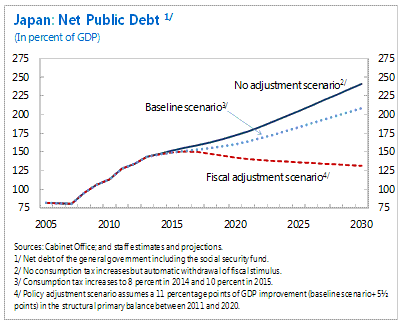
12. To bring public debt to sustainable levels, an ambitious and concrete consolidation plan beyond 2015 is urgently needed. Staff estimates that over the next decade, structural fiscal consolidation of 11 percent of GDP is needed to put the debt-to-GDP ratio firmly on a declining path. The increases of the consumption tax rate to 10 percent by 2015, together with expiring stimulus and reconstruction spending, account for about half of this adjustment. An additional structural fiscal adjustment of 5.5 percent of GDP after 2015 therefore needs to be identified. While higher than expected nominal growth from a complete macroeconomic reform package could generate fiscal improvements, these should be saved to serve as a buffer against potential shocks to the fiscal position and higher than expected social spending especially on health care. If these reforms succeed, an important tail risk would be taken off the table and economic and fiscal stability would increase globally.
13. Such a medium-term plan should be as growth friendly as possible. Given the magnitude of the needed adjustment, broadly equal efforts on both the revenue and spending side are needed. The fiscal reform should also encompass measures that stimulate incentives to work and invest, and address equity concerns. Key elements could include:
With such a plan in place, some fiscal space would be created to smooth the fiscal adjustment in 2014-15 should growth disappoint.
14. Ambitious structural reforms are essential for the overall success of the new policies. A more flexible economy is needed to raise productivity and wages and to support the exit from deflation. It is therefore critical that the growth strategy to be unveiled in June focuses on creating growth opportunities for the private sector.
15. Reforms should build on steps already taken towards reviving Japan's economic dynamism. The government's participation in the Trans-Pacific Partnership negotiations and its plans to raise the employment of women are important and welcome steps. But the mission sees an urgent need to expand these efforts to create broader growth synergies. Important other measures include:
16. A complete package of policies—“three-arrows”—provides an opportunity to further strengthen financial system stability. The FSAP Update found the financial system to be generally sound, but identified some key risks, in particular related to Japanese banks’ large JGB holdings. These holdings can decline in the next two years as QQME leads to a transfer of JGBs from bank balance sheets to the BoJ. In turn, this could reduce the sensitivity of bank balance sheets to interest rate shocks and allow them to extend more credit at home and abroad and raise profitability. Rising stock prices have given banks and insurers an opportunity to divest their equity holdings to reduce exposure to market risk. By solidifying financial stability, these factors would enhance the role of the financial sector in promoting growth.
17. However, the new framework also presents challenges, particularly if the package is incomplete. Specifically,
18. Important progress has been made in several regulatory areas in line with the FSAP Update recommendations, but continued efforts are needed to strengthen financial stability. Basel III implementation, which began in March, will strengthen capital standards of internationally-active banks in a phased manner. Improvements have also been introduced regarding the stress testing methodology to incorporate a more thematic risk assessment for the banking system. Furthermore, the authorities have submitted legislation to the Diet on bringing large exposure limits for banks in line with international best practices and establishing an orderly resolution regime for financial institutions. As part of international efforts, the cross-border risk monitoring arrangements with foreign supervisors have deepened. Building on this progress, the mission recommends:
19. The recent large depreciation of the exchange rate must be understood in the context of the critical and welcome effort of the BoJ to decisively exit from deflation. Compared to the average level in 2012, the yen has depreciated by about 20 percent in real effective terms by April 2013 as a result of aggressive monetary easing, higher energy imports, reduced safe-haven effects, and the expected widening of interest rate differentials with the U.S. So long as monetary easing pursues domestic goals, and is accompanied by comprehensive fiscal and structural reforms, we do not see the yen's current depreciation as problematic. Over the medium-term, once a complete set of reforms (i.e. all three arrows) are in place, the expectation is that the exchange rate and current account balance would move to levels broadly consistent with fundamentals.
20. A complete package of reforms will likely create positive economic spillovers, but near-term effects could be more mixed. Under a complete package, higher growth in Japan and easier global financial conditions would more than offset the effect of exchange rate appreciation in trading partners. Some direct competitors in export markets may be negatively affected, although lower import costs of Japanese intermediate inputs through the Asian supply chain would mitigate these effects. Capital outflows from Japan as a result of portfolio rebalancing could also generate spillovers, although so far there have been few signs of such flows. The effects of capital inflows on recipient countries depend on the size of countries capital markets and domestic economic conditions, particularly, whether they experience economic slack or overheating risks. Incomplete policies could put pressure on the BoJ to maintain an accommodative stance for longer, which would risk creating negative spillovers to the rest of the world as Japan’s growth would remain subdued and the exchange rate would be the main transmission channel.
***
21. We are grateful to the authorities for their generous hospitality and very constructive discussions.
| Public Affairs | Media Relations | |||
|---|---|---|---|---|
| E-mail: | publicaffairs@imf.org | E-mail: | media@imf.org | |
| Fax: | 202-623-6220 | Phone: | 202-623-7100 | |

