Speeches People's Republic of China and the IMF People's Republic of China Hong Kong Special Administrative Region and the IMF Indonesia and the IMF India and the IMF Iraq and the IMF Japan and the IMF Republic of Korea and the IMF Malaysia and the IMF Singapore and the IMF The IMF and the World Trade Organization -- A Factsheet Free Email Notification Receive emails when we post new
items of interest to you.  |
|
|
|
Asia—Economic Outlook and Policy Challenges Remarks by David Burton Director, Asia and Pacific Department International Monetary Fund to the Singapore Press Club and the Singapore Foreign Correspondents' Association Singapore, March 5, 2003 It is a great pleasure to be here in Singapore today, and to have this opportunity to address both the Singapore Press Club and the Singapore Foreign Correspondents' Association. In my talk today I would like to share with you some thoughts on the economic outlook for Asia, both in the near term and looking further ahead. I will focus in particular on the challenges facing the region, especially those of coping with volatility and uncertainty in the global economy, and of adapting to the emergence of China as a major economic power. In this context, I will discuss policies needed for sustaining rapid economic growth over the medium term, including the unfinished reform agenda, and the role for domestic demand management and the expansion of intra-regional trade in counterbalancing fluctuations in exports to the rest of the world. Recent economic performance, outlook, and risks Let me start by briefly reviewing recent developments in, and the short-term outlook for, the regional economy.
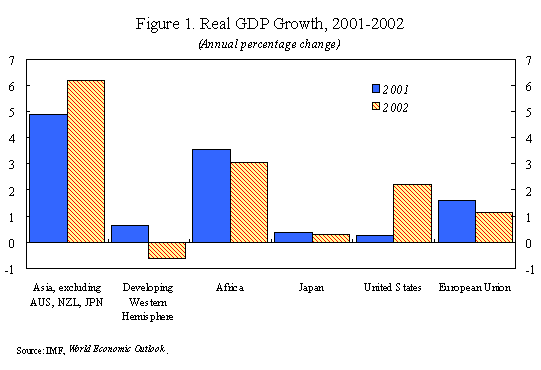
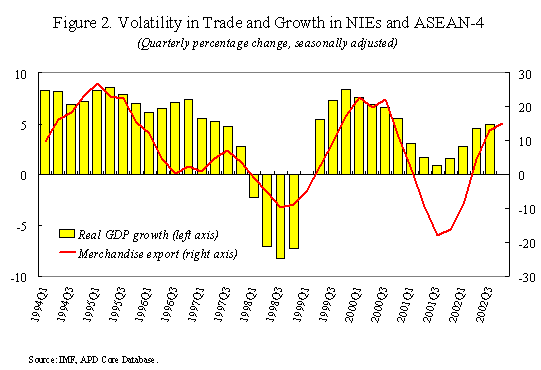
Economic performance in the Asia region was quite impressive in 2002, with growth picking up smartly, even though the recovery in industrial country growth was relatively weak. Excluding China, India, and Japan, growth in the region accelerated to 4¼ percent last year from only 1¾ percent in 2001. And non-Japan Asia was the fastest growing region in the world with real GDP expanding by more than 6 percent, as growth in China increased to 8 percent (Figure 1). Nevertheless, excess capacity remains in several economies, including here in Singapore, where the recovery has been weak and unemployment is still high relative to levels in the past. The pick-up in growth in the region in 2002 reflected in large part strong export performance as the global economy recovered (Figure 2); the region also benefited from a further shift toward Asian sources of supply for electronics, even as the recovery in demand in that sector faltered in mid-year. China's rapid export growth was also underpinned by its entry in the WTO. Toward the end of the year, however, there were indications that export growth was starting to slow in many countries in the region. Domestic demand also played an important part in last year's improved growth performance, with an easing of monetary or fiscal policies contributing to recovery in several countries, including, Korea, Malaysia, Singapore and Thailand. In China, strong investment spending, partly spurred by entry into the WTO, was an important source of economic stimulus. I would also note that good progress with structural reform in recent years and the sound macroeconomic policy frameworks now in place in most countries in the region provided a solid foundation for the rebound in activity in 2002. In Japan, however, a recovery supported by surprisingly strong consumption as well as exports appeared to be running out of steam toward the end of the year, with output registering only a modest increase for the year as a whole. Inflation in the region generally remains subdued despite the significant rise in international commodity prices in 2002. In many economies, substantial margins of excess capacity kept demand pressures on prices weak. Several economies, notably China, Hong Kong SAR, and Japan, experienced persistent deflation in 2002, though the causes differed. In China, the underlying factors have been mainly structural, especially strong productivity growth combined with the impact on prices of a reduction in trade tariffs, rather than weak demand. In Hong Kong SAR, deflation represents the continuing impact of declining property prices combined with the effects of increasing integration with mainland China. In Japan, substantial excess capacity continues to exert downward pressure on prices. Turning to 2003, prospects for the region will depend significantly on developments in the global economy about which there is currently considerable uncertainty. Global recovery remains heavily dependent on developments in the United States, and if US growth were to falter there is no obvious candidate to take up the slack. Moreover, growth in the advanced economies has slowed in recent months, and forward looking indicators are not particularly encouraging. The recent slowdown, however, appears to be largely due to rising uncertainty about the possibility of war in Iraq, and its effects on oil prices, equity markets and business confidence. While there are downside risks, the most likely scenario is for the recovery to gradually regather momentum during the year. Reasons for thinking this include the policy stimulus already in the pipeline in advanced economies, and the likelihood that by now we have seen the worst of the fallout from the bursting of the equity market bubble. Also, there is scope for further easing of monetary policy in advanced economies if this should prove necessary. Under this most likely scenario, we project that the anticipated strengthening in the global economy would underpin broadly unchanged growth of about 6 percent in non-Japan Asia in 2003-04, making it once again the fastest growing region in the world. More specifically:
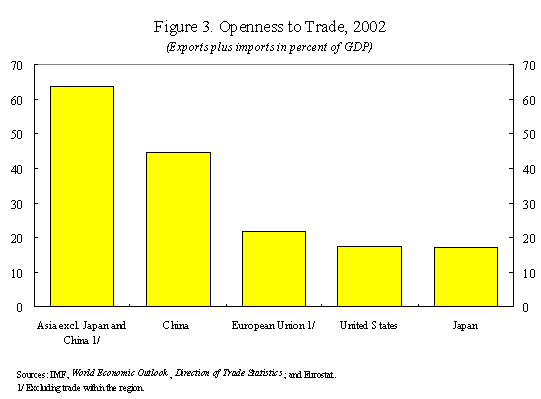
Near-term macroeconomic policy challenges As noted above, however, there are sizable downside risks to this relatively favorable outlook. Should these materialize, many Asian countries have scope to use macroeconomic policies to support economic activity. However, given the large size of export sectors relative to GDP in most of the countries in the region (China, India, and Japan are exceptions), and the concentration of exports in the volatile electronics sector, monetary and fiscal policies are likely to be able only partially to offset the impact on growth of a downturn in the global economy (Figure 3). Monetary policy should generally be the first line of defense. With inflation low in most countries in the region, there is scope for further easing of monetary policy should growth falter. However, countries where banking system restructuring is incomplete and non-performing loans remain a problem, or where credit expansion has recently been rapid (e.g., Korea), may also be constrained in the use of monetary policy. Also, countries with pegged exchange rates will be constrained in their use of monetary policy; most countries in the region, though, have adopted flexible exchange rates, which should facilitate their adjustment to external shocks.
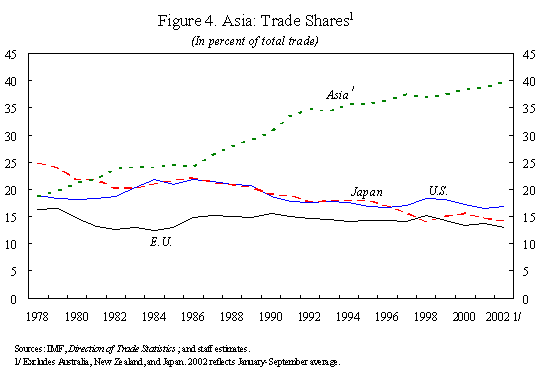
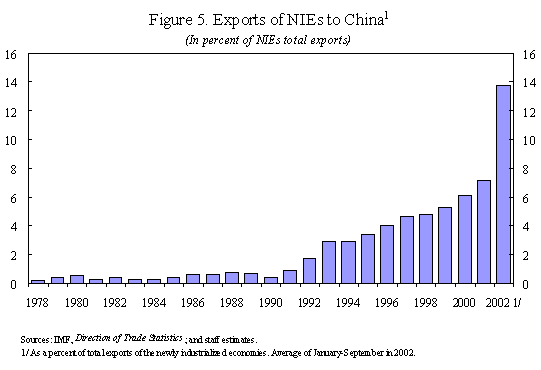
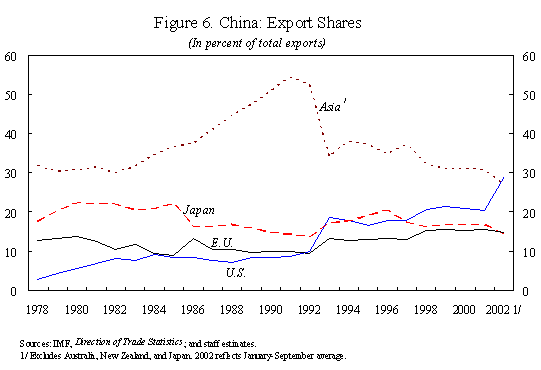
Budgetary positions are sound and public debt levels moderate or low in some countries (e.g., Korea and Singapore), reflecting a strong tradition of fiscal prudence in the region. Thus, there is room for these economies to allow higher budget deficits through the effects of automatic stabilizers if growth slows, and to introduce quick acting and temporary budgetary measures to support activity. However, in several other countries, such as India, Indonesia, Japan, and the Philippines, high budget deficits and public debt levels constrain the room for maneuver, and reducing fiscal imbalances should remain a priority. It is also important to note that balance of payments positions are strong in most Asian economies. External current accounts are in surplus in most cases, and international reserves generally at comfortable levels, with reserves for the region as a whole having risen to close to $1½ trillion by end 2002. This leaves the region well placed to cope with the balance of payments effects of a period of higher oil prices and lower export demand that could result from conflict in Iraq. A general lesson here, and one to which I will return, is that countries with sound macroeconomic positions are best placed to ride out periods of economic turbulence. It follows that it is important to take advantage of periods of strong economic growth to reduce fiscal deficits and lower public debt, while keeping inflation low and preventing problems developing in banking systems. This will be an important challenge for the region in the period ahead. Intra-regional trade In considering Asia's vulnerability to fluctuations in the global economy, an issue that has been much discussed recently is whether growing intra-regional trade has reduced and could further diminish reliance on demand from outside the region. Looking at the data on Asia's trade, a few things stand out:
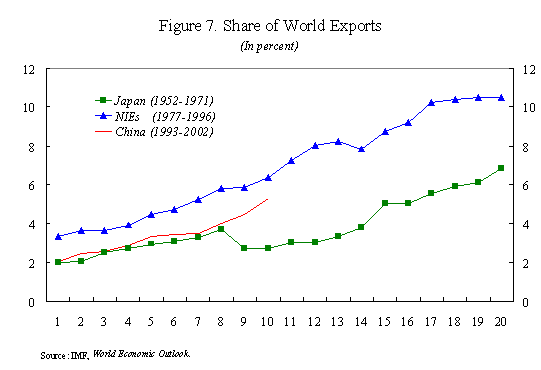
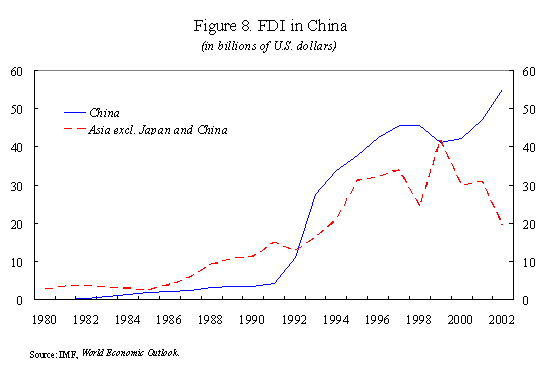
These developments illustrate the emergence of China as an important link in the region's production chain. More and more of the region's exports, especially of electronics, are being channeled through China for final processing and assembly, taking advantage of the country's low costs for this type of production activity. At the same time, with the growth in consumption in China and the rest of the region, part of the growing intra-regional trade undoubtedly goes to meet final demand within Asia, either directly or as inputs into products ultimately consumed within the region. The Monetary Authority of Singapore has estimated that about half of intra-regional trade is to satisfy final demand in the region. Taking this estimate, only about 20 percent of non-Japan Asia's exports go to meet final demand in the region. Thus, at this stage, intra-regional trade provides only a limited counterweight to demand from outside the region, and the global economic environment remains the key driver of regional activity. Looking forward, however, demand from within the region will almost certainly become an increasingly important factor, given the rapid pace of economic growth in Asia, and spurred by regional trade initiatives. The IMF, for its part, welcomes the steps being taken toward greater regional economic integration and cooperation in Asia, in the context of outward-oriented and liberalizing policies. Adjusting to China Let me now turn to the question of the medium-term economic prospects for the region. For many countries, in looking forward, the issue that looms large is how to cope with China's rapid development and integration into the global economy. So let me start with the China issue before addressing the more general one of the policies that are needed to ensure a continuation of sustained high growth over the longer run. China's rapid economic growth and emergence as an export power house is without doubt a development of historic and global proportions. And China's accession to the WTO was certainly an important event in this process, though China had already made major progress in liberalizing its trade regime, and its integration into the global economy was already well underway. Concerns of countries in the region relate to how to compete with China's dynamic export sector and how to continue to attract FDI in competition with China. A first observation is that China's export growth, while dramatic, is not unprecedented in the region's history. Over the last decade, China's share of world exports has risen by 3 ½ percentage points to over 5 percent in 2002 (Figure 7). This is similar to the gains in trade in earlier periods when Japan and the NIEs emerged as export powers. China's export growth is, of course, set to continue, and may in time exceed these earlier episodes. But, to date, what has happened is comparable to previous episodes of explosive export expansion in other parts of Asia with which the region has coped. China's success in attracting FDI has indeed been remarkable. FDI accelerated in 2002 spurred by membership of the WTO, rising to over $50 billion (Figure 8). The increase in these flows to China appears to have been to some extent at the expense of FDI to the rest of the region, which has been falling in recent years. At the same time, a significant part of the FDI into China has come from within the region, especially from more advanced economies. China's membership of the WTO undoubtedly represents opportunities as well as challenges for the countries in the region. Chinese disposable incomes are rising, and Chinese consumers are developing sophisticated tastes, including for imported goods. Chinese companies need specialized capital goods, components, and raw materials. And China offers considerable investment opportunities for companies in the region. How individual countries will fare in coping with the further emergence of China will depend on many factors, not least progress in strengthening business environments, and creating conditions conducive to investment and innovation, a subject to which I will return. In the first instance, however, the impact will depend on the degree of trade complementarity with China.
Policy requirements for sustained growth Let me now turn to the policies needed both to support sustained high growth, as well as to facilitate the flexibility needed to adjust to China's growing economic integration into the global economy. As in other regions, the key to rapid development will be action to strengthen the structural and institutional underpinnings of a dynamic market economy.
To sum up, recent economic performance in Asia has generally been impressive, and the prospects for the region are bright, though challenges will need to be overcome. The buoyancy of the region's recent economic growth reflects strong macroeconomic fundamentals in most of the region as well as the progress that has been made with reforms, especially by those countries affected by the Asian crisis. The immediate outlook is for continued solid growth in the region, although sizable downside risks related to uncertainties about the strength of the global recovery and to Iraq exist. Despite the growing importance of intra-regional trade, the global environment will remain for the time being the main driver of activity in the region. Most Asian economies, however, are well placed to ride out any turbulence. And there is scope in several countries in the region for macroeconomic policies to support growth in the event of a global slowdown. Looking further ahead, the region is expected to continue to grow rapidly. However, further strengthening of the institutional and structural underpinnings of a dynamic market economy will be needed to enable countries to respond quickly to new challenges, including those posed by the emergence of China as a major economic power. Thank you. |
IMF EXTERNAL RELATIONS DEPARTMENT
| |||||||||||||