Speeches The IMF And Civil Society Organizations -- A Factsheet Proposals for a Sovereign Debt Restructuring Mechanism (SDRM) -- A Factsheet Free Email Notification Receive emails when we post new
items of interest to you.  |
|
|
|
Transparency and the IMF Toward Second Generation Reforms Thomas C. Dawson Director of External Relations International Monetary Fund Prepared text for remarks to Nordic and Baltic Monetary and Financial Committee1 Tallinn, March 17, 2003 These are the years of living transparently. Nowhere is the culture change more apparent than at financial agencies—at finance ministries and central banks, and at the international financial institutions. My colleague Barry Potter spent a long part of his career in the UK Treasury and then moved to the IMF to work on, among other things, the Code for Fiscal Transparency. He jokes that he "spent the first 25 years of his career assisting ministers in hiding what was going on and the next five years trying to unveil what was actually happening."2 At the IMF, the first generation transparency reforms began following the Mexican tequila crisis of 1994 and were accelerated during the Asian crisis of 1997-98. It was widely accepted that in reporting their financial positions some of the crisis countries had been, shall we say, `economical with the truth'. The IMF therefore launched initiatives to increase the transparency of the data—particularly on international reserves and external debt—provided by its members to the IMF and to financial markets. The Asian crisis also unleashed much deeper changes in IMF transparency. Not only were countries under pressure to come clean, but the IMF itself came in under unprecedented pressure to reveal its policy advice to countries, that is, to be less secretive. To respond to these demands, the IMF started to urge its member countries to publish documents that had been kept outside the public eye. We used to publish virtually nothing, now we publish virtually everything. The spate of financial crises provoked not just a demand to know what advice the Fund was giving, but a public debate on whether it was the right advice. That is, the Fund's competence came into question. So great was the clamor that the Fund had to defend its actions not just to its member countries but to a variety of audiences—the media, academics, civil society organizations and, indeed, the public at large. The steps taken in response are part of the ongoing transformation of the Fund into an open institution, one that `listens and learns'. How successful have the reforms been? Although anyone who has worked at—or has had substantive interaction with—the IMF for a number of years recognizes the quantum leap in IMF transparency, it is better not to rely solely on personal observation or the opinions of friends. We know the reforms have been successful because outside observers, including prominent critics of the institution, have also applauded the increased transparency of the institution. Here are a few examples—
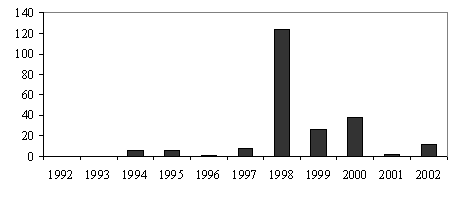
References to the IMF and the word "secretive" in First generation reforms Let me know discuss the specifics of what has been achieved and the challenges ahead. There are three pillars of the first generation transparency reforms7:
Publication: The amount of information the IMF now makes available about its activities is truly phenomenal. Consider these examples—
In short, information once guarded closely as state secrets is now routinely published. And fears in some quarters that the release of this information would shake the pillars of modern civilization seem to have been unfounded. Financial markets are happy getting a steady stream of information from us and from our member governments. And they like it better than the old system when a sudden deluge of information which had been kept bottled up would come out and destabilize markets and countries. Not only are we being more open about the financial situation of our member countries, we are being more open about the Fund's own financial position and accounting practices. The IMF should certainly lead in this area and fully practice what we advise others to do. We now provide:
To add to all the examples of publications that I mentioned earlier, we now also publish important policy papers on the Fund's financial matters. These include quota reviews and safeguards assessments, as well as background papers on IMF financial structure and operations. Making this torrent of material available to a wide audience, and in a timely fashion, could not have been done without the IMF's external website. Nearly 1,400 items were added to the Fund's external website last year, double the number of items posted only two years ago. The Fund's website receives about 4 million hits per month. Building an open institution: In addition to telling the world more about what it is doing, the IMF has been listening more to what others think of what we're doing. Steps have been taken over the last few years to build an institution that shows willingness to learn from experience, and takes into account outside views in developing policies and carrying out reforms of the institution. There are several examples by now that illustrate this learning culture at the IMF:
But no matter how honest the attempt at self-examination and self-criticism, we all have a tendency to end up being a tad generous to ourselves. So a very crucial element of the attempt to build an open institution is the establishment of an Independent Evaluation Office (IEO), which started operations in July 2001. Studies by an independent office can take care of the problem of excessive generosity of internal assessments, and therefore also carry more credibility with the public at large.8 This is particularly the case because the IEO's evaluations are likely to involve considerably more interaction with outsiders than do internal assessments. For each evaluation, the IEO publishes an issues paper on its website and invites comments before defining the terms of reference. Once the terms of reference are decided, the office invites substantive contributions from interested parties wishing to respond on points included in the terms of reference. This type of interaction is not typical of internal evaluations. The IEO has the freedom not only to decide how it will carry out its investigations but what topics it will investigate. The first three topics it has chosen to investigate clearly show that the office is taking the `bull by the horns':
With its first study, the one on prolonged use of IMF resources, the IEO has established its credibility as an office that is truly independent. As a colleague at the Fund remarked when the study first started circulating, "The IEO is taking the `I' in its acronym very seriously." The study pulls no punches, which is of course a bit hard on IMF staff, who are at the receiving end. But as the IEO's Director, Montek Ahluwalia, says: "We can hope to improve future performance only if we are willing to accept that we could have done better in the past." Standards and codes: The early transparency initiatives in 1996 were aimed at guiding IMF members in publishing a regular and timely flow of economic and financial data, particularly of course data on international reserves and external debt. Over time, the efforts have expanded beyond data standards to include other standards useful for IMF and World Bank operational work. These include codes of good practices in: transparency of fiscal, monetary, and financial policies; banking supervision; securities, insurance and payments systems; corporate governance; accounting, auditing, insolvency and creditor rights; and, most recently, anti-money laundering and combating the financing of terrorism. In all these areas, the IMF works closely with national authorities and relevant international agencies to help ensure that best practice is recognized and implemented. Reports assessing countries' observance of various standards and codes are then compiled. Nearly three-fourths of all such completed reports (called ROSCs) have been published. Provision by the Fund of statistical data in various formats, and providing links to data posted by authorities on their websites, is another important dimension of data transparency. The Dissemination Standards Bulletin Board maintained by the IMF's Statistics Department is key to the sharing of statistical standards and data globally. Toward second generation reforms What has been achieved in the space of only a few years is impressive. But hard work lies ahead to deepen the first generation transparency reforms. With respect to publication, it is true that the bulk of IMF documents are now posted on the website. But most of the Fund's output is prepared for the officials of member countries or for internal deliberation, often in specialist language; outsiders find it difficult to absorb it or draw the essence from it. Much of it needs to be summarized and explained for outside audiences. As the Fund's transparency policy has prompted the release of more documents and data, this need for explanation has become larger and more urgent. Even journalists who specialize in monitoring the Fund say that the Fund's policy advice and program conditions are often difficult to understand and, consequently, not reported as accurately or as widely as they might be. One interesting example of this occurred when the PIN summarizing the Board's discussion on the Fund's transparency initiatives was itself the subject of jokes in the media over its use of nontransparent language. One of the reporters on the `IMF beat' wrote: "It's official. The IMF wants to publish its papers in plain, easy-to-understand English. And they said it themselves, buried in a rambling, 10-page document sure to lull most readers into a confused sleep ... The IMF said that its internal and external review came to the conclusion that it might be a good idea to use `clearer and more straightforward language in documents.' But the first try at plain speaking resulted in gem after gem of IMF speak."9 So more needs to be done to make Fund material understandable―including by presenting it in plain language and reducing jargon. I should note, by the way, that it's not only the IMF that is fighting to avoid the use of jargon; there are indications that even the CSOs have to be on the guard against it. One CSO speaker told a World Bank audience recently that as part of the preparations for his speech he had received the following tip from a staff member: "Be careful about acronyms and civil society jargon. Internal civil society language like 'indigenous resource mobilization strategies', 'horizontal and vertical accountability' and '501(c)(3)s' may turn off your audience. If you think you're losing them, toss in some references to PRSPs and HIPCs and hopefully they'll be drawn back in."10 In addition to being jargon-free, communication with some audiences would work better if there was more publication of IMF documents in languages other than English, including local languages as well as the most widely used international languages. This can be very beneficial in increasing understanding and support for IMF policies as well as fostering country ownership. But publication in languages other than English can be costly. The bulk of the expense—more than 90 percent—is for translating and checking the translations for accuracy, a difficult task given the complexity of Fund documents. The head of the IMF's office in Tokyo, Hiroyuki Hino—a Ph.D economist with several years of Fund experience—told me recently that he tried to assess the quality of the Japanese translation of the Article IV staff report for Japan; he soon found that he was not up to the task! If more and more documents, or at least the summaries, are in plain language, perhaps the costs of translation will also decline substantially. The World Bank is somewhat ahead of the IMF in publishing in non-English languages but not by a wide margin. The Bank estimates that about seven percent of its website content is in languages other than English, whereas the Fund's external website has about 4.3 percent of its pages in languages other than English (including 1.8 percent each in French and Spanish). The website will of course remain the primary means of disseminating Fund documents. In the next stage of reforms, the website will have to focus on the quality of information provided and maintain its ease and speed of access for users everywhere. The content of the website will need to be made more user-friendly, less technical, and more streamlined. *** As the IMF proceeds with second generation reforms, it will have to grapple with an overarching issue: the trade-off between further progress on transparency and maintaining the institution's effectiveness in doing what it was set up to do. There is a doctor-patient or lawyer-client element to the relationship between the Fund and its members, and the effectiveness of the relationship depends to some degree on confidentiality. For example, disclosing prematurely details of ongoing loan negotiations could be disruptive and detrimental to the country's interest. To date, the tension has been resolved by accepting that improvements in transparency should be introduced pragmatically and without compromising candor and comprehensiveness in IMF discussions and documents. When the transparency initiatives were first launched, it was felt that setting overly ambitious targets in an international institution of members at varying stages of development and with different traditions would risk being perceived by some as interference with internal structures—a perception that could discourage candid dialogue and even the implementation of reforms. It was therefore accepted that the IMF could not be more transparent than its members wanted it to be. But public opinion and civil society organizations are coming to expect forward movement, rather than a standstill or backsliding, with respect to transparency. Some of them view the Fund as a public institution whose accountability is to the public at large rather than to our members. They therefore compare our transparency to that of national government agencies that are subject to laws such as the U.S. Freedom of Information Act. For instance, a London-based NGO, Article XIX, has criticized the Fund's transparency policy as "failing to fully guarantee the public's right to know in accordance with international standards". In particular, they admonish the Fund for not having an independent review process that would allow the public to appeal against an unfavorable decision regarding the release of information. They also argue that the Fund should have process guarantees on its transparency policy, e.g. time-bound decisions and written explanations for any refusal to release information. Such pressures run counter to the IMF's long tradition of dealing in confidence with officials of member governments, particularly when sensitive issues are discussed. The IMF governs by consensus and its current procedures respect the fact that, to be effective, some of the consensus-building process must be conducted in confidential forums. How the IMF can continue to serve our member countries effectively while satisfying the demands for greater transparency will be one of the main challenges in the period ahead. 1 I thank Prakash Loungani for assistance and Lynn Aylward and Sabina Bhatia for comments. 2 See http://www.internationalbudget.org/conference/2nd/imf.htm 3 See http://www.imf.org/external/np/tr/2003/tr030122.htm. 4 See interview with Charles Calomiris, IMF Survey, September 3, 2002 (http://www.imf.org/external/pubs/ft/survey/2001/090301.pdf) 5 "World Bank Begins to Publish Payment Data That Had Been Secret", by Mark Drajem, Bloomberg, December 17, 2002. 6 This is not simply because media attention to the IMF has dwindled to nothing. Articles about the IMF in the press, though not at their 1998 peak, still remain at very high levels. For further details, see "A Review of the Fund's External Communications Strategy" (http://www.imf.org/external/np/exr/docs/2003/021303.htm). 7 See "The IMF and Transparency-Moving Forward", speech by Shailendra J. Anjaria, October 28, 2002 (http://www.imf.org/external/np/speeches/2002/102802.htm). 8 This discussion of the IEO's work is based on an interview with IEO Director Montek Ahluwalia in IMF Survey, January 14, 2002. (http://www.imf.org/external/pubs/ft/survey/2002/011402.pdf) 9 "IMF promises plain, er, English", by Mark Egan, Reuters News, January 13, 2001. 10 "Civil Society, Governance and Globalization", speech by Kumi Naidoo. IMF EXTERNAL RELATIONS DEPARTMENT
| |||||||||||||||