MR. STARRELS: Welcome to all of you.
This is our fourth economic forum in our annual series, and today we
will be discussing the subject of financial globalization. The chair of
today's session is Mr. Kenneth Rogoff, the Economic Counselor of the Fund,
and the Director of the IMF's Research Department. Ken, the floor is yours.
MR. ROGOFF: Thank you very much, John, and welcome to all of you who
have come this morning, and we're going to talk about financial globalization.
Certainly the idea for the Forum was inspired by much interest we've had
in the paper that the Research Department at the Fund recently released
on the effects of financial globalization on developing countries, some
empirical evidence, and I have to my right two of the co-authors of the
paper, Shang-Jin Wei and Eswar Prasad, both of the International Monetary
Fund, and I myself am actually a co-author as well.
We have three very distinguished panelists to share with us their thoughts
on the general issue, and they will speak in alphabetical order.
The first is Fred Bergsten, who is the Director of the Institute for
International Economics, and I think needs no introduction here; and Jeffrey
Frankel, who is a Professor of Economics at the Kennedy School at Harvard
University and a former member of the Council of Economic Advisers under
President Clinton; and, finally, Dan Tarullo, who is a Professor of Law
at Georgetown University and a former high-ranking official in the Clinton
administration.
Before I turn the floor over to Shang-Jin and Eswar, I thought I'd just
make a couple of introductory remarks.
First, with respect to the IMF paper on the Effects of Financial Globalization
on Developing Countries that the Research Department released, it is true
that the paper probably emphasizes more than usual that when it comes
to financial globalization and developing countries, the glass can be
half-empty, as well as half-full.
Now, some polemicists have interpreted the paper as a retraction of IMF
views on financial globalization, and this is certainly not the case.
Indeed, this work builds on work done in the Research Department elsewhere
in the Fund, done elsewhere in the profession over the last 20 years,
and I think the results flow very naturally from that earlier work.
Then, just a couple of specific points about the paper.
First of all, the definition of financial globalization here is de facto
what actually countries do, not de jure what they say. There's much talk
about capital controls, but these are very difficult to measure, enforcement
often varies, and there other factors, such as geography, that matter
a lot. Capital flows often follow trade flows, which themselves are very
closely linked to geographical proximity, and so the paper looks at how
much countries are actually financially globalized, and it's not about
capital controls per se.
Secondly, the paper doesn't raise the issue of exchange regime. That
is left for future work, and it isn't discussed in great detail in the
paper, but one certainly might argue that some of the problems that we
find with financial liberalization might be much less in a world of flexible
exchange rates than a world of fixed exchange rates.
Certainly, capital account liberalization that might have been premature
or too fast was a contributory factor in the Asian crisis. I think everyone
agrees on that. On the other hand, had there been flexible exchange rates,
as many of us were arguing prior to the Asian crisis, had there been flexible
exchange rates in Asia, we might have seen a mini Asian crisis, instead
of a maxi Asian crisis. These are issues that still need to be explored.
And with that, I'll turn the presentation over to Eswar.
MR. PRASAD: Thanks, Ken, and good morning.
So this study, as Ken mentioned, was done by the Research Department.
Now, the objective of this paper was essentially to provide some empirical
evidence on the effects of financial globalization on the developing countries.
Given that financial globalization is a very broad and encompassing topic,
we decided to focus our attention on three specific questions:
First, what is the effect of financial integration on economic growth
in developing countries?
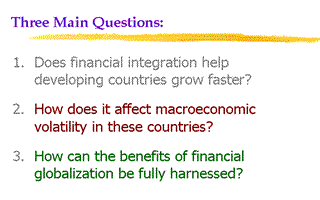
What is its effect on macroeconomic volatility?
And, finally, how can the supposed benefits of financial globalization
be fully harnessed?
Now, it should be noted that financial globalization and financial integration
are, in principle, slightly different concepts. Financial globalization
refers to the worldwide phenomenon of capital flowing more across national
borders, while financial integration, typically refers to an individual
country's degree of financial integration with the global economy in terms
of capital flows. For the purposes of this presentation, we use the two
terms interchangeably.
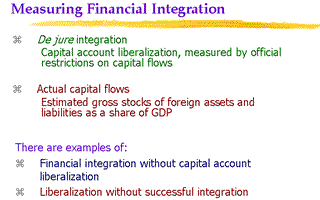
Now, as Ken mentioned, there are two different ways of looking at financial
integration. One is simply based on a measure of capital controls; that
is, what the legal restrictions are on capital flowing across national
borders. However, this turns out not to be a very good measure because
capital markets do tend to be smart about finding their ways around these
controls.
So, in some sense, actual capital flows constitute a better measure of
a country's integration into global financial markets. And, in fact, there
are examples of financial integration without capital account liberalization.
Some Latin American countries in the '80s, for instance, had large capital
outflows, although this was not something they desired, even though they
did have capital controls in place.
On the other hand, many countries in Africa do have open capital accounts,
but they are not able to obtain capital inflows, and therefore by this
measure they're not really integrated into the world economy.
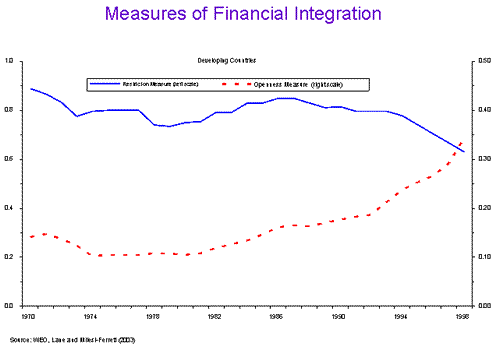
Now, for developing countries, it turns out that even though the capital
account restrictions measure, which is the blue line, has not changed
as much over time, there is a dip in this number in the 1990s, showing
the capital controls have declined.
The surge in actual capital inflows is really quite large, and by that
measure of financial integration, on average, developing countries have
participated in the process of financial globalization quite actively
starting in about the late 1980s.
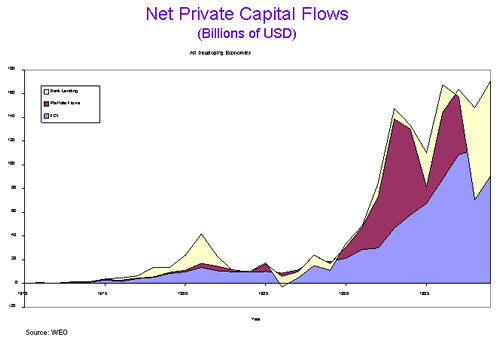
Now, net private capital flows, which we focus on in this paper, to developing
countries really surged starting in the 1980s, and the blue shaded area,
which you see at the bottom, which is FDI flows, have been the most important
component, although bank lending and portfolio flows in different periods
have had different levels of importance.
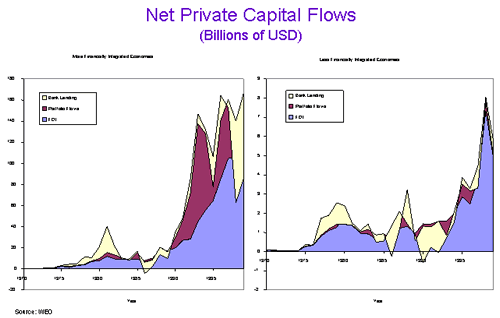
But one of the striking facts about these capital flows is that a substantial
fraction of them have, in fact, gone to a very small group of developing
countries, about 25 of them, which are typically called the emerging markets.
We refer to them as the more financially integrated economies. And although
the two figures look similar, the scales on the two show that there are
enormous differences. About 95 percent of the total capital flows from
the industrial to developing countries have, in fact, been accounted for
by this relatively small group of more financially integrated economies.
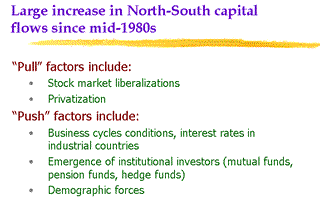
What accounts for this large increase in north-south capital flows since
the mid-1980s? On the one hand, there are what are characterized as "pull"
factors. These are specific factors endemic to the developing countries
themselves, and these include developments in those countries such as
stock market liberalizations and privatization.
In addition, there were a number of "push" factors, which really
are factors that pushed capital from the industrial countries to the developing
world. These include business cycle conditions and interest rates in industrial
countries, as well as the emergence of institutional investors.
In addition, demographic forces are likely to play a fairly important
role in the years to come. One possibility about financial globalization,
or a concern that has been raised, is that in view of recent financial
crises which have meant that the financial flows from industrial to developing
countries have slowed down, that there might, in fact, be a complete hiatus
in these flows or possibly even a much longer-term stoppage.
But there are some demographic forces that are likely to lead to a resumption
of capital flows. In one sense, as the aging population continues to expand in the
industrial countries, there is going to be a pressure for these savings
in order to finance the pensions of these older generations to be put
in some place where the return to capital is higher.
And given that developing countries are typically poor, these pressures
for capital to flow from the industrial countries to the developing countries
are likely to intensify in the future years. So developing countries will
once again very likely face the balance of risks and benefits associated
with financial globalization.
MR. WEI: Now we turn to the question on the effects of financial integration
on economic growth.
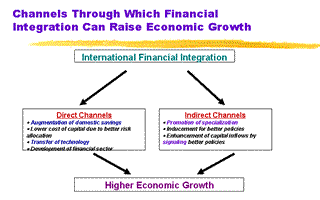
The first thing we want to point out is that in theory there are many,
many channels through which financial integration can increase the growth
rates in developing countries, and these include direct, as well as indirect,
channels. The direct channels encompass augmentation of domestic savings,
reduction in cost of capital due to better risk allocation, transfer of
technologies, development of financial sectors. The indirect channels
encompass promotion of specialization, inducements for better macroeconomic
and other policies, enhancement of capital flows by signaling better policies.
Those channels potentially could increase the economic rates of growth
in developing countries.
However, empirically, or in terms of actual experience of developing
countries, it turns out to be hard to identify a strong and robust causal
relationship between more financial integration and higher growth rates
for these countries.
In fact, if you look at the fastest- and slowest-growing economies in
the last two decades, you will find that certain economies that have managed
to achieve very high growth rates, without having really opened capital
accounts in all dimensions. In this sense, financial integration is not
a necessary condition for a high growth rate.
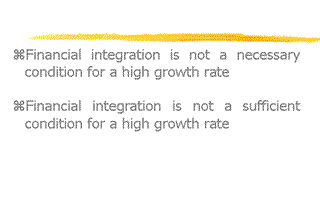
If one looks at the country experience, one will also find countries
that are relatively financially integrated but still fail to achieve relatively
high growth rates. In that sense, financial integration is not a sufficient
condition for a high growth rate either.
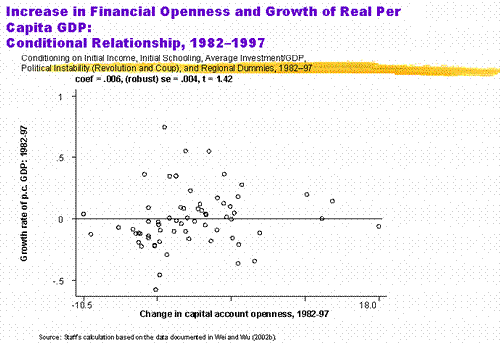
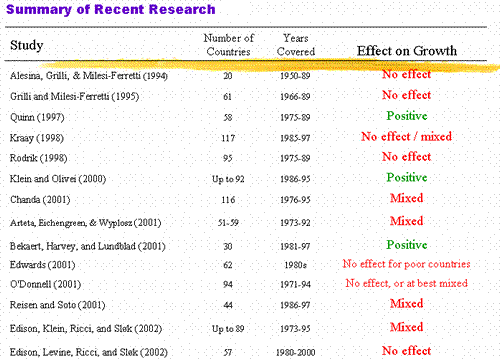
This graph depicts a lack of clear relationship between growth rates
of per capita GDP and changes in capital account openness. In fact, of
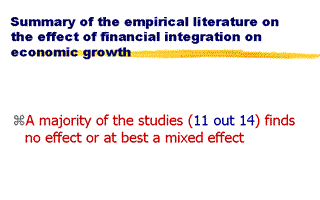
14 recent empirical studies that have looked into this question, only
3 find positive connection between these two variables. Eleven of them,
or a majority of the studies, in fact, fail to find a positive effect
or, at best, find a mixed effect.

So the question is why it is so difficult to find a strong and robust
effect? Recent studies have suggested that most of the difference in income
per capita across countries tends not to stem from differences in capital
labor ratio, but from differences in total factor productivity. Total
factor productivity differences are explained by soft factors or "social
infrastructure," such as control of corruption, rule of law, quality
of financial supervisory and other institutions, and so on.
This suggests the importance of absorptive capacities in explaining effect
of financial integration.
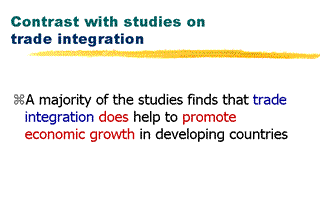
This contrasts with studies on trade integration. On that subject, a
majority of the studies, in fact, find that trade integration does help
to promote economic growth rates in developing countries.
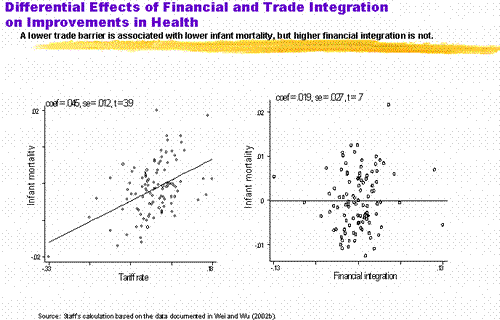
This is confirmed from a number of different angles. These two charts
on the projector sort of contrast the difference between trade and financial
integration.
The left chart shows that generally there is association between lower
tariff rates, in other words, more trade integration, and lower infant
mortalities, in other words, improvement in standard of living in developing
countries. Whereas, the right chart essentially shows no significant correlation
between more or less financial integration and higher or lower infant
mortalities.
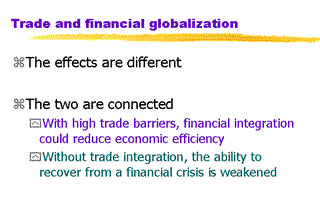
So therefore we conclude that trade and financial globalization potentially
have differing effects. However, the two are also connected.
First, with higher barriers to trade, developing countries may encourage
certain inefficient domestic industries. In that context, more financial
integration could mean more capital flow into less-efficient industries,
hence, exacerbating the misallocation of resources. That is one connection.
As another connection, one of the mechanisms through which developing
countries may recover from a balance of payment crisis is by expansion
of exports and accumulation of foreign exchange earnings. In that context,
without proper trade integration, a developing country's ability to recover
from a financial crisis through that channel is weakened.
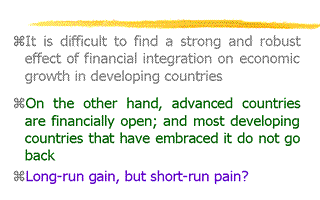
To summarize what I just said, empirically, it is difficult to find a
strong and robust effect of financial integration on economic growth rate.
On the other hand, we note that advanced countries tend to be financially
open, and most developing countries that have chosen to be financially
integrated seldom go back.
So this suggests the possibility that financial integration may entail
long-run gains, but there is a possibility of short-run pains. One of
the short-run pains is a potential increase in macro volatility.
MR. PRASAD: So this pain, in terms of volatility, is something that is
obviously of concern to developing countries.
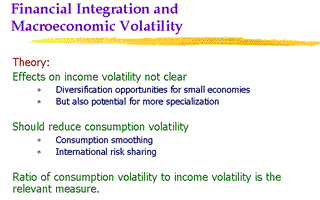
Now, what does theory say? The implications of theory for the effects
of financial integration on income volatility are not entirely clear.
On the one hand, financial integration provides diversification opportunities
for small economies. On the other hand, it does provide a potential for
more specialization which could, in fact, increase income volatility.
On the other hand, there is a clear prediction that financial integration
should reduce consumption volatility. And at a basic level, consumption
is really what people care more about than income.
Now, consumption, should be smoothed, better, through international financial
markets. Essentially, the idea here is that even if countries have country-specific
income risk, they can, in a sense, pool their risks using international
financial markets and financial instruments that are part of that process.
So the question is whether this prediction of theory is borne out in
the data. In principle, it's really not just income volatility, which
is what people typically look at, but the ratio of consumption volatility
to income volatility that matters. In other words, how smooth consumption
is, relative to income,matters in terms of welfare comparisons.
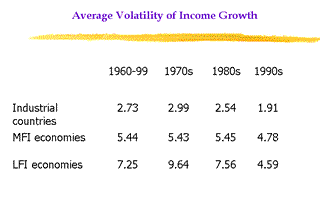
Now, if one looks at some simple averages, in terms of volatility of
income growth, it turns out that over the last four decades, as one might
expect, industrial countries have typically had lower volatility, as measured
by the standard deviation of income growth. More financially integrated
economies, which tend to be a little more advanced among the developing
country group, have slightly higher volatility, while the LFI economies,
the less financially integrated economies, had the highest volatility
of them all.
Now, the interesting thing is what happens going from the '80s to the
'90s. And, again, the '90s one can think of as the period when these developing
economies really participated in financial globalization. Across the board
for all three groups of countries, you will see that volatility declines.
For MFI economies, it declines a little bit. Whereas, for the LFI economies,
it declines quite substantially.
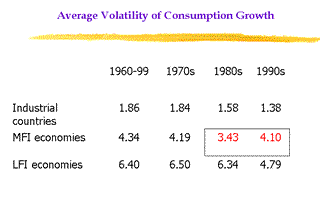
On the other hand, when one looks at consumption growth, there is a striking
result, which is that consumption volatility has, in fact, declined in
the '90s, relative to the '80s, for industrial economies and for the LFI
economies.
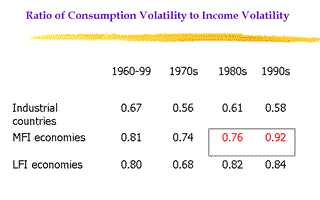
For the MFI economies, on the other hand, which are precisely the countries
that undertook financial integration and should have hoped to get lower
consumption volatility, their consumption volatility, in fact, rose. And
not only did it rise in an absolute sense, when you look at the ratio
of consumption to income volatility, that increased as well for these
economies.
So, in this particular respect, it looks like the prediction of theory
doesn't seem to have been borne out. Why is this so?
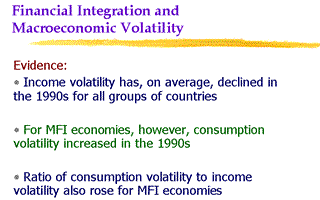
To summarize, the evidence suggests that income volatility has declined
for all groups of countries, while, for MFI economies alone, consumption
volatility has increased both in absolute and relative terms.
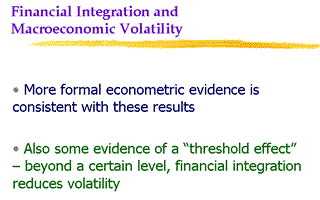
So what is going on? It turns out that more formal econometric evidence
is consistent with these results, but there is also some evidence of a
threshold effect. Only beyond a certain level of financial integration
do countries see its benefits in terms of lower consumption volatility.
In other words, countries that seem to have attained the level of financial
integration that industrial countries have, do seem to have seen the benefits
in terms of lower consumption volatility. But it seems like the more financially
integrated economies are stuck in the middle, where they are seeing the
worst of both possible worlds.
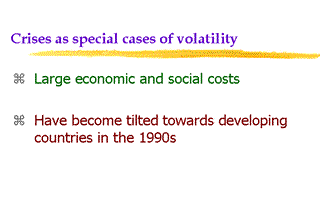
Now, of course, when one thinks about volatility, one typically thinks
of crises. In our terminology, volatility is a more general phenomenon,
and financial crises, which are typically more severe manifestations of
volatility are, in a sense, just a special case. But of course it's an
important special case because crises, more than general episodes of volatility,
have large economic and social costs.
But an interesting thing is that although both industrial and developing
economies did face financial crises of various sorts in the '70s and '80s,
in the 1990s, it looks like developing countries have, to a greater extent,
started exerting a monopoly on these sorts of crises. What can account
for this?
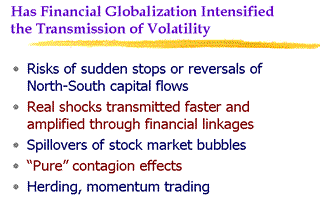
One possibility is that financial globalization by itself has intensified
the transmission of volatility, and there are various channels through
which this can take place. For instance, north-south capital flows can
be easily reversed, as we've seen in many cases, and shocks can be transmitted
much faster when there are financial linkages, as well as trade linkages
to transmit these shocks.
In addition, spillovers of stock market bubbles, as well as the contagion
effects that we've heard about that are boosted by the sort of seemingly
irrational behavior of herding and momentum trading in international financial
markets all make developing countries more subject to the spillovers of
these shocks. But there are a number of other risks as well.
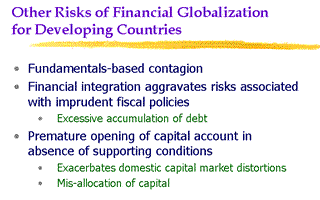
One is fundamentals-based contagion. When countries do not have the macroeconomic
fundamentals in place, it used to be the case that these countries could
still plod along for a while. In a more financially integrated world,
however, a problem in one developing economy can easily force investors
to look more closely at the fundamentals of another economy and thereby
breed contagion. So, in other words, if countries are close to the brink,
the process of financial globalization can very often push them over the
brink.
In addition, financial integration aggravates certain kinds of risks.
If a country is implementing imprudent fiscal policies, it used to be
the case that a country was constrained by how much capital it could raise
within the country. Now, of course, with the opening of the international
financial markets, there is a possibility that countries can accumulate
excessive amounts of debts by borrowing from abroad.
And then a phenomenon that we've seen in many countries, premature opening
up of the capital account, although it seems to bring benefits in the
short run, can have fairly severe consequences in the absence of supporting
conditions, which include domestic capital market distortions. So, essentially,
if capital flows in and the domestic financial sector is not well-equipped
or well-supervised to allocate this capital properly, you can have the
problem of misallocation of capital.
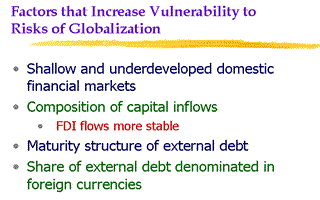
Thus, there are a number of factors, including shallow and undeveloped
domestic markets that heighten the risks of globalization. The composition
of capital inflows, in addition, does seem to matter. FDI flows, in general,
are more stable and are not reversed as easily.
In addition, the maturity structure of external debt and the share of
external debt denominated in foreign currencies all seem to matter in
terms of increasing the vulnerability of a developing country to financial
crises, but it should be pointed out that many of these factors are, in
a sense, under the control of the countries themselves, even though international
financial markets do, at some level, dictate the sort of borrowing that
a country can do, whether it's FDI or bank borrowing.
And even though factors like the maturity structure of external debt
are, to some extent, determined by domestic factors, it turns out that
developing countries, through the policies that they undertake, can, in
fact, play a very important role in how these factors do play out.
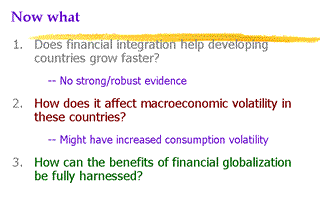
MR. WEI: So far we have discussed the fact that empirically there is
no strong and robust evidence that the financial integration has raised
growth rates and the fact that, if anything, financial integration might
have increased consumption volatility.
Now, we come to a third and last question: how can the benefits of financial
integration be fully harnessed? We, earlier, mentioned the notion of absorptive
capacity, which refers to a combination of human capital, financial market
adequacy, macroeconomic policies and quality of governance.
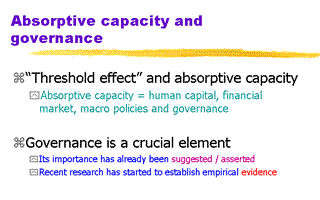
Here, we would like to emphasize, in particular, that the quality of
domestic institutions and governance is a crucial element of that capacity.
This notion has been suggested and asserted in various areas. Recent research
has provided empirical evidence on this issue.
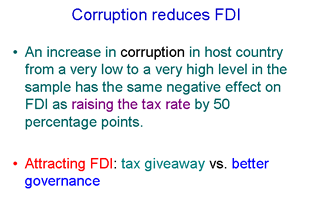
For example, one recent study suggests that there is a connection between
corruption and inward foreign direct investment. Countries with a higher
level of corruption, tend to have less foreign direct investments. An
increase in corruption from a relatively low level to a relatively high
level has the same negative effect as raising marginal corporate tax rates
by 50 percentage points, which is not trivial.
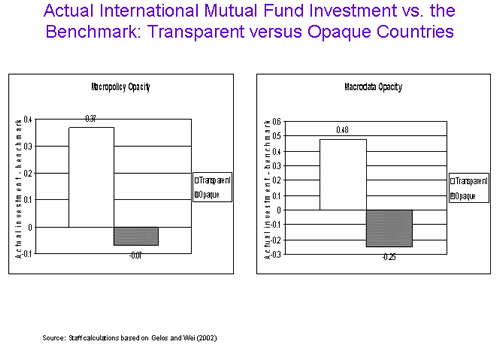
And other research has demonstrated a relatively clear association between
a country's level of transparency, in terms of macro policies and in terms
of corporate governance, and inward portfolio investment. On average,
international mutual funds tend to systematically invest less in more
opaque or less-transparent countries.
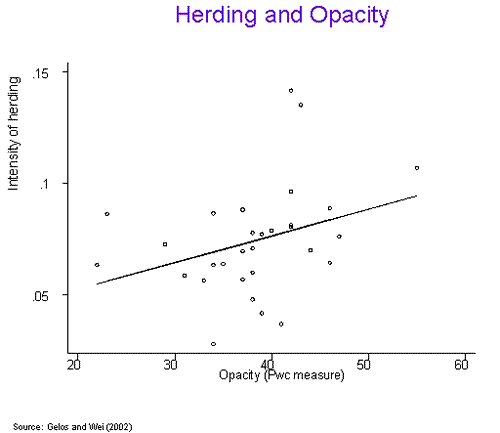
Finally, investors are said to engage in herding, or the tendency to
mimic each other's behavior, a pattern that has been alleged to have contributed
to volatility in developing countries. That phenomenon, in recent research,
has been shown to be associated with a country's lack of transparency
as well. For example, this chart shows a close association between less
transparency and more herding.
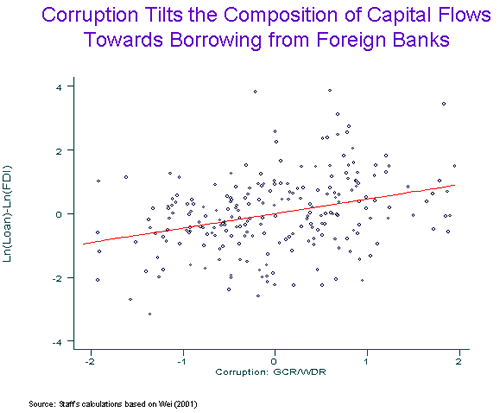
In addition, recent research also shows that quality of governance may
affect the composition of capital inflows, in a way, for example, discouraging
FDI and, in relative terms, encouraging borrowing from international banks.
Hence, less transparency makes any given amount of capital inflows more
subject to sudden stops, sudden reversals, and therefore increases the
vulnerability of the developing countries.
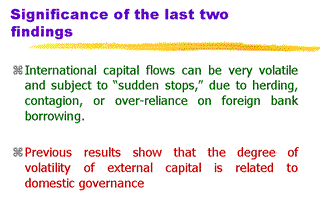
Just to recap, it has been said that international capital flows can
be very volatile, subject to sudden stops due to herding, contagion, over
reliance on foreign banks, but the previous studies show that this degree
of volatility of external capital, at least in part, is related to quality
of a country's domestic governance.
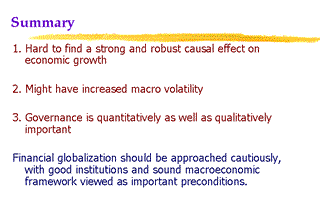
Overall, this Research Department study finds that it is empirically
hard to find a strong and robust causal relationship between more financial
integration and higher growth rates. Financial integration might have
increased the macro volatilities. Finally, domestic governance is quantitatively,
as well as qualitatively important in a developing country's experience
with financial globalization.
Thanks.
MR. ROGOFF: Thank you very much, Eswar and Shang-Jin.
Now, we'll turn to our three panelists, and you can either speak from
here or the podium, as you choose. First, is Fred Bergsten, Director of
the Institute for International Economics.
MR. BERGSTEN: Let me start by congratulating the authors for a wealth
of material, some fascinating analysis on a very important set of questions
on which, as Ken said at the outset, there is still a great deal of active
debate.
But having said that, I must admit to having found the paper to have
been curiously unsatisfying, and the reason was encapsulated by Ken when
he started this morning's discussion by saying the result of the paper,
the bottom line, is the cup is half full, the cup is half empty; not a
very clear outcome on this central question.
The main puzzle of the paper, as in fact Shang-Jin reiterated I think
three times in his presentation, why is it so difficult to find a strong
and robust relationship between what happens in the financial sector on
the one hand and in terms of the eventual desired outcome of development
and growth on the other?
As I puzzled about that myself and tried to ferret out why it might be
that it was so hard to find the relationship that most of us would at
least hypothesize exists, I concluded that the authors may have misspecified
the issue.
I would suggest an alternative specification of the financial sector
issue in analyzing the impact on growth and development and suggest that
it might provide a more fruitful avenue for searching for the relationship.
When the authors specified their financial sector variable in the paper,
they make a distinction between de jure integration, official capital
controls and the like, and actual capital flows, which they label financial
globalization. But then they, in fact, throw the two terms together, use
them interchangeably anyway and do not make what I would regard as the
much more important distinction.
I would hypothesize that the key difference that should be struck is,
on the one hand, liberalization of financial sectors and, on the other
hand, liberalization of the capital account.
Now, the paper of course references, at various points, the relationship
between those two variables. It talks about the interrelationships between
them, and they are indeed closely related, but I would suggest there is,
in fact, a clear conceptual and empirical distinction between liberalizing
your financial sector and liberalizing your capital account to international
movements of money, and it is that distinction which may be more important
in discerning the implications, particularly of the former liberalization
of the financial sector for growth and development.
Now, when I refer to liberalization of the financial sector, what of
course I have in mind is the opening up of that sector to competitive
forces internally and internationally; opening up the sector to foreign
participation, especially banks, but insurance companies, money managers
and others, without necessarily opening up the economy to movements of
capital flow, including by those same foreign participants in the domestic
financial sector liberalization process.
An important institutional point is that liberalization of the financial
sector, at least to the extent it moves beyond unilateral action by the
country in question, is often pursued through international trade negotiations,
not financial institutions like the Fund or the normal banking operations.
The World Trade Organization, in fact, negotiated a major financial services
agreement back in 1997 which bound a lot of the liberalization of financial
sectors that had already been undertaken and negotiated at least a modest
further expansion of that liberalization.
China's entry into the World Trade Organization in the last few years
is of course a cardinal example where liberalization of the financial
sector was agreed as part of a trade negotiation, while the country in
question maintained very extensive controls on international capital movements
in and out of the economy.
So it is clear, I think, that financial sector liberalization can be
done without capital account liberalization. There is, in fact, a rich
literature on that. We published a major study on it by Wendy Dobson and
Pierre Jacquet at our institute a couple of years ago, and I think that
is the distinction that I would focus on in future efforts in this area.
I would hypothesize, as I say, that financial sector liberalization is
much more important than capital account liberalization in pursuing growth
and development. It is the chief method for activating several of the
direct channels for moving from the financial sector to growth that the
authors in fact laid out very nicely. The most important, of course, the
development of the financial sector itself, by definition, takes place
when you open up that sector per se.
That is the way to increase competition in your financial sector, bringing
in foreign actors, open it up to the domestic range of actors, as is pointed
out in the paper, but you can also achieve some of this through other
channels: technology transfer, pressures to improve the regulatory and
supervisory framework, a lower cost of capital due to better asset allocation,
participation in better corporate governance as the banks improve their
ability to evaluate corporate performance in the economy. All this, again,
to underline the point ad nauseam, can be done without liberalizing the
capital account, and it would seem much more important.
Therefore, I would focus on financial sector liberalization, rather than
capital flows, as pointed out in the charts here, in looking to establish
a clearer linkage between what happens on the financial side and the bottom
lines of growth and economic development.
There are, of course, a number of policy implications, if that hypothesis
is right. The obvious ones of sequencing that we talk about frequently
that financial sector liberalization should, at a minimum, precede liberalization
of the capital account, but maybe countries should confine themselves
to liberalizing the financial sector for quite some time before moving
on to opening up the capital account. That, again, is what China seems
to be doing now, with some good results, certainly at this point in time.
I cannot resist, in closing off this point, in noting that the United
States Government, and particularly the Treasury, has badly confused,
and I think badly muddied, the issue in recent months and years.
There have been recent Free Trade Agreements negotiated between the United
States on the one hand, Chile and Singapore on the other hand, where the
U.S. Government insisted not only on opening up the financial sector,
which I think is quite proper substantively and quite appropriate for
a trade agreement, but also insisting that Chile and Singapore liberalize
their capital accounts, which I regarded as extraneous to the trade deal,
and, in fact, on the argument I'm making now, not necessarily of benefit
to the countries involved.
And in intellectual terms, the point is simply that that further, I think,
muddied the waters between the two concepts, which seem to me to be desirable
to distinguish in our thinking about policy and our future analysis in
this area.
So I would suggest to the Research Department, when it next tackles this
issue, to take a hard look at whether it could, in fact, distinguish clearly
between these two aspects of financial globalization or financial liberalization
and focus on the financial sector, rather than the capital account.
My second main point, which I'll make much more briefly because Ken actually
made it in his opening remarks when he referred to the much wider proclivity
of countries now to use floating exchange rates to offset crisis problems
that emerge.
The paper correctly points to the increased risk of crisis that results
from—and here I deliberately use the term—capital account liberalization,
the opening to international capital flows. That's a clear result from
the paper. We've seen it, of course, in practice in many countries in
the last decade.
It should be noted, however, and Ken was saying that, that there are
very significant compensatory changes that a number of countries have
instituted in their economic policies that would help them avoid or respond
more effectively to crises of the 1990s variety, therefore making it more
justifiable for them to open up and take the risks caused by increased
reliance on international capital flows.
The most important of those compensatory changes, the one that Ken mentioned,
is of course greater flexibility of exchange rates, where there has been
a dramatic shift, over the last decade or so, in the direction of countries
relying on fixed, but adjustable, pegs over to managed, but floating,
rates that give them much greater defense against crises emanating from
this element.
In addition, I would note the very large increase in holdings of foreign
exchange reserves not only by Asian countries, but by many other emerging
market economies. If you look at the change in reserve holdings by the
big emerging markets from the pre-crisis period, say, 1994/'5, up until
today, you will find that most of them have increased their reserves by
factors of two to four, giving them much greater amounts of ammunition
to respond to crises that may emerge from the teeter-totter, the see-saw,
the reverse flow of capital flows that we see all too frequently.
A combination of more flexible rates, much bigger reserves does, I think,
provide most emerging markets with stronger defenses against '90s-type
crises driven by reversals of capital flows. That obviously does not obviate
the risk, it doesn't obviate the cost thereof.
It does give them better defenses against those problems, and therefore
has to be entered into any calculus of the cost-benefit effect of exposing
a country to more crisis risk from increased exposure to international
capital flows, particularly through capital account liberalization.
My final point will simply be a speculation, a "what if" question
that asks what might we be looking at in this area if we were meeting
here 10 years from today instead of today?
Today, we are concerned with capital flows to emerging market economies.
We're asking whether those flows are large enough, what motivates them,
what they do for growth, whether they are stable, what's the composition,
et cetera.
My speculative question is whether, when we meet here in 10 or 20 years
from today, we might be asking about capital flows from emerging markets
to rich industrial countries on the grounds that, as the demographic and
aging transition takes place so profoundly in the industrial world, leading
to bigger budget deficits, perhaps external deficits, that the rich countries,
as a group, may become increasingly dependent on imports of capital from
the rest of the world, particularly, at that time, the still rapidly growing,
high-population, relatively young, high-saving countries that we now think
of as the emerging markets.
The United States, for its own reasons, is already heavily dependent
on those capital inflows, to the tune of half-a-trillion dollars or so
a year, and many of those have come from emerging markets, the flip side
of the capital build-up I just referred to.
But as the rest of the industrial world moves in the direction I mentioned,
toward twin deficits, if you will, a very possible outcome of the demographics
and the aging profile of Japan and Western Europe, it may be that the
next research project that the Fund will have to undertake in that period
will be capital flows from emerging markets to industrial nations and
what effect those have on our growth in the developed world.
Thank you.
MR. ROGOFF: [Off microphone.] Jeffrey Frankel.
MR. FRANKEL: Very good. Thank you.
Well, Ken mentioned that the Research Department study on financial globalization
has been received, in some quarters, as a sort of revolutionary recantation;
that the IMF, the bastion of financial globalization, has now decided
that maybe it's not so great after all. And he also mentioned that it's,
in fact, a little less of a revolutionary shift than it seems.
The Research Department, and others at the IMF, in the past have not
had as doctrinaire a view on the subject as one might think. In that respect,
it's similar to many of the great icons of globalization that people associate
with free trade and that benefits of open capital markets, in fact, have
much more nuanced views.
A few examples: Bob Rubin is on record saying financial markets often
do crazy things. George Soros, it's famous that he's sometimes held up
as the icon of speculation, but in his writings he says that financial
markets operate like wrecking balls knocking over national economies.
You can come up with quotes from Larry Summers, and Jagdish Baghwati,
and Jeff Sachs, all of those people on free trade. I think that just means
there's a temptation to oversimplify the views of pro-globalizers.
Having said that, this study is a bit of a shift. I mean, the IMF has
been pretty strong on the benefits of financial integration, and I think
the study, as understated and qualified as it is when you read the language,
does represent a shift. Of course, there is a clear distinction which
needs to be made between the benefits of free trade and goods and services,
which most of us continue to believe are clearly there, both in theory
and in practice, versus the situation for financial markets, which really
is a more complicated issue.
Perhaps an even greater historic shift was, and maybe this is a recantation,
was The Economist magazine earlier in May had a special section, "A
Cruel Sea of Capital." So that, for them, is quite a shift. Maybe
May 2003 will go down in history as the time when views had really shifted
away from the benefits of free financial markets.
Then, there is a temptation to think, well, maybe the apotheosis of financial
globalization is a straw man. Maybe nobody really believes, is so naive
as to believe that all of these great benefits that we read about in our
textbooks are really there, but that's not quite right. It's not quite
a straw man.
I mean, the models that we academics use, most of them, still have built
in these advantages of being able to finance investment more cheaply by
borrowing abroad than if you had to do it out of domestic savings, and
smoothing shocks, diversifying and smoothing fluctuations and all of the
rest of it.
As Fred Bergsten mentioned, the U.S. Treasury still, in a sense, bases
its policy on this view in insisting that Singapore and Chile or at least
it's sharply limiting their ability to have controls on capital inflows
as part of these FTA agreements. So it's not completely a straw man.
Let me recap, once again, the two big findings that make us worry that
financial markets, in practice, don't have all of the benefits that they
do in the textbooks.
The first one has to do with variability. In theory, capital flows are
supposed to be countercyclical. A lot of the point is that if you have
a temporary downturn in your economy, you're supposed to be able to borrow
from abroad to smooth things over. But, in fact, capital flows are procyclical.
They tend to come into a country that's booming, and they tend to go out
to a country that is in recession. That much is true even of industrial—
[Tape change: Side A to Side B.]
MR. FRANKEL: —growing rapidly. That's when our trade deficit gets worse,
and we borrow from abroad and when we go into recession, trade deficit
falls, and that's true of most industrialized countries.
But this study properly focuses on the variability not of the whole economy
of output, GDP, but rather on the variability of consumption because that
is what the theory most specifically says capital flows are supposed to
be able to stabilize, so you don't have to have consumption falling in
proportion to the economy in a downturn.
And the key finding is that, for developing countries, in particular,
those that have liberalized the most with respect to financial markets,
have not experienced a reduction in that variability of consumption. To
the contrary, they've experienced an increase in the variability of consumption,
and that's pretty worrisome.
I don't find that surprising if you just look at the record of the crises
in emerging markets that we've seen over the last 10 years, going back
to Mexico, in December '94, and all of the ones in East Asia and the rest
of the world since then. Those were sharp recessions in each case, and
it's not surprising that it shows up as a high variability of consumption.
What I find most disturbing in this study, in this survey of the state
of the art, which is what it is, is the second question, whether countries
that are financially open tend to grow more rapidly, on average. That
one I really would have liked to see, that, sure, you have these setbacks
from time-to-time, and sure it's painful, but that's part of the growing-up
process, and that on average, if you financially liberalize, you will,
in the long run, grow more rapidly.
After all, the United States, in the 19th century, when we industrialized
and had our most rapid growth rate, we had recession crashes that were
sharper than the ones we have today, but then we pretty quickly picked
ourselves up and moved beyond them, and so one would hope that the same
would be true of industrialized countries or there is an analogy, I mean,
there's lots of analogies in this business, but my favorite—you can pick
your cars or planes or trains or favorite mode of transportation, but
I actually like the car one because it can be used to make so many different
points.
So the highway analogy is that financial markets are like superhighways,
that they get you where you want to go more rapidly and, yes, you have
accidents, and maybe because cars go faster these days, the accidents,
when they occur, are bigger than they used to be. But still, on net, we
come out ahead. But do we come out ahead? If the variability is no lower,
and the growth rate is no more rapid, that is really quite disturbing.
What are the implications for the bottom line of policy? Well, I mean,
given such a strong conclusion, you'd think there would be very strong
implications. They're not quite as strong as you would think. A lot of
the things that you would need to do, even if financial markets worked
well, like macroeconomic discipline and structural reforms, a lot of them
you still need to do.
But I have a list of four categories of, well, answers to the question,
given that some degree of financial globalization is inevitable, how can
we try to make it work as well as possible, to minimize the frequency
and severity of crises or these sudden stops?
The first is that we should be open to some tinkering on the margins;
so, for example, Chile-style controls on capital. It's very important
to note that this is different. There is a tendency, both for the proponents
and the opponents of capital controls, to lump them all together. There's
the Chile-style controls on inflows, and the Malaysia controls on outflows,
and the Tobin Tax, and you just throw it all in together.
Well, no, they are quite different, in terms of whether we're talking
about inflows or outflows, short term/long term, is it a tax penalty or
is it quantitative, and it makes a real difference.
To my mind, the Chile-style controls on inflows do have a possible role
to play during a particular phase in the cycle, when capital is coming
in very, very rapidly, and you want to penalize short-term capital. And
high reserve requirements on banks' foreign dollar liabilities would be
another example of tinkering.
The second category of implications is I agree with what Fred said, that
it's an important distinction between liberalizing the financial sector,
in other words, letting in foreign banks and other financial institutions
to offer some competition in your domestic financial system versus liberalizing
the flow of capital, and you can do one without the other, and I think
that's completely right.
One has to ask why does the U.S. Treasury always seem to take this position
of trying to get Chile to, for example, to agree not to put on controls.
I think there a little bit of political economy is relevant. I actually,
on this, do agree with the critics that the Treasury is, to some extent,
responding to pressure from Wall Street and from banks who want to be
able to play in these markets and want to be able to bring capital in
and out freely, and I think the right answer is to give them the first
because it is beneficial and not necessarily give them the second in all
circumstances.
The third implication for how can we make financial markets work to minimize
the frequency and severity of crises is to pay attention to the composition
of capital flows. And this was actually apparent even before the East
Asia Crisis; that for a given current account deficit, given capital inflow,
it makes a lot of difference what form it takes.
If it's short term, if it's intermediated through banks, if it's denominated
in foreign currencies, you're much more likely to get into trouble than
to have a crisis. If it's long term, if it's in domestic currency or if
it's equity or, best of all, if it's FDI, direct investment, then that
reduces the chance of crisis, and the Research Department study talks
about that at some length and documents it.
Fourth, and finally, is what you're doing with the rest of your economy,
particularly institutions, which we now pay more attention to, and we
don't just worry about macroeconomic policies, including even here at
the IMF, there has been a lot of work on governance, both corporate governance
and government governance transparency, low corruption. These things turn
out to be quite important—supervision of banks in the financial systems.
Actually, one that I put pretty high on the list is countercyclical fiscal
policy.
Many developing countries actually have procyclical fiscal policy, particularly
in Latin America. In a boom, they spend a lot of money, and then in a
recession they have no choice but to cut back sharply, and that really
makes things worse.
In industrialized countries, well, I think in the U.S., we're moving
back into a procyclical fiscal policy for the coming decade probably,
but usually it's not that, most industrialized countries it's not that
procyclical, and at least we got it right in the 1990s, and this I think
actually requires institutions because the temptation in a country in
Latin America, at the stage when the money is flowing in, there is just
very strong political temptation to spend the money rather than running
a surplus.
To conclude, the paper has—the Research Department study concludes that
maybe there's a threshold effect; that at low stages of development, financial
liberalization may actually be bad, and then you have to get over a particular
threshold, and then maybe it turns out to be good. And this is reminiscent
of many findings in development of U-shaped relationships. There's a Kuznet's
curve with respect to income and equality, and there's a version of that
for the environment, and in many respects there are some things that seem
to get worse at first and then eventually get better.
Perhaps, the best interpretation of that, and I think the major hypothesis
that is now on the table and needs to be explored, is that a prerequisite
to making capital controls work well is to have the good institutions,
and the rule of law, and the low corruption and all of that, which many
poor countries lack.
So actually let me conclude with the highway analogy again. It's good
to make points about moral hazard and, yes, air bags reduce the probability,
but perhaps people drive faster with air bags, and so there's more accidents,
but, no, that's not a reason to do without air bags. That's analysis to,
if there's an IMF rescue capability, that maybe countries are a little
less careful than lenders, but that's not a reason to do without the air
bags or the ambulance.
The highway analogy can be used in lots of ways, but the one that I like,
in particular, is the idea that if you are planning an exit ramp, and
it's going to bring the benefits of this superhighway to a particular
village in a poor country, that you can have real problems if you just
dump the superhighway traffic into the village that you haven't yet paved
the roads or built sidewalks or taught people to walk out of the street
and to have traffic lights, and you need to have that kind of development
of infrastructure first before you can dump the high-speed traffic into
the town, and the lesson is that sequence matters, and we want to proceed
with both, but make sure that the financial liberalization doesn't get
out ahead of the domestic reforms.
MR. ROGOFF: Thank you very much.
Our last speaker is Dan Tarullo, Professor at Georgetown Law.
MR. TARULLO: Thank you, Ken.
I assume my presence on this panel is meant to lend a bit of an interdisciplinary
perspective, and I'm going to try to do that by beginning with what I
see the paper as having done; that is, the paper begins with the theoretical
advantages of integrated capital markets well-known in the textbooks,
notes that in a broad range of studies, there's a lack of robust empirical
support for the theoretical advantages of globally integrated capital
markets, and asks the question why—what is it that has led to the situation
in which the benefits are not realized in practice, as they're supposed
to be in theory?
Now, there are three sets of options that a researcher or a policy analyst
can take when faced with this situation:
One is just to assert the theory anyway. That's done in some quarters
of this town, but that's not the role that the researchers here chose
to take;
Two is to change the theory; to say, well, we've hit a moment of a Kuhnian
revolution, and it turns out the textbooks were wrong. That's also not
the road down which the researchers want to head because I think their
intuitions lead them to believe that some measure of financial market
integration is a good thing; or,
Third, trying to determine what real-world phenomena impede the realization
of the theory. And here is where an economic methodology comes in very
handy because one tries to correlate and, if possible, draw some causal
inferences about the relationships between certain things going on in
economies or not going on in economies and the benefits of globalization.
The perspective, that, to me, has always been a very—the social science
methodology is always, in my judgment, as a nonsocial scientist, an important
check upon the tendency of people to draw unfounded inferences from particular
situations, from anecdotes and the like.
I want to try to complement that perspective, though, in thinking about
how you would move forward, the practical ways one would move forward,
which is presumably what a lot of emerging markets are asking themselves.
Now, I'm going to do that in the context of the absorptive capacity discussion,
which occurs towards the end of the paper, and which can be found, although
usually quite briefly, in a number of the papers cited in the current
IMF paper.
Now, the absorptive capacity discussion comes up in the context of researchers
saying, okay, so what is it that seems to be a prerequisite for enjoying
the benefits of financial integration and/or globalization? And, once
again, let's try to isolate some of the key variables, and let's try to
do so with rigor, so that we don't draw these unfounded inferences.
Well, as a number of the papers that are cited in the IMF paper we're
discussing today have noted, there are different explanations that are
given. I noted in some of these papers cited that, although they're not
inconsistent exactly with one another, they certainly have different emphases
as to which factors are most highly correlated with the benefits of financial
globalization. And so, at the very least, we have a bit of a muddled picture.
Now, the other route one can go was taken by some of the colleagues across
19th Street of the people sitting here. A World Bank study a couple of
years ago concluded that the capacity to absorb capital encompasses not
just macroeconomic policy frameworks, but also political stability, the
health of the financial system, the educational attainment of the workforce,
the quality of physical infrastructure, the efficiency of government services,
and the degree of corruption.
Well, it's not clear to me how much use that is either to an emerging
market Finance Ministry trying to figure out how to derive benefits from
financial integration and/or globalization because what that's essentially
saying is, hey, become an industrialized country, and then you'll have
the benefits from financial globalization.
The complementary way perhaps to look at the policy challenge is to regard
it as an instance of legal transition, transition in legal regimes. Now,
a transition in legal regimes occurs whenever, A, there are significant
changes in the applicable laws or enforcement of those laws—that's self-evident—or,
B, when there are significant changes in private actor capabilities or
propensities such as to change, in significant ways, the outcomes of the
previous law's application.
So it can be either, in the case of de jure changes, you change the law,
or de facto changes, the behavior of people out there shifts significantly
as a result of which the impact on society is different because of the
application of the old set of rules.
Now, the whole idea of transitions in legal regimes is that the desired
end state, say, of making some changes in the law, of deregulating, is
not achieved just by virtue of making those changes. That's the notion
of transition, which is intuitively fairly obvious I think.
But despite its intuitive obviousness, our own, that is, U.S., regulatory
history is littered with examples of poorly handled transitions; the textbook
example of which is the transition from a single regulated long-distance
monopoly up until the early '80s for long-distance telephone services
and the situation thereafter. It did not occur to anyone that there would
be some transitional needs for quasi regulation at a time when a previously
unregulated private monopoly had now had constraints lifted from it.
In financial services, the example that's usually found is the deregulation
of interest rates and some other deregulatory steps in the '70s and early
'80s, which are now thought to have contributed to the S&L debacle
of the 1980s. I don't want to comment too much on the fact that both of
these regulatory mishaps are in the 1980s.
Now, what does one conclude from taking this approach of a transition
of legal regimes, as opposed to just trying to isolate variables to see
what do we need to change or how do we need to sequence in order to move
towards an effective capital liberalization policy, capital account liberalization
policy.
Well, the first, and I think probably most important, point of distinction
is that the problems of regulation in a transition period may well be
different from those either of the regulated, the previous regulated period
or of those which you anticipate when you finally have made the adjustment,
and you've now got a new state of regulatory supervision in place.
Market actors are adaptive. They're not omniscient. They tend to make
mistakes, overshooting, undershooting, just misperceiving, when faced
with a new set of market conditions or a new set of legal possibilities.
This, in many respects, was what we saw with the S&L problems in the
United States. It wasn't just venality, although there was plenty of it;
it was also just the inability of formerly highly regulated S&Ls to
exercise the new legal authority they had in a profit-maximizing fashion
over the medium term.
So this means that during the transition period you will probably need
a different kind of regulation either, of course, than you had in the
previous period or than you anticipate having going forward. That point
is the one I think which is most frequently lost upon reformers is that
they just have their eye on the ball of the next state that they would
like to achieve after deregulation and don't see that there can be some
significant problems calling for different forms of regulation in the
medium term. This, again, is seen again and again in the financial sector,
as a matter of fact.
Now, secondly, note that a number of the more successful stories of capital
account liberalization and, indeed, a financial sector liberalization,
have multiple stages; that is, there are multiple transitions. This series
of multiple transitions usually then will call for a different set of
regulatory or prophylactic approaches, not just again a single set.
If these necessary kinds of intermediate forms of supervision or regulation
or constraint are not developed, then not only might you endure some short-term
pain that might have been unnecessary—maybe some is always necessary
for the long-term gain, but some might have been unnecessary—but also
as we have seen in examples in industrialized countries, as well as emerging
market countries in the past, you may have a retardation of the movement
towards that desired end state because these transition problems are holding
down the adjustments of market actors and holding down the adjustments
of regulators as well.
Third, you do have some risk, though, that an excessive attention to
transition problems may mean that you never start moving fast enough along
that road to the new state you'd like to reach. Some say that that's what's
happening right now in the United States with our last set of major financial
reforms, Gramm-Leach...; that there were so many prophylactic measures
put in place, there were so many, to use Jeff's road analogy, there were
so many barriers that the cars had to swerve in and out of, that you're
actually not achieving as much as you would like to have achieved.
Fourth, well, fourth is suggested by that famous opening line of Anna
Karenina, that happy families are all alike, but each unhappy family is
unhappy in its own way.
Well, a well-functioning, integrated financial market is pretty much
probably similar to other well-functioning, integrated financial markets,
at least in important respects, but every market which is not integrated
with the rest of the world or every financial market which is pretty highly
regulated is probably pretty unique in its characteristics and in the
ways in which money is allocated.
That means that problems and likely market responses will differ substantially
depending on the particular legal and market contexts of the country in
question. This makes prescriptions very hard to develop in the abstract
and guidance very hard to generalize in the abstract.
Again, this is not something that I can document in the case of capital
account liberalization. Although if you read some of those studies that
Central Bank has presented at that Bank for International Settlements
Conference on China not too long ago, I think you see evidence of these
very different pots and very different set of regulatory responses, but
I have seen them again and again in the context of financial regulation
in European countries, the United States and Japan.
So what, if any, general conclusions can I draw notwithstanding my caution
about drawing too many general conclusions about financial market liberalization
and financial market globalization?
Well, one, and Jeff and Fred have already mentioned this, the imposition
of fairly inflexible rules such as those which the Treasury Department
is trying to push upon FTA partners surely seems misguided; that is, that
in the presence of so many different variations and so many different
possibilities for transition problems, to say, in essence, that there
should be no capital controls just seems intellectually misguided.
Second, it may mean that there are multiple ways to address particular
problems, even when the problem resembles that in another country. Developing
hedging implements rather than limiting forex positions is one prosaic
example.
Third, and finally, I think, to some degree, my observations about transition
regimes call into question the application of best practices, even the
best practices developed in the best of faith by the best kinds of regulators
in Basel or people working with them here in Washington.
Basel II, the Basel Accord II, which is in the process of being concluded
and promulgated right now, may not be best practice for anyone, the U.S.
included, but it surely would not be the best practice for emerging market
financial regulators. Internal ratings-based approaches to bank regulation
are just not going to be viable in emerging markets for some time to come.
The absence of rated borrowers in emerging markets means that the adoption
of a standard approach being promulgated under Basel II would also, in
all likelihood, be inappropriate.
So this leaves us not, I'm afraid, with a particular prescription, but
perhaps with a methodology, with a methodology in working with a particular
emerging market of regarding this as a transition of legal regime, asking
what the capacities and, thus, likely shifts in market and supervisory
behavior are and then trying to map out a transition regime which is self-consciously
different from the one that you will get to, you hope, when eventually
more capital market liberalization has been achieved.
Thank you.
MR. ROGOFF: Thank you very much, Dan, and thanks to all three of our
extraordinary panel of speakers.
We have a little bit of time left for questions from the audience. If
you have a question, if you could please identify yourself and state your
affiliation.
QUESTION: My name is Klaus Riechel. I'm from the African Department of
the Fund.
I believe that one aspect can be explored a little bit more, and that
is the effect of globalization on the incentive system for, and the behavior
of, financial institutions or participants in financial markets.
It seems to me that globalization has contributed to a shortening of
the time horizon of operators in financial markets. It has also enlarged
the scope for large-scale operations with just very minimal costs attached
to engaging the operations and thereby exploit the volatility of markets
for making short-term gains.
I think, generally, when we look at countries in Africa, and I remember
also a number of countries in the Pacific, banks are less inclined to
engage in the local development financing aspect than they were ever before.
They can make the money much easier, much faster elsewhere.
I can remember a case in the Philippines, where the Land Bank, which
had been established to support the development of rural communities and
rural production, quickly moved over to making essentially all of its
money in the money market because it was too difficult, time-consuming
and costly to engage in development lending.
So I think, generally, the aspect of how has globalization changed incentive
structures and the behavior of financial operators would be a useful complement
to the research that you have done.
Thank you.
MR. ROGOFF: Thank you.
Are there any further questions?
QUESTION: I'm Rick Rowden with Action Aid USA.
I just would like to know is this change in understanding at all going
to result in changes in IMF loan conditionality?
MR. ROGOFF: Well, I think as I stated at the outset, I mean, I don't
think there's been a change in understanding. I think this is, you know,
the work reflected in our report is certainly something that reflects
thinking over the last 20 years. It's certainly true that the IMF is constantly
rethinking things, and trying to look at evidence, and listen to critics,
et cetera. So one certainly has seen an evolution of thinking.
I'll certainly say, in the '80s, and up to the mid-'90s, there were lots
of papers coming out of the IMF Research Department about the capital
inflows problem, problems with excessive capital flows, problems with
premature opening of capital markets, problems with having fixed exchange
rates. So I mean there's a way, and I think as Jeff said, a way in which
the IMF is painted by polemicists that, you know, it doesn't necessarily
capture how it's been.
QUESTION: I'll sharpen the question a little.
I mean, it is true that at the 1997 annual meetings in Hong Kong that
the IMF put on the table the notion that capital account convertibility
should be an eventual goal. Do you feel that there's been an evolution
away from that priority in the IMF?
MR. ROGOFF: Yes, but I mean I think—I wasn't here in 1997. I guess you
were, Jeff, so maybe you were responsible for that, I don't know. Of course,
it wasn't—
[Laughter.]
MR. ROGOFF: —it wasn't passed, and there has been a lot of thinking,
and if you look at the papers like ours, coming out of the Research Department,
there are papers on sequencing and liberalization. Jacob Frenkel, who
held my position at one time, wrote the first papers on that. Sebastian
Edwards, across the street at the World Bank, emphasized the importance
of that. Carmen Reinhart is now in the Research Department, together with
Guillermo Calvo, wrote papers, prior to the Latin American crisis, the
Mexican crisis and the Asian crisis about the dangers of capital inflows.
So, I mean, I think there's—I can't speak for the politics surrounding
that particular historical event, but if you want to add anything, as
a Clinton administration adviser, you can.
QUESTION: Eliana Cardoso from Georgetown University.
I have a question about the advice to liberalize slowly, and the question
is related to the efficacy of capital controls.
Before the 1980s debt crisis, Latin America had all types of controls
in place and capital flowed in and out anyway. Today, is a kind of a cliche
to say that the answer are capital controls on inflows, as adopted by
Chile in the 1990s. Yet, in '97-'98, Chile was badly hit by the Asian
crisis and decided to give up the controls.
The evidence seems to show the controls were only effective on the very
first years before the market learned to know how to get around them.
Thus, isn't empty advice to emerging countries that have already liberalized
the capital account to go slowly or to use these types of controls?
MR. ROGOFF: Does anyone want to take this?
MR. : I guess my view is that it's too often phrased as a choice between
you should go all the way to free markets right away or it's a gradual
trend. I think one possibility is episodic or cyclical, that certainly
Chile's capital controls didn't protect it from the crisis entirely and
are not the key to its success, and it has been rather successful.
But it is just another tool in the kit to be used when you have, in very
special circumstances, when you've got very large capital inflows, when
there's a danger they're going to be too short term. And I agree with
the earlier question, that part of the problem is short-term composition,
and if you can shift the composition to long-term that that helps.
And at most it's a way of playing for time for a year or two until you
find out are you the next Asian tiger and is this inflow going to finance
useful investment, and then like an umbrella that you fold up when it
stops raining, if you don't need it any more when the—when Chile removed
the controls, it was when the problem was no longer excessive capital
inflows, but the tide had returned.
I see no reason why a country like Chile shouldn't put the umbrella back
up again if it's able to, and needs to, in some future episode of very
large short-term capital inflows.
QUESTION: Thank you very much. I wonder if the—I am [?], IMF and SID
Research Member.
I wonder if the panel could shed some light on financial globalization
operating within the framework of institutional corruption, not in the
sense that an endemic, as we understand it in developing countries, but
as an institution structure regulated, encouraged, through fiscal incentives,
by some industrial countries. What then can we say about the moral and
ethical environment in developing countries, particularly for emerging
entrepreneurs?
Finally, does financial globalization show or has it shown throughout
the years the level of commitment in development, while, when we look
at the level of reinvestment of earnings, as compared to the repatriation
of profits, and the charges, and fees, and royalties, it doesn't seem
that a real commitment, which is a good identification level for globalization
to be looked at.
Thank you.
MR. ROGOFF: I wonder, Shang-Jin, do you want to speak to this?
MR. WEI: I'm not sure I completely understood the question on the corruption
point. If you're asking about the relative complicity of industrialized
countries and their companies—
QUESTION: [Off microphone.] [Inaudible]—maintain Germany as a structured
institution, where the payments are tax deductible.
MR. WEI: Oh, yes, that's not supposed to—in theory, they are now changing
that because of the OECD agreement on tax deductibility.
QUESTION: So there is an impact on the developing countries' moral and
ethical environment, climate of business, particularly for developing
entrepreneurs. And then, again, we see that the financial globalization
is not really showing a great level of identification and commitment in
development, when it insists on repatriation profits, particularly for
countries which have high level of debt servicing and even negative capital
inflows.
MR. : I can comment on the first point, and maybe you can comment on
this—the Fund staff can comment on the second.
With respect to the corruption issue, I don't think there's any question
but that the developed countries have been complicit in institutionalized
corruption. A lot of emerging markets, their failure to enforce their
own laws with respect to overseas corruption, even in the face of the
OECD agreement that says they're supposed to do so, is perhaps evidence
of Jeff's political economy point again; that mercantilist kinds of considerations
trump ethical considerations and even development considerations.
MR. WEI: Indeed, for every corrupt deal, there is a side that receives
the bribe, and there's the side that pays the bribe. So, therefore, it
is tempting to think that developed countries, including Germany until
1999, by not criminalizing bribery to foreign government officials in
developing countries, in particular, might have contributed to this.
The thing we might want to note is that the same company from developed
countries does not necessarily or did not necessarily pay bribes everywhere
in the world. The same company might pay bribes in Indonesia, but not
in Singapore. So corruption is still mainly the product of a developing
country's domestic business environment.
The study that is referred to by the Research Department paper suggests
that developing countries with different levels of corruption have very
different abilities to attract foreign direct investment. There is relatively
clear evidence that higher corruption leads to less foreign direct investment.
There is also relatively clear evidence that higher corruption leads
to less-desirable composition of capital inflows, relatively more volatile
type of capital inflows, such as borrowing from banks; relatively less,
more stable type of capital flows such as FDI.
QUESTION: May I say just one word on the level of commitment of global
[inaudible]?
MR. ROGOFF: Let Eswar speak for a minute, and if you have something to
pick up on that, feel free.
MR. PRASAD: Just a few observations.
First, starting with Eliana Cardoso's question, you had pointed out that
it may not make sense to think about these issues after the horse has
left the barn in the case of many countries. But it's still true that
many of these countries, the more financially integrated economies have
been shut out for a little while from international capital markets and
are now coming back into them, so on what terms they do so is important.
And, in addition, as we noted, only about 25 countries have really participated
in this process so far. So our study is really intended to draw lessons
for a much broader group of countries. And one of the issues that we did
point out, which gets back to Fred Bergsten's point, is really that the
domestic financial sector development is, in our view, a crucial precondition
in order for countries to obtain the benefits and control the risks of
financial globalization, and we think that this is, in fact, a key point.
And in addition to that, we think that institutions are, in fact, something
that need to be emphasized, and this may be go back to that question as
well. It is not entirely accurate to say that the IMF's views about these
things have not changed.
It's true that this paper has picked out some of these important nuances,
that the process of capital account liberalization by itself is not going
to be able to deliver the benefits or protect it from the risks that a
number of conditions have to be in place, and those are very consistent
with the messages that the IMF had always delivered.
But it's true that, in view of recent crises, our emphasis on financial
sector issues, and on institutions, has in fact become much more important
over time. So, in that sense, we have taken our approach forward, but
not really changed our views in any way.
MR. ROGOFF: I'm afraid we're past our time limit, and I want to thank
the audience for coming. If there are any further questions, if you want
to send e-mail queries, we welcome them.
Thank you very much for coming and thanks to the panelists.
[Applause.]
[Whereupon, the economic forum was adjourned.]
|