

Finance & Development, March 2020, Vol. 57, No. 1 PDF version
 Abebe Aemro Selassie on Africa's Infrastructure Gap and Debt
Where the Sun Shines
Renewable energy sources, especially solar, are ideal for meeting Africa’s electrical power needs

About half of sub-Saharan Africa’s population today does not have access to electricity. Those who do have electricity pay on average nearly twice as much as consumers elsewhere in the world. Power shortages cost the continent about 2 to 4 percent of GDP a year.
And the large electricity needs will only grow in the foreseeable future. Given that the population in sub-Saharan Africa is expected to grow from 1 billion in 2018 to more than 2 billion in 2050, the demand for electricity is projected to expand 3 percent a year. This takes into account a steady increase in access to electricity as well as greater energy efficiency.
Meeting that demand with current energy sources would have severe consequences for health and the environment. The current energy mix in Africa is based mostly on burning coal, oil, and traditional biomass (wood, charcoal, dry dung fuel). This reflects the energy resources of the continent, but also the use of technologies of the past. While this energy mix is comparatively cheap, it is insufficient to meet current needs, and negative effects on the environment are left unaddressed. The continent’s sources of energy will need to change, especially if African governments aim to achieve a healthy environment for their citizens and meet the emission limits for greenhouse gases set out by the 2015 Paris Agreement.
Getting the energy mix right
Fortunately, thanks to notable technological advances, Africa does not have to rely on large amounts of fossil fuel, as advanced economies did when they were at Africa’s current stage of development. There is the option to design an energy mix, built largely on renewable sources, that supports both strong growth and low emissions. Apart from ensuring an ecologically sustainable approach to development, investing in renewable energy will also generate new job opportunities (IMF 2019).
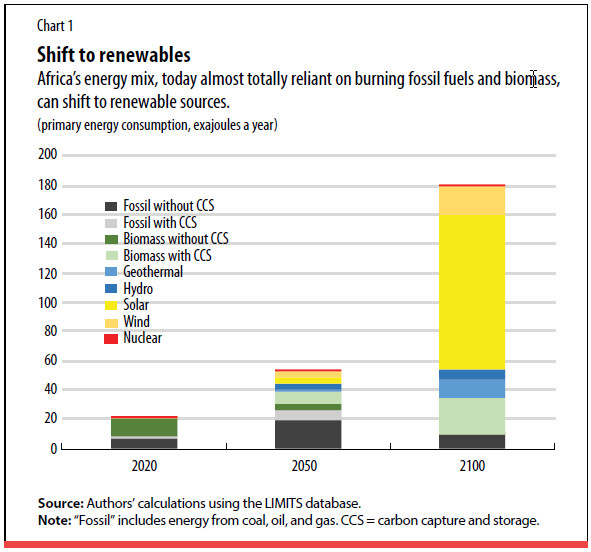
The right energy mix will allow Africa to develop rapidly while respecting the emission levels required under the 2015 Paris Agreement, in which governments commit to limiting global warming to 2°C above preindustrial levels. Chart 1 shows one such projection, in which the energy mix relies on a variety of technologies.
The chart, based on projections made in 2013, suggests using modern biomass, cultivating high-energy plants, and using crop residue to produce synthetic fuels, as well as carbon capture and storage (CCS), which involves storing carbon dioxide emissions underground. Other researchers have proposed different mixes, all making use of these technologies (Schwerhoff and Sy 2019). However, these technologies carry risks. Biomass production competes with food cultivation and nature conservation. CCS has not yet been tested at an industrial scale. Both technologies can face resistance from local populations. To avoid large-scale reliance on unsustainable technology, Africa will need to move toward an economically and environmentally sound energy mix. This will require addressing the financial challenges of installing renewable energy capacity while seizing opportunities provided by falling prices and technological progress.
Falling cost
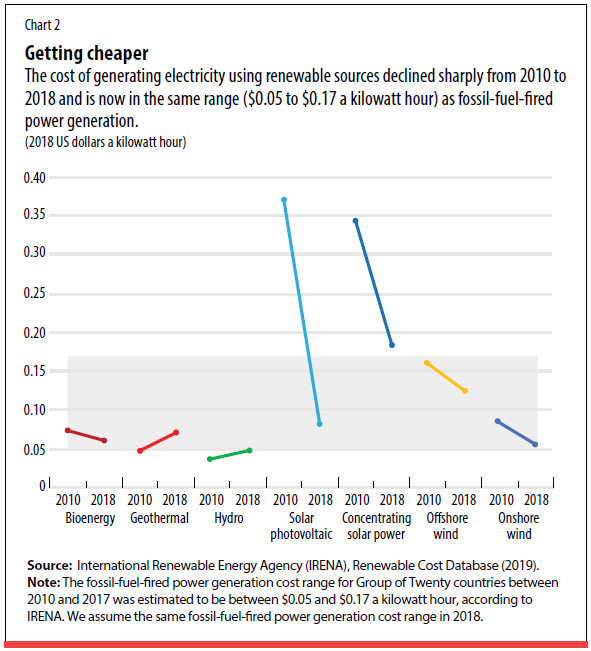
Prices for renewable energy have fallen substantially in the past few years, especially for solar power, whose cost decreased 77 percent between 2010 and 2018 according to the International Renewable Energy Agency (see Chart 2). While biomass, geothermal energy, and hydropower cost the least, these sources have limited potential.
As illustrated in Chart 1, both geothermal energy and hydropower can reach a value that is several times larger than today’s generation capacity. The energy need, however, far exceeds this capacity. Geothermal energy can be very efficient (as we have seen in Kenya) but is available only in certain locations. Hydropower requires a careful balancing of environmental, social, and economic objectives. It is impossible to exploit the entire technical potential of hydropower: it requires the inundation of large areas, which threatens local ecosystems and often involves relocation of the local population. Hydropower is currently being hampered by continuous drought in southern Africa, and related energy generation has been severely curtailed in Zambia and Zimbabwe because dam levels are dangerously low. Conversely, there are large hydropower projects coming onstream or in preparation in west Africa, the Democratic Republic of the Congo, and Ethiopia.
More promising for large-scale expansion of renewable electricity generation are solar and wind power, whose prices are now in the same range as those of fossil fuels. In addition, conditions for solar energy are excellent in Africa, where sunshine is not only abundant but also much more reliable than elsewhere. And investment into renewables is in fact picking up in Africa. South Africa, Uganda, and Zambia have held renewable-energy auctions that achieved competitive prices and attracted private investors. South Africa already has several solar power plants with a capacity of more than 100 megawatts. The Lake Turkana Wind Power project in Kenya is another success story.
Despite successful examples in many countries, solar and wind accounted for only 3 percent of the electricity generated in Africa in 2018 compared with 7 percent in other regions of the world. The supply of electricity in Africa is strongly dominated by fossil fuels and to a lesser extent by hydropower (79 percent and 16 percent, respectively).
The problem with renewable energy has always been that its supply fluctuates, posing a challenge for reliance on renewables as a source of electric power. Technological advances in stabilizing the electricity supply now make it possible for renewable energy to constitute a large share of the energy supply. These advances include using hydropower as a buffer during periods of peak demand, pooling electricity production from different geographic regions through a well-connected electricity grid, adjusting electricity demand to supply, and storing energy with flow batteries and hydrogen electrolysis. Currently, the share of variable renewable energy in total energy production is so low that variability is not yet a major concern. As this share increases, these options can be rolled out at a reasonable pace. With these technological advances, updates of Chart 1 show that it is possible for Africa to rely 100 percent on renewable energy by 2050 without slowing development.
Overcoming financial challenges
Financing is now the biggest challenge, however. Fossil fuel plants are comparatively cheap to build but expensive to run, as they require continued purchases of fuel. In contrast, renewable sources are inexpensive to operate but have high installation costs, which must be financed up front. Providing a high-quality energy basis for African development thus requires a comprehensive approach to financing (Schwerhoff and Sy 2017). If Africa is to take a new, low-carbon approach to development, its countries must mobilize public, private, and multilateral and bilateral donor financing to raise the funds needed for renewable-energy projects.
On the public side, African governments can generate significant revenue by reducing the inefficiency caused by fossil fuel subsidies, which benefit mainly coal and oil. These subsidies are estimated at 5.6 percent of sub-Saharan African GDP (Coady and others 2019). Progressively phasing out subsidies—while protecting the vulnerable—could raise financing for renewable-energy projects. Moreover, African governments can potentially mobilize more of their domestic resources to cover the initial capital costs of renewable energy. For example, with an average tax-to-GDP ratio of about 14 percent in 2017, sub-Saharan African countries have ample room to increase their tax revenues. Use of carbon taxation could boost tax revenue while reducing fossil fuel carbon dioxide emissions (IMF 2019).
On the private sector side, African countries must make substantial efforts to attract private investment to the renewable sector. Surveys have identified governance-related risks—complex bureaucracy and changing regulation—as the greatest threat to private investment in renewable-energy projects in Africa. Attracting private financing will require improvements in governance to reduce political risk. Reforming the financial sector to boost the incipient green bond market and reducing financial risk by transferring part of it to public actors can also help attract private investment.
At the international level, multilateral financial institutions play an important role in facilitating long-term financing to support investment in climate change mitigation. In addition to identifying alternative sources of funding, these institutions provide tailored advice on the effective deployment of climate financing.
The 2015 Paris Agreement is based on advanced economies’ commitment to mobilizing the equivalent of 0.12 percent of the world’s GDP a year through 2025 to address the needs of developing economies. Honoring this financial commitment would smooth the way for the transition to a low-carbon-energy economy across Africa—thecontinent with the lowest contribution to global warming. Only about 4 percent of global-energy-related carbon dioxide emissions in 2018 originated there (IEA 2019), yet Africa is the region most affected by climate change. This twist of fate certainly justifies more international support for the continent.
GREGOR SCHWERHOFF is an economist in the World Bank’s Macroeconomics, Trade and Investment Department. MOUHAMADOU SY is an economist in the IMF’s Fiscal Affairs Department.
References:
Coady, D., I. Parry, Nghia-N.-P., and B. Shang. 2019. “https://www.imf.org/en/Publications/WP/Issues/2019/05/02/Global-Fossil-Fuel-Subsidies-Remain-Large-An-Update-Based-on-Country-Level-Estimates-46509Global Fossil Fuel Subsidies Remain Large: An Update Based on Country-Level Estimates.” IMF Working Paper 19/89, International Monetary Fund, Washington, DC.
International Energy Agency (IEA). 2019. Africa Energy Outlook 2019. Paris.
International Monetary Fund (IMF). 2019. Fiscal Monitor: How to Mitigate Climate Change. Washington, DC, October.
International Renewable Energy Agency (IRENA). 2019. Renewable Power Generation Costs in 2018. Abu Dhabi.
Schwerhoff, G. and M. Sy. 2017. “Financing Renewable Energy in Africa—Key Challenge of the Sustainable Development Goals.” Renewable and Sustainable Energy Reviews 75 (August): 393–401.
———. 2019. “Developing Africa’s Energy Mix.” Climate Policy 19 (1): 108–24.
PHOTO CREDIT: ISTOCK KENCANNING; PATTHAMA MOOMUANG
Opinions expressed in articles and other materials are those of the authors; they do not necessarily reflect IMF policy.