



Policies aimed at slowing warming could be better designed to reduce inequality
In recent decades, global economic growth has lifted millions out of extreme poverty and reduced inequalities between countries. But unmanaged climate change threatens to set back that progress by damaging poverty eradication efforts worldwide, and disproportionately affecting the poorest regions and people.
The evidence is mounting: a World Bank report estimated that an additional 68 to 135 million people could be pushed into poverty by 2030 because of climate change. Our own research shows that if the most dire projections of future economic damages in the current scientific literature hold true, climate change would reverse the gains of the past few decades and cause inequality between countries to rise again. Within countries, the impacts of climate change also risk worsening inequality.
At the same time, actions taken to curb warming could have an unwelcome effect on inequality, if climate policies prove too burdensome for poor countries. Such actions need to be complemented by measures to offset the costs on the poor and vulnerable across and within countries.
We view mitigating climate change as a necessary condition for sustainably improving living standards around the world. At the same time, we maintain that distributive and procedural justice must be at the forefront of every stage of environmental policymaking. In planning, development, and implementation, the effort to reduce emissions must be at the service of broader objectives of
development, such as poverty and inequality reduction, the creation of decent jobs, improvement of air quality, and improvement of public health.
Risk to health and livelihoods
Since the Industrial Revolution, emissions of greenhouse gases due to human activities have increased from a negligible level to more than 40 billion tons a year. As these emissions have accumulated in our atmosphere, they have increased the average annual temperature by about 1 degree Celsius compared with the pre-industrial era. Temperature increases have led to glaciers and ice caps melting, sea levels rising, and more frequent and extreme meteorological events, such as heat waves and droughts, with cascading effects on ecosystems, agricultural yields, human health, and livelihoods.
While the effects of climate change are global, and their projected impacts concern every area in the world, a wide scientific literature suggests that climate risks disproportionately affect the poorest countries and people, who are more exposed and more vulnerable to their impacts.
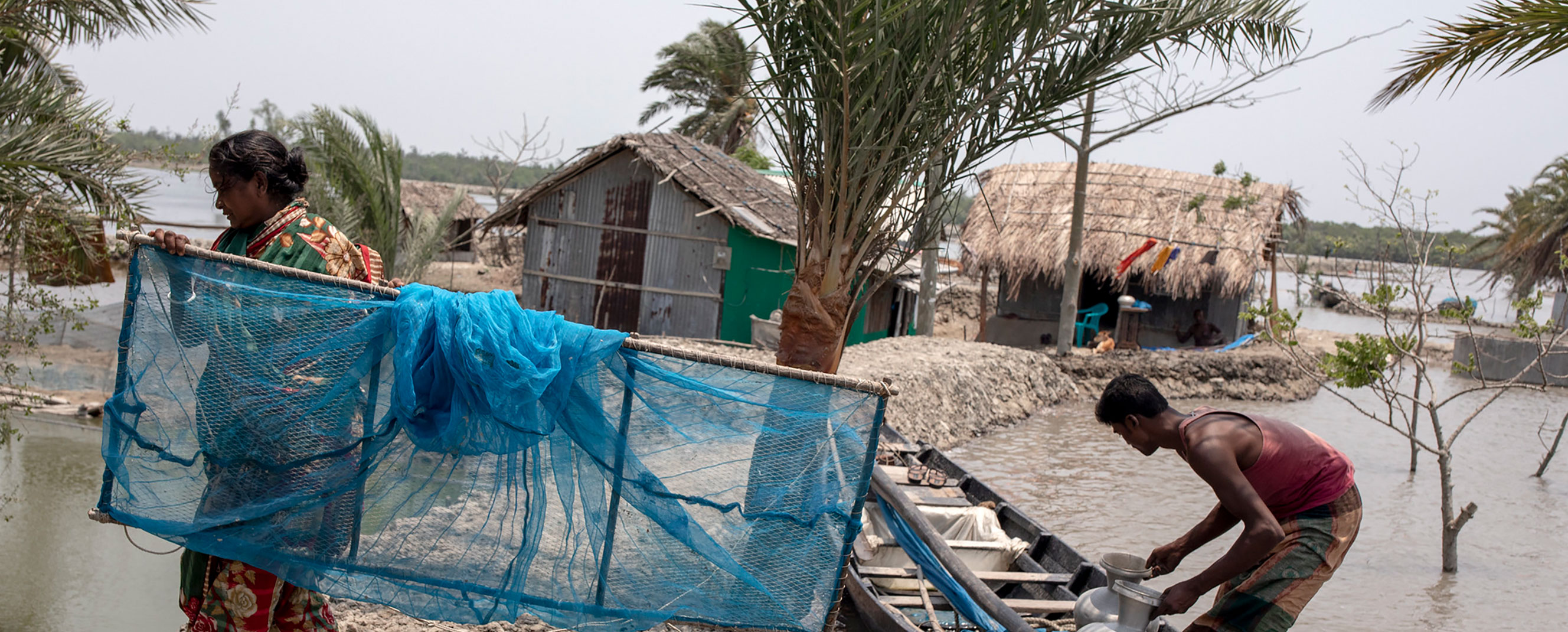
In the poorest economies, a large part of the population depends directly on activities that may be the most affected by climate change, notably, the agricultural, forestry, and fisheries sectors. People with the lowest incomes are the most likely to depend for their survival on resources provided by nature. Rising temperatures are exacerbating preexisting disparities in access to clean water and affordable food. Most of the time, the poorest populations do not benefit from insurance mechanisms or have access to basic health services, making them particularly vulnerable to any shock hitting their assets and income streams.
Rich countries and people
And it is the populations of these economies most vulnerable to climate change who contribute the least to the accumulation of greenhouse gases.
Greenhouse gas emissions today are mainly linked to the level of a nation’s wealth: the richest countries represent only 16 percent of the world population but almost 40 percent of CO2 emissions. The two categories of the poorest countries in the World Bank classification account for nearly 60 percent of the world’s population, but for less than 15 percent of emissions. On a per capita basis, emissions are about 20 metric tons of CO2-equivalent a person a year in the United States—approximately double the amount per person in the European Union or in China, and almost 10 times the amount in India.
This cross-country inequality is rooted in history: the contribution of the developed economies to global warming is greater than their share of current emissions because they have added to the accumulation of greenhouse gases in the atmosphere for a longer period. For example, the contribution of the United States to cumulative emissions is 25 percent of the total, the European Union’s 22 percent, China’s 13 percent, and India’s 3 percent.
Reducing inequalities
Without action to limit and adapt to climate change, its environmental impact will continue to amplify inequalities and could undermine development and poverty eradication. While inequality refers to differences in income or wealth across the whole range distribution, poverty concerns individuals below a given income threshold, or lacking access to basic needs. By hitting the poorest hardest, climate change risks both increasing existing economic inequalities and causing people to fall into poverty.
Limiting the global temperature increase to 1.5°C requires reaching net zero CO2 emissions by 2050 and reducing global emissions by approximately 50 percent in 2030, compared with 2010 levels. Limiting the increase in temperature to 2°C means net zero CO2 emissions should be reached by 2070, and global emissions should be reduced by 25 percent by 2030. Every fraction of a degree counts because the impacts of climate change increase with rising temperature in a nonlinear way. For instance, while an increase of 1.5°C would expose 245 million people to a new or aggravated water shortage, this number becomes 490 million at +2°C.
The need is urgent for policies to transform rapidly and profoundly the way we use energy and transportation, produce and consume food as well as other goods, and shelter ourselves. The question is how to design these policies.
Mitigation efforts
Reducing emissions will ultimately limit climate change impacts and their unequal effects; however, mitigation policies must not neglect their own impacts on inequalities. As they affect energy or food prices, mitigation policies may also slow down progress in energy access and affect the poorest, who spend a higher share of income on these goods.
Thus, mitigation efforts should be shared fairly to ensure they serve the broader objectives of development, poverty and inequality reduction, improvement of air quality, health, and so forth. Given their greater historical contribution and greater ability to pay for mitigation, rich countries should pave the way by taking ambitious climate action. Financial transfers between countries can also reduce the burden of mitigation for poorer countries and increase participation in mitigation efforts.
Within regions and countries, policy design is key to making sure climate policies do not hurt the poorest. For instance, redistribution plans for the revenues generated by carbon prices can offset the negative impacts on poor people and even lead to net benefits for the poorest. Conversely, concerns about the regressive effects of policies have prevented strengthening existing carbon tax levels, for instance in France following the Yellow Vest movement. Other policies, such as investment in low-carbon technologies or building standards, can also have unequal effects on individuals, depending on their design.
Promoting adaptation and resilience
In parallel to reducing emissions, adaptation policies must be put in place to decrease the exposure of the most vulnerable populations to climate change impacts. This means devising rules regulating construction in risky areas, such as flood zoning, land entitlement, and building standards. The poorest communities must be provided with better health services and new insurance mechanisms.
As the poorest tend to be excluded from the decision-making process, there is always a risk of underinvestment in actions that would be particularly beneficial to them. Policies need to be tailored to ensure they do not impose undue financial constraints on those who have the fewest resources. Policymakers must guarantee that adaptation policies will actually benefit those most in need and will not be hijacked by the wealthiest or by political interests.
Another idea of interest is the creation of adaptation funds that would ensure technological transfers from rich countries, which produce most patents, to poorer ones.
Increasing countries’ mitigation ambitions will be the main topic of the United Nations Climate Change Conference of the Parties (COP26) November 1–12. The success of those negotiations is a precondition to limiting inequality-exacerbating climate change. At the same time, careful attention to the equity and fairness of actions for vastly unequal countries will be key for the success of the negotiations themselves.
Jointly tackling climate change and inequality reductions requires paying attention to the intricate links between these issues. Limiting climate change is essential to reduce the risks it would impose, notably on the poorest. However, to design climate policies, the recognition that individuals and countries differ in their ability to mitigate emissions and to cope with climate change impacts is essential. Poorly designed policies risk amplifying existing inequalities, but just transitions to low carbon and more resilient economies can foster more equal societies.
This article is based on the paper “Influence of Climate Change Impacts and Mitigation Costs on Inequality between Countries” published in the journal Climatic Change in February 2020.

CÉLINE GUIVARCH is a researcher at the Centre International de Recherche sur l’Environnement et le Développement in Nogent-sur-Marne, France.

NICOLAS TACONET is a researcher at the Centre International de Recherche sur l’Environnement et le Développement in Nogent-sur-Marne, France.

AURÉLIE MÉJEAN is a researcher at the Centre International de Recherche sur l’Environnement et le Développement in Nogent-sur-Marne, France.
Opinions expressed in articles and other materials are those of the authors; they do not necessarily represent the views of the IMF and its Executive Board, or IMF policy.