Tourists board train on Victoria Falls bridge at the Zambia-Zimbabwe border. The
TADAT framework was piloted in Zambia in November 2013 (photo: Wang Yue/Newscom)
IMF Technical Assistance
Tax collection is a central function of government, and weak tax administration
can compromise development, growth, and trust in government. Like all government
agencies, tax administrations face strong public demands for efficient service delivery,
operational accountability, and transparency. While much has been achieved in reforming
and modernizing tax administrations, there is still no single effective approach
to assessing the relative strengths and weaknesses of a tax administration.
To address this, the IMF is partnering with other organizations on a new initiative,
the Tax Administration Diagnostic Assessment Tool, or TADAT. TADAT country assessments
are expected to contribute to strengthened tax administration, enhanced revenue
mobilization, improved services to taxpayers, and better taxpayer compliance and
discipline.
A TADAT kick-off event, which included an inaugural meeting of the Steering Committee
and a meeting of the Technical Advisory Group, was held in Washington recently.
The Steering Committee comprises the IMF and the World Bank, and different partners
supporting the TADAT Trust Fund, that is, the European Commission, Germany, Japan,
the Netherlands, Norway, Switzerland, and the United Kingdom.
The Steering Committee will oversee the further development and management of TADAT,
and its public launch in 2015. The Technical Advisory Group will guide the development
and application of TADAT. It includes tax administration experts from several countries,
regional tax organizations, and the World Bank.
Why TADAT?
“Countries at all income levels often grapple with conflicting demands for
both higher spending and lower taxes,” said IMF Deputy Managing Director Nemat
Shafik. “In these circumstances, measures to strengthen tax administration
effectiveness are critical if the necessary fiscal space is to be found to improve
public services, reduce poverty, and improve social outcomes, while collecting taxes
fairly, efficiently, and transparently.”
Over the years, IMF technical assistance to many of its member countries brought
to light a common array of challenges to effective tax administration reform. In
2011, a feasibility study that was commissioned by the Public Expenditure Financial Accountability (PEFA) Program
concluded that it would be feasible and desirable to develop a tool for assessing
tax administration performance. The IMF responded to this call by developing TADAT.
Just as PEFA helps assess public financial management, TADAT aims to provide an
objective, evidence-based assessment and baseline of a tax administration’s
performance, which is to inform the stakeholder dialogue on reform priorities. Repeat
assessments will be used to assess the progress achieved.
A focus on outcomes
TADAT’s standardized approach to diagnosing a tax administration will pinpoint
the relative strengths and weaknesses of a country’s tax administration, providing
a clear and objective assessment to all stakeholders. A TADAT assessment will focus
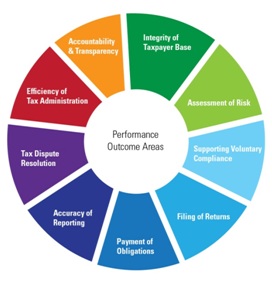
on tax administration outcomes rather than inputs or processes. Nine high-level
performance outcome areas (shown in the TADAT wheel) will drill down to 27 indicators,
and ultimately 60 scored dimensions. The intended scoring system will follow the
PEFA model with simple A through D grades.
TADAT’s future
The TADAT framework has now been put to the test in two pilot assessments, in Zambia
(November 2013) and Norway (December 2013), with support and input from the Zambian
and Norwegian authorities. The pilot assessments showed the framework to work well
overall, but also highlighted the need for adjustments in some areas.
Maimbo Nyanga, the Director for Research and Planning of the Zambian Revenue Authority
(ZRA), speaking at the kick-off event, explained that the TADAT assessment was particularly
useful to the ZRA in gaining a better understanding of reform needs and priorities:
they faired favorably in certain areas where they were uncertain of their performance
but were contemplating reforms, but had overlooked higher priority shortcomings—to
which the ZRA now intends to devote more of its limited reform resources.
Frode Lindseth of the Norwegian Tax Administration suggested that, while the TADAT
assessment confirmed the strong performance of the Norwegian Tax Administration,
it helped to identify room for improvement in a few key areas.
Pilot assessments
A draft TADAT Field Guide was prepared from the pilot experiences and is now being
carefully reviewed by the Technical Advisory Group. Several more pilot assessments
will be undertaken in 2014 to further refine the tool by testing it in other countries.
The TADAT Secretariat will be located in the IMF, with staffing already under way.
In the next few months, a detailed work plan and budget will be developed for discussion
and endorsement at the next Steering Committee meeting in June. Tasks ahead include
delivering further pilot assessments; finalizing the TADAT assessment framework;
setting up a system for training and accrediting TADAT assessors; and finalizing
the field guide to help assessors in carrying out their work.
By mid-2015, the TADAT Secretariat will launch the final version of the assessment
tool. Once the TADAT framework is fully released, the Secretariat, together with
the Steering Committee and the Technical Advisory Group, will ensure that TADAT
assessments are carried out to the highest quality standards, promote the worldwide
acceptance and application of the assessment framework, and revise the assessment
framework periodically as needed.
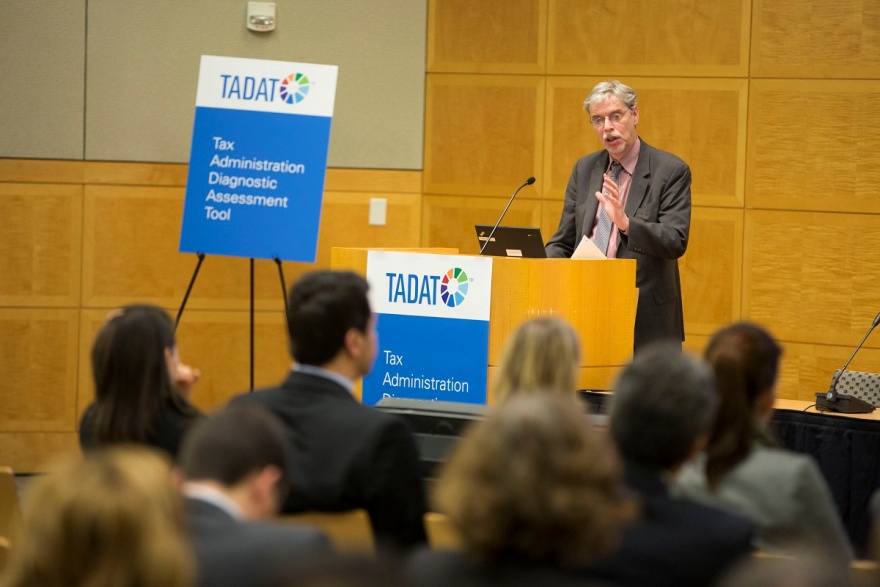
IMF Fiscal Affairs Department Deputy Director Michael Keen at the TADAT kick-off
event (photo: IMF)