The conference concluded with a lively exchange among policy experts: (1-r): Lael
Brainard, Paul Krugman, Adam Posen, Claudio Borio, and Maurice Obstfeld (photo:
IMF)
Annual Research Conference
The
Sixteenth Jacques Polak Annual Research Conference—hosted by the IMF
at its Washington, D.C., headquarters on November 5 and 6—gathered some of
the best researchers in the field to discuss the lessons and the future of unconventional
monetary policies.
Unconventional monetary policies work, but . . .
Much of the recent debate has focused on whether unconventional monetary policies
have had the expected effects on asset prices and the real economy. Several conference
participants tackled these aspects.
Focusing on asset prices, the Federal Reserve Board’s John Rogers explored
the relationship between unconventional monetary policies and risk premiums. He
argued that U.S. monetary policy easing significantly lowersterm premiums on domestic
and foreign bonds (that is, the extra yield on longer maturities) and foreign exchange
risk premiums (that is, the compensation for risks associated with instruments denominated
in foreign currency), indicating the relevance of the portfolio balance channel.
Dietrich Domanski, from the Bank for International Settlements,examined how portfolio
adjustments by long-term investors (insurers and pension funds) to contain mismatches
in the duration of assets and liabilities may have amplified the effects of unconventional
monetary policies.
Other presenters discussed how to assess a country’s monetary policy stance
and its impact on the real economy when the policy interest rate is lowered to zero,
that is, when it hits the zero lower bound. Merrill Lynch’s Dora Xia discussed
how to calculate a shadow interest rate summarizing such a monetary stance (a theoretical
measure of the effective nominal interest rate that can actually be negative). Using
her definition of the shadow rate, she showed that unconventional monetary policies
have been successful in loosening monetary policy and stimulating the real economy
in the United States.
Eric Engen and David Reifschneider from the Federal Reserve Board explored unconventional
monetary policies’ effects on private perceptions about how monetary policy
responds to changes in inflation and output. Feeding these perceptions intothe Federal
Reserve model for the United States, they find a non-negligible effect on unemployment
but argue that the slowadjustment in policy expectations and persistent beliefs
that the pace of recovery would be faster than it was have limited the impact of
actual monetary policy on real activity and inflation.
Tim Eisert, from Erasmus University Rotterdam, argued that the asset purchase program
of the European Central Bank had significantly improved the health of banks in euro
area economies under financial stress, by raising the value of their holdings of
sovereign debt. Healthier bank balance sheets had resulted in increased loans to
the corporate sector, which led to a buildup of cash reserves but no visible improvement
in employment or investment.
Overall, these presentations suggested that unconventional monetary policies had
a visible impact on asset prices and some effects on the real economy, although
of limited magnitude.
Is it time to lift off?
The discussion also shed light on how to lift off from thezero lower bound when
the strength of a country’s economy is highly uncertain. The Federal Reserve
Board’s David Lopez-Salido argued that, when available information is incomplete,
a country’s optimal policy rate may remain at the zero lower bound even when
positive signals aboutthe equilibrium real rate would otherwise have called for
an increase in the policy rate.
Monetary and fiscal policy interactions matter
Three interesting presentations explored the interaction between unconventional
monetary policies and fiscal policy.
Pierpaolo Benigno, from Guido Carli Free International University for Social Studies
and the Einaudi Institute for Economics and Finance, explored the inner workings
of unconventional monetary policies through their impact on central bank capital
and the role of treasury support.
Pushing the boundaries of unconventional monetary policies, Adair Turner, from the
Institute for New Economic Thinking, argued for using monetary financing of fiscal
deficits as a tool to stimulate aggregate nominal demand and discussed how to design
rules to prevent its misuse.
Focusing on the threat of future fiscal crises, Ricardo Reis, a professor at Columbia
University and the London School of Economics, examined the stabilizing role that
quantitative easing could play at the onset of such events, exploring how balance
sheet policies can reduce inflation’s sensitivity to fiscal shocks and prevent
a credit crunch by shifting sovereign risk away from banks’ balance sheets.
Should the Fed worry about spillovers?
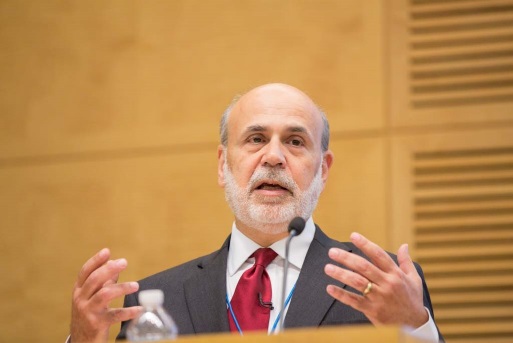
Ben Bernanke: The “currency war” was never fought.
In a highlight of the conference, former Federal Reserve Chairman Ben Bernanke,
now a Distinguished Fellow at Brookings Institution, delivered the Mundell-Fleming
Lecture, focusing on international dimensions of Federal Reserve policies. He downplayed
concerns expressed by some emerging market economies about “currency wars,”
arguing that monetary easing’s demand-diverting (expenditure-switching) and
demand-augmenting (income) effects on emerging-market exports and activity largely
offset one another. In his view, “currency war” flags mostly reflect
the frustration of open emerging market economies confronted with the trilemma—that
is, the difficulty of seeking monetary independence while targeting the exchange
rate.
The former Fed chairman also addressed concerns about financial stability spillovers
of U.S. monetary policy onto emerging market economies. He argued that a high cross-country
correlation of asset returns and other evidence supposedly pointing to a global
financial cycle—highlighted in recent research—has not yet built a compelling
case for altering U.S. monetary policy on account of possible spillovers. He
did support increased international cooperation in financial regulation and continued
close consultation on monetary policy.
Other conference participants also focused on international dimensionsofunconventional
monetary policies.
Adding to the discussion of possible beggar-thy-neighbor effects (that is, those
that improve the fortunes of one country at the expense of others), the Peterson
Institute of International Economics’ Joseph Gagnon presented evidence that
official purchases of foreign assets and foreign reserve stocks can have sizable
effects on a country’s current account, especially when the capital account
is closed. However, the domestic-assets purchases typical of quantitative easing
involve no such effects.
Feng Zhu from the Bank for International Settlements also analyzed the spillover
of unconventional monetary policiesacross major currency blocs and other economies.
He argued that monetary policies in the United States and the euro area affect one
another, but the magnitudes are asymmetric, as are the effects on third countries.
The Bank of England‘s Tomasz Wieladek focused on the evidence of recent “deglobalization”
in cross-border bank lending in the United Kingdom—one of the world largest
financial centers—and argued that unconventional policies designed to support
domestic credit may unintentionally reduce cross-border lending.
Are unconventional monetary policies suitable for emerging market economies?
Rutgers University Professor Roberto Chang offered a theoretical analysis of various
unconventional policies undertaken by emerging market economies in recent years:
direct lending to the private sector, liquidity facilities, bank equity purchases,
and sterilized foreign exchange operations.
Let’s agree to disagree . . .
The conference concluded with a lively exchange among four distinguished policy
experts that highlighted significant unresolved differences in views.

Posen: Let’s stop calling central bank balance sheet expansion and contraction
“unconventional.”
Peterson Institute President Adam Posen warned against viewing quantitative-easing-type
policies as unconventional. He argued that when movements in the monetary policy
rate do not transmit fluidly across asset classes, as evidence suggests, there is
a case for using the central bank balance sheet to influence monetary conditions
more broadly, even in normal times. He dismissed concerns that quantitative easing
will lead to uncontrolled inflation but also stressed that monetary stimulus cannot
fully substitute for fiscal policy.

Krugman: Unconventional monetary policy has had none of the predicted negative effects
and less than hoped positive effects.
Consistent with the evidence presented throughout the conference, Paul Krugman,
Distinguished Professor at the City University of New York and a New York Times
columnist, assessed the results of unconventional monetary policies and contended
that such policies had not been a game changer, as initially hoped. At the same
time, he argued strongly against the view that highly accommodative monetary policy
induces financial instability.

Borio: Critical not to overburden monetary policy to avoid being stuck in low growth.
The Bank for International Settlements’ Claudio Borio challenged this benign
view on unconventional monetary policies and financial stability. He maintained
that reliance on such policies reflects, in part, an asymmetric conduct of monetary
policy over the financial cycle, as monetary policy fails to contain financial excesses
but responds aggressively and, above all, persistently when the costs of such imbalances
materialize. The weak effects of unconventional monetary policies are no surprise
in his view, as impaired balance sheets often prevent monetary easing from gaining
traction in the aftermath of financial crises. Borio also warned about the risk
of falling into a debt trap—with high debt constraining the willingness to
raise interest rates toward normal levels. He concluded by stressing the limits
to monetary policy and the need to place emphasis on balance sheet repair with fiscal
support as well as on structural policies to boost sustainable output growth.

Brainard: U.S. economic and financial conditions sensitive to spillovers from emerging
economies.
Lael Brainard, one of the governors of the Federal Reserve, took a different view
of the results of unconventional monetary policies, contending that preliminary
evidence suggests these policies are effective in overcoming the policy constraints
imposed by the zero lower bound. She also challenged the view that unconventional
monetary actions have fundamentally distinctive spillover effects on the rest of
the world, as they work through the same channels and in similar magnitudes as conventional
policies. In her view, announcements of U.S. unconventional monetary policy measures
elicited strong negative political reactions because of the discontinuity of discrete
policy changes around the zero lower bound and the greater uncertainty that those
announcements generated regarding the Federal Reserve policy reaction function.
What now?
After two intense days of lively discussions, we learned a great deal about unconventional
monetary and exchange rate policies.
Perhaps a consensus is emerging on how much (conventional and unconventional) monetary
policy can achieve. Extraordinary measures prevented a greater economic recession,
and arguably a depression, in 2008-09, but—paraphrasing Adam Posen—
these “over-the-counter remedies” needed support from the stronger “prescription
medicines” of fiscal policy and balance-sheet repair. Countries that have
recently gone to the pharmacy for the first time would do well to keep this analogy
in mind.
As for other aspects of unconventional monetary policies, such as financial stability
implications or spillovers to other countries, it seems that the jury is still out.
That means there is still much work to be done, here at the Fund and elsewhere,
to fully understand the policy toolkit at our disposal.