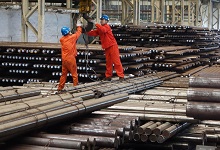
Workers at a steel factory in Dalian city, China: low unemployment, a dip in commodities
prices, and an increase in disposable income are some of the factors contributing
to continued growth across Asia (photo: Imaginechina/Corbis)
Regional Economic Outlook
Despite a slight moderation, Asia remains the engine of global growth, according
to the IMF’s latest Regional Economic Outlook for Asia and the Pacific. While
external demand remains sluggish, domestic demand continues to show resilience across
most of the region, driven by low unemployment, growth in disposable income, lower
commodities prices, and macroeconomic stimulus.
“Of course, Asia is impacted by the still weak global recovery, and by the
ongoing and necessary rebalancing in China,” said Changyong Rhee, Director
of the Asia and Pacific Department at the IMF. “But domestic demand has remained
remarkably resilient throughout most of the region, supported by rising real incomes,
especially in commodity importers, and supportive macroeconomic policies in many
countries,” he added.
A mixed outlook
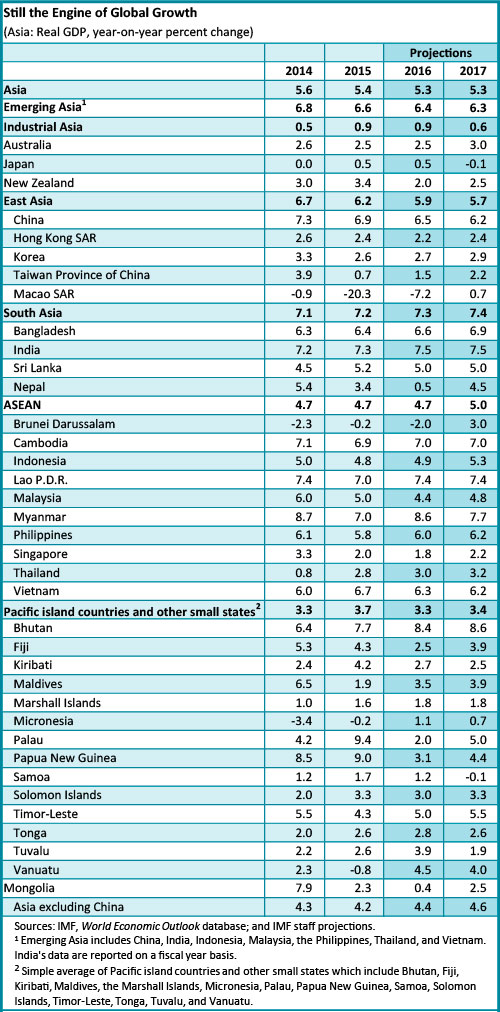
The outlook for individual countries within the region varies (see table). China
and Japan, the two largest economies in Asia, continue to face challenges. China’s
growth is forecast to moderate from 6.9 percent in 2015 to 6.5 percent this year
and 6.2 percent in 2017. China’s economy continues its rebalancing of shifting
away from manufacturing and investment to services and consumption.
While this transition to slower but more sustainable growth is desirable for both
China and the global economy, it is causing changes in the manufacturing sector
over the medium term, as heavy industries, such as steel and shipbuilding, face
major consolidation to reduce excess capacity. Meanwhile, consumer expenditure has
become a more important growth engine.
Japan’s growth is expected to continue at 0.5 percent in 2016, before
dropping to -0.1 percent in 2017 as the effect of the widely anticipated consumption
tax increase takes hold (although this forecast does not take into account likely
growth-supporting policies to offset the increase). An aging population and high
public debt remain major drags on Japan’s long-term growth.
Other economies in the region are set to perform well. India has benefited from
lower oil prices and remains the fastest-growing large economy in the world, with
GDP expected to increase by 7.5 percent this year and next. In Southeast Asia, Vietnam
is leading the fast-growing economies in the region, helped by rapidly growing exports
of electronics and garment manufactures. For the Philippines and Malaysia, growth
is expected to remain robust, underpinned by resilient domestic demand.
Downside risks loom large
However, the region faces a number of external challenges, including slow growth
in advanced economies, a broad slowdown across emerging markets, weak global trade,
persistently low commodity prices, and increasingly volatile global financial markets.
These risks compound domestic vulnerabilities, such as high debt incurred in recent
years. In the short term, China’s transition to a new growth model will disrupt
its regional partners, especially those heavily exposed to the region’s biggest
economy.
Geopolitical tensions and domestic policy uncertainty add risks of potential trade
disruptions or lower domestic demand. Natural disasters, too, can reverse economic
gains, particularly in lower-income countries and small states (including many Pacific
islands). Small states also face the challenge of reduced financial services by
global banks (or “de-risking”), which could hold back financial inclusion
and growth.
The report also recognizes, however, that the outcome could turn out more positive
than forecast. Low commodity prices could be a bigger boost to the region’s
economies than expected; and regional and multilateral trade agreements, such as
the Trans-Pacific Partnership, could benefit Asia-Pacific even before they are ratified.
Boosting resilience and growth
While Asian economies have strong buffers and are relatively well positioned to
face the challenges ahead, countries will need to adopt economic policies that shore
up growth and reduce their exposure to global and regional risks. For instance,
since monetary settings are broadly appropriate and inflation remains low, there
is room to cut policy rates if needed to boost demand.
On the fiscal front, gradual consolidation is generally desirable to rebuild policy
space, but countries can adjust the composition of spending to allow for growth-friendly
and much-needed infrastructure and social spending in many economies.
Flexible exchange rates should continue to be the first line of defense against
external shocks. At the same time, foreign-exchange intervention and capital-flow
measures could be deployed in special circumstances, such as disorderly market conditions.
The report also notes that region has extensively used macroprudential policies
to deal with financial volatility and risks and should continue to do so as a complement
to monetary and fiscal policies.
The report also emphasizes that structural reforms are needed to help bolster potential
growth and facilitate rebalancing. The region’s past reforms have been highly
effective, fostering economic diversification and facilitating Asia’s entry
into global markets.
Winners and losers from China’s transition
Three background studies in the Regional Economic Outlook report
also discuss how commodity exporters and countries in the Asia-Pacific region are
affected by income inequality and China’s rebalancing. China’s slowdown
has an impact on global commodity prices, contributing in particular to a large
drop in prices of some metals. At the same time, demand for some foodstuff has increased
as a result of rebalancing in China, as changes in consumers’ tastes have
tended to favor higher-quality and higher-protein items, and Chinese tourism continues
to grow.
The analysis shows that the impact of China’s rebalancing will depend on each
country’s specific exposure to China’s economy. Economies that rely
on China’s consumers can be winners, while those more dependent on investment
and manufacturing could lose in the near term. Over time, however, the region is
likely to benefit as the rebalancing makes China’s growth model more sustainable.
Tackling increasing inequality
The third study in the report notes that more recently inequality has risen in many
countries in Asia, with growth less beneficial to the poor compared with the past.
The report concludes that structural reforms, along with fiscal policy, can help
reduce inequality and foster more inclusive growth. Countries will need to address
inequality of opportunities, in particular the need to broaden access to education,
health, and financial services, as well as tackle labor-market duality and informality.
Reforms should avoid costly, across-the-board subsidy schemes while focusing instead
on the expansion of social spending through well-targeted interventions and more-progressive
tax codes. Recent reforms, such as the elimination of fuel-price controls in most
major economies of the region, bode well for the future.