At the same time, we found a developing economy penalty throughout the
talent distribution. Compared with their counterparts from high-income countries who had the same score in the IMO, participants born in
low- or middle-income countries contribute considerably less to published
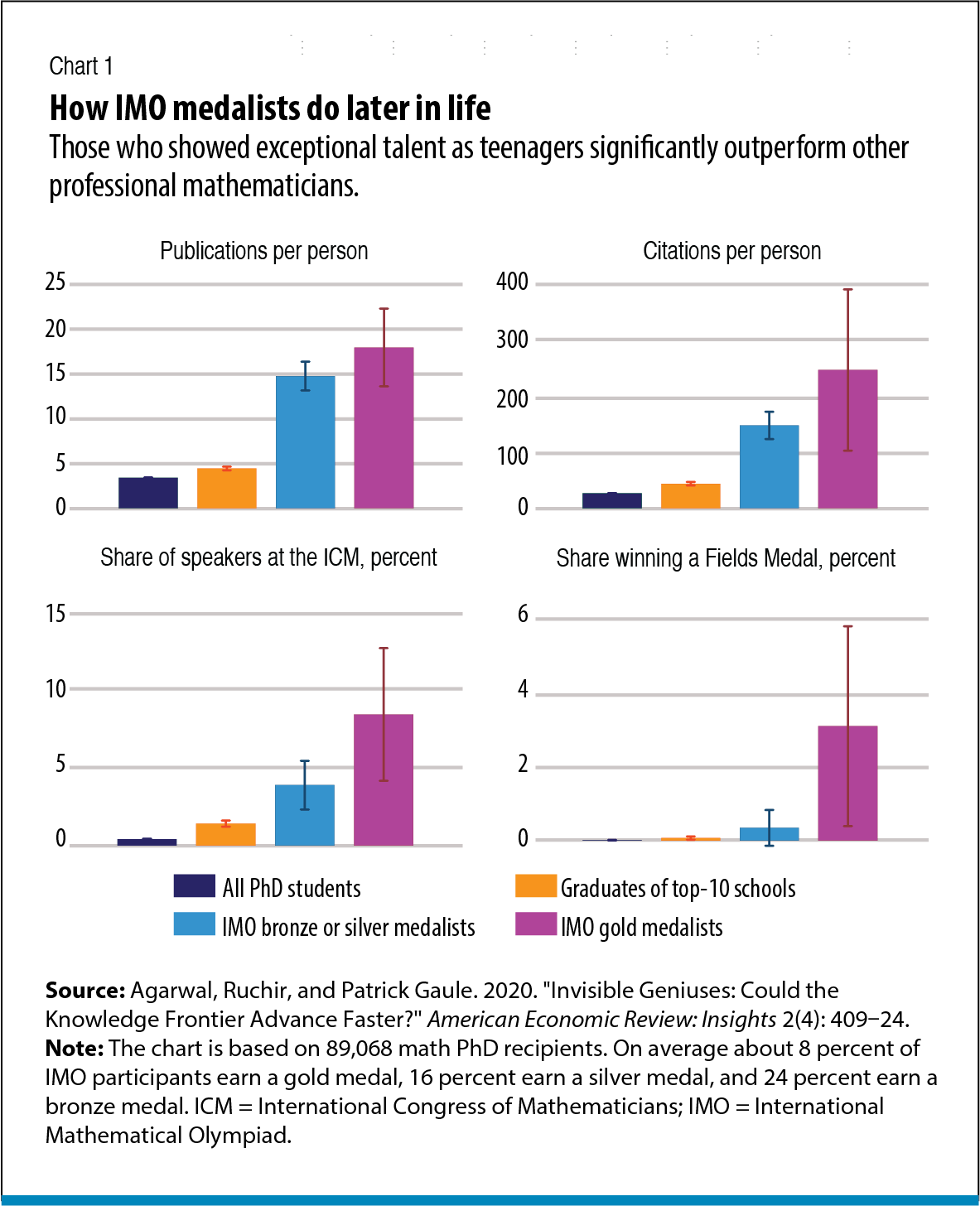
research over their lifetimes (see Chart 1). We reached that conclusion by
counting individuals’ published work, as evidence of original research, and
citations of their research by others as evidence of their findings’
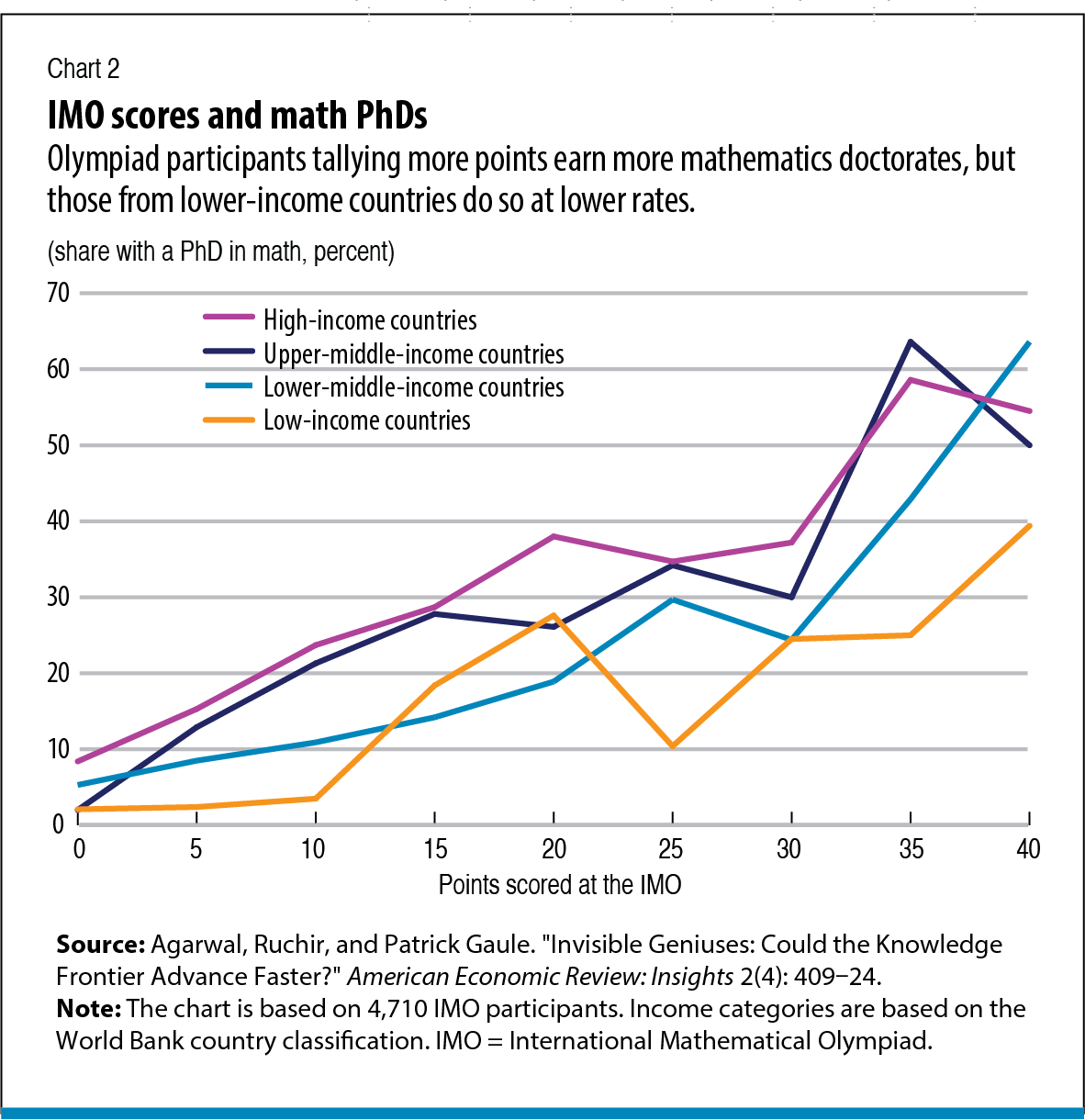
influence. A participant born in a low-income country produces 34 percent
fewer mathematics publications and receives 56 percent fewer mathematics
citations than an equally talented participant from a high-income country (see Chart 2). The findings suggested overall that large scientific gains
can be achieved by easing barriers to people’s migration to places where
their talent can be nurtured.
Our recent work (written jointly with Geoff Smith) makes it possible to
quantify the effect of immigration barriers on the advancement of science
using hand-curated data sets of talented individuals—Nobel laureates, Fields
medalists, and IMO participants. We combine our data set of career
histories with newly collected survey data of 610 recent IMO participants,
which includes information on the universities they applied to, were
admitted to, and attended. The survey also asks a series of questions about
how respondents would choose between hypothetical university offers in
different countries—where offers were either funded or unfunded. These
questions allow us to shed light on the role of funding as a constraint to
pursuing education abroad.
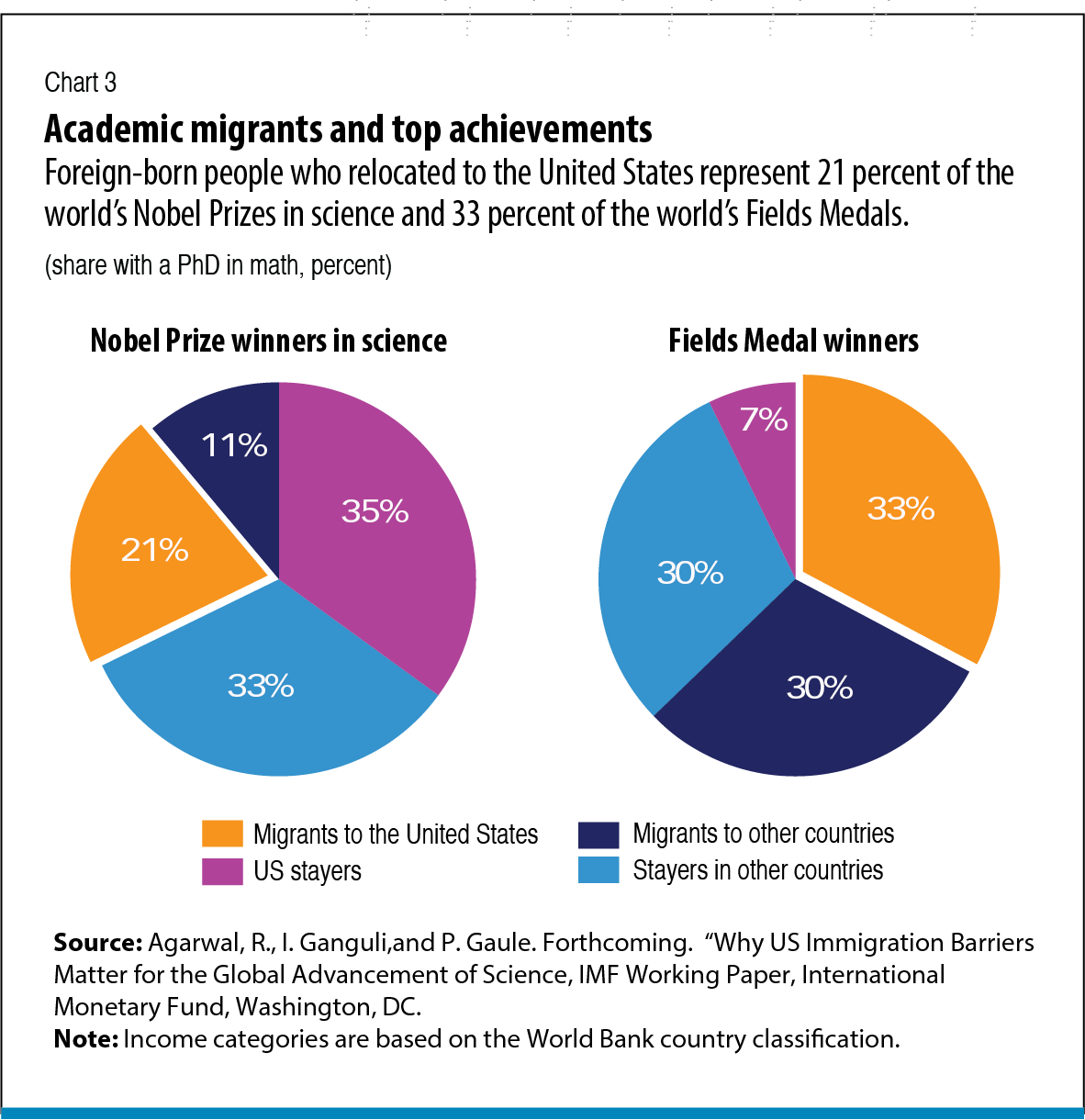
Our analysis highlights four main results. First, using data on Nobel Prize
winners and Fields medalists, we document the central role migrants to the
United States play in the global knowledge network—representing 21–33
percent of these frontier knowledge producers (see Chart 3).
Second, using our novel survey data and hand-curated life histories of IMO
medalists, we show that migrants to the United States are significantly
more productive than migrants to other countries—even after accounting for
their talent during their teenage years. Migrants to the United States are four to six times more productive than stayers, while
migrants to the United Kingdom are more than twice as productive
as stayers. The term “stayer” refers to those who remained in their country
of birth. Using information on the future occupations of the medalists we
show that the US productivity premium is driven by both the extensive
margin (that is, migrants are more likely to choose academic careers when
they migrate to the United States) and the intensive margin (in other
words, among those who choose academic careers in math, migrants to the
United States are more productive than those who remain in their home
country), in roughly equal measures.
Third, we document that financing costs are a key factor preventing foreign
talent from migrating to the United States. In particular, among developing
economy IMO participants in our survey, 66 percent dream of studying in the
United States, while only 25 percent manage to do so. Financing appears to
be a key constraint driving the gap between the dreams and the actual study
destinations among talented youth. Forty percent of respondents report that
the availability of financial assistance was “very important” or “extremely
important” to their decision to attend their particular undergraduate
institution rather than a different one—the share rises to 56 percent for
developing economy participants.
Fourth, our findings suggest that certain policy changes that reduce
immigration barriers to the United States—by addressing financing
constraints for top foreign talent—could increase the global scientific
output of future cohorts of talent by up to 42 percent. This large increase
results from the combination of two factors: talented individuals are much
more productive in the United States than in their home country (as
previously discussed), and many talented individuals aspire to move to the
United States but can’t because of financing constraints. Scholarships
could thus make a huge difference. Of course, improvements that help young
people develop their talent at home are also important, including to
nurture those who prefer not to leave their country and those who can’t.
Addressing this problem requires investing in better research institutions
in more countries to nurture domestic talent, in addition to providing
financial opportunities for talented youth who dream of studying abroad.
The pandemic and restrictive immigration policies recently have added new
barriers to academic migration. These deprive talented individuals of the
opportunity to nurture their abilities and compel many to settle for an
inferior educational environment that is not suited to their preferences or
strengths. And humanity is deprived of countless potential discoveries. Our
findings suggest that timely action by global policymakers and the
scientific community is needed to ensure equal opportunities for talented
individuals and to accelerate the global advancement of science and
knowledge.