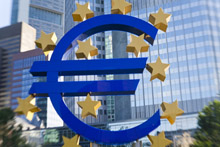
Euro sign: policymakers and banks have made headway to fix financial problems, but
the region remains vulnerable (photo: Peter Adams/Corbis)
EUROPEAN UNION FINANCIAL SECTOR
“Restoring financial stability in the European Union has not been easy, and
the priority is now to establish single frameworks for crisis management, deposit
insurance, supervision and resolution, with a common fiscal backstop for the banking
system, especially for the monetary union,” said Charles Enoch, Deputy Director
in the IMF’s Monetary and Capital Markets Department and head of the mission
that conducted the assessment.
Repair and reform
The IMF said policymakers and banks have made good headway to fix recent financial
problems in the European Union. But the region remains vulnerable, and policymakers
and banks need to intensify their efforts across a wide range of areas:
Bank balance sheet repair. Banks need to build strong capital buffers.
Greater disclosure requirements, especially of impaired assets, would buttress credibility
in the improvement in banks’ health. National authorities and the prospective
Single Supervisory Mechanism should undertake selective asset quality reviews, coordinated
at the European Union level. This would add credibility to the stress tests envisaged
by the Single Supervisory Mechanism and the European Banking Authority.
An effective banking union. Maintaining momentum to establish an effective
Banking Union will anchor financial stability and ongoing crisis management. Allowing
the European Stability Mechanism to directly recapitalize banks would help break
the adverse link between government finances and banks, which has caused so much
trouble in several European countries now undergoing painful adjustment. It will
be critical for the Single Supervisory Mechanism to deliver supervision of the highest
quality from the outset. Ultimately, its effectiveness will depend on strong governance
and common safety nets in the form of a single resolution authority and deposit
guarantee scheme. This recommendation builds on IMF research released in February 2013.
Stronger European Union financial oversight framework. Prompt passage
and implementation of capital requirements and resolution directives and regulations,
as well as strong coordination across the various oversight institutions are important
to achieve policy consistency, including with national policies. The IMF underscored
that standards adopted through these directives should be well above internationally
agreed minima.
The IMF’s assessment of the European Union covers a region rather than a single
country and draws on the analysis and findings in individual European country reports,
as well as visits to the key European Union and euro area financial oversight institutions
in November and December 2012.
Main risks
The IMF outlined three main financial risks facing the European Union:
• Further declines in growth leading to deterioration in the balance sheets
of banks and governments.
• Stresses and dislocations in wholesale funding markets that could lead to
adverse liquidity and refinancing conditions.
• A major further drop in asset prices.
The IMF said uncertainty about the regulatory environment and the burden it may
place on banks and financial institutions are also sources of risk. In several countries,
the high degree of concentration in the banking sector creates too-big-to-fail problems
that could amplify the country’s vulnerability.
Mind the gaps
Policymakers are urged to promptly agree and implement proposals by the European
Commission to harmonize capital requirements, bank resolution, and insurance supervision
frameworks, according to the IMF.
Separating banks’ retail activities from those deemed more risky, along the
lines of proposals set out in the Liikanen and Vickers reports, and currently being examined or implemented
in a number of European Union member states, may assist authorities to resolve banks
if necessary, but they are no panacea and should not substitute for other ways to
improve loss-absorption capacity, the IMF said.
The IMF assessment found that the present weak economic outlook provides a challenge
to the life insurance and pensions industries, parts of which have also been affected
by exposures to weak banks and sovereigns. Careful attention will be needed by the
supervisory authorities, particularly as the European Commission’s insurance
supervision proposals are implemented.
Strong coordination across Europe’s various supranational agencies will be
critical, the IMF said. This will help ensure smooth decision making and make policies
consistent, especially for crisis management.
The IMF said European officials expressed interest in another assessment within
about three years to assess progress in setting up the banking union and the changes
to the financial oversight framework envisaged for 2014.