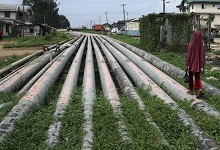
Pipeline running through Okrika community near Nigeria's oil hub city of Port Harcourt.
Falling oil prices have reduced export revenue for sub-Saharan Africa’s oil
producers, which account for about half of region’s GDP (Akintunde Akinleye/Reuters/Corbis)
REGIONAL ECONOMIC OUTLOOK
While the business and macroeconomic environment has improved considerably over
the past decade or so, other factors that underpinned strong growth—particularly
high commodity prices and accommodative financing conditions—have become less
supportive. The prices of many commodities exported by the region have fallen by
around 40-60 percent in the past two years, and borrowing costs have risen amid
a reassessment of global risk in anticipation of a U.S. interest rate hike. In addition,
larger external and fiscal deficits weigh on some countries.
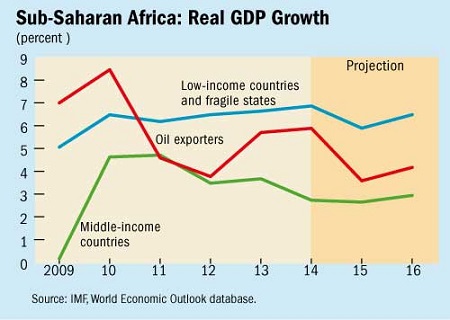
As a result, while growth in sub-Saharan Africa is still stronger than many other
regions, the IMF’s latest Regional Economic Outlook for Sub-Saharan Africa puts
growth at 3¾ percent this year, even lower than in 2009 in the aftermath
of the global financial crisis. The forecast for 2016 is slightly higher at 4¼
percent.
Variation across region
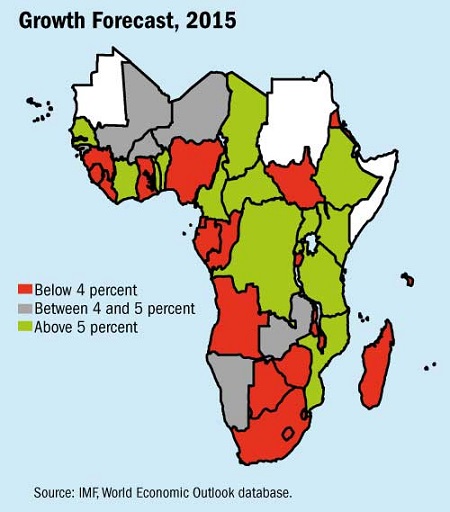
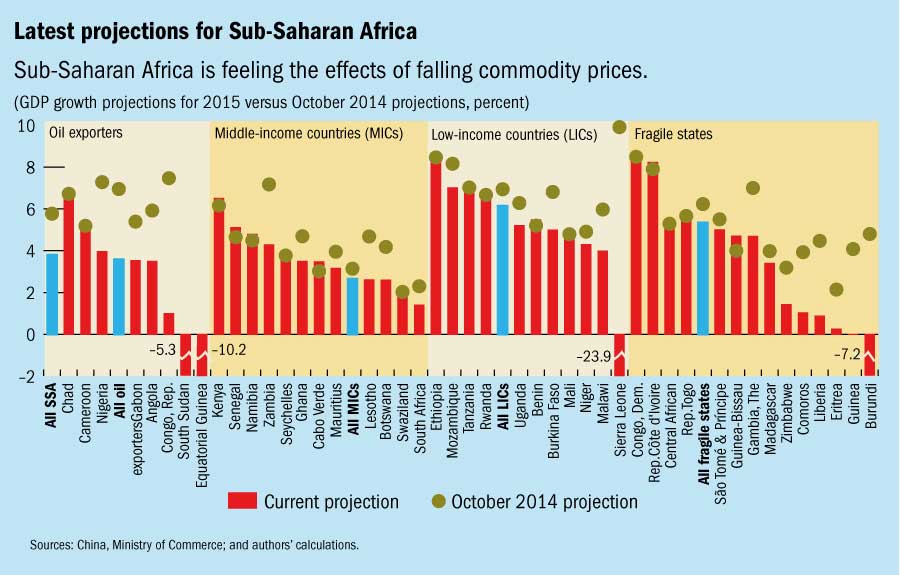
But despite the difficult overall picture, the report finds that there is considerable
variation across the region (see charts below). In most low-income countries, growth
is generally holding up, supported by infrastructure investment and private consumption.
Countries such as Cote d’Ivoire, Ethiopia, and Tanzania are expected to grow
at 7 percent or more this year and next. Other low-income countries, however are
feeling the pinch from commodity prices, even though cheaper oil has eased their
energy import bill.
Hardest hit are the region’s oil exporters as falling oil prices have drastically
reduced export revenue and forced a sharp fiscal adjustment. The oil producers account
for about half of the region’s GDP and include the largest producers, Nigeria
and Angola. Several middle-income countries, including Ghana, South Africa, and
Zambia, are also facing unfavorable conditions, ranging from weak commodity prices
to difficult financing conditions and electricity shortages.
Limited scope to counter drag on growth
Savings have been modest during the recent period of rapid growth, leaving limited
room to counter the drag on activity in the region or smooth the adjustment to the
recent shocks. Many countries now have weaker fiscal and external balances than
at the onset of the global financial crisis in 2008. And while in many cases this
situation reflects countries’ efforts to address large infrastructure needs,
it leaves them with fewer resources to contain the effects of the current downturn.
For oil exporters in particular, fiscal adjustment is unavoidable in the face of
a sharp and seemingly durable decline in oil prices. Fiscal policy in most other
countries needs to balance development needs and debt sustainability, which will
become increasingly difficult as higher interest rates and lower growth adds to
debt burdens.
On the monetary policy front, wherever the terms of trade have worsened sharply
and the currency is not pegged, the study recommends that exchange rate should be
allowed to depreciate to absorb part of the shock. Exchange rates have also come
under pressure in countries where commodity exports do not play such a large role.
Given the strong global forces behind these pressures, intervening here, too, would
risk depleting scarce foreign exchange reserves. Accordingly, central bank intervention
should focus on containing disorderly exchange rate movements. Monetary policy should
respond only to second-round effects of exchange rate depreciations on prices and
to other upward shocks to inflation.
Improving competitiveness, reducing inequality spurs growth
Beyond these more immediate challenges, the Regional Economic Outlook also
discusses, in two background studies, how longer-term growth in the region can be
supported by efforts to improve competitiveness and reduce inequality.
The first study suggests that the region’s recent period of high growth and
substantial trade integration, has also been accompanied by a widening of trade
imbalances and a weakening of competitiveness, especially among commodity exporters.
With some of the past sources of growth dissipating, the region needs to nurture
new sources by increasing the sophistication of its exports and integrating into
global value chains, which will only happen with greater competitiveness. The policy
actions to achieve this objective depend on specific country circumstances, but
progress can be facilitated by pursuing sound macroeconomic policies, investing
in infrastructure while keeping debt on a sustainable path, continuing to eliminate
trade barriers, and improving the business climate.
The second study considers the implications for sub-Saharan Africa of persistently
high income and gender inequality. The region has among the highest levels of inequality
in the world. With growing international evidence suggesting that persistent inequality
can impede macroeconomic stability, the study finds that policies aimed at reducing
inequalities to levels seen in some fast growing emerging Asian countries (for example
by expanding access to education and health care) could potentially increase growth
by one percentage point annually in sub-Saharan Africa. Carefully designed fiscal
and financial sector policies and the removal of gender-based legal restrictions
could also reduce inequality and improve long-term growth in the region, the study
says.