




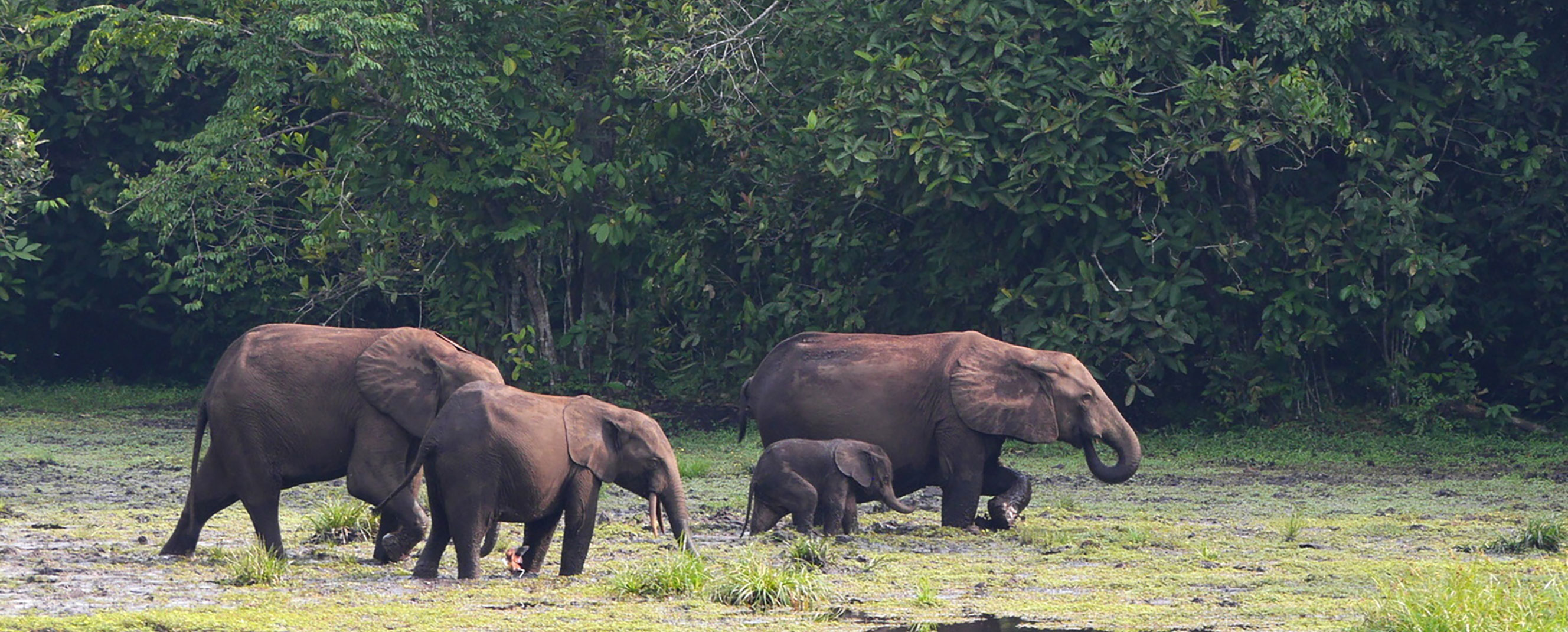
African forest elephants fight climate change by contributing in surprising ways to natural carbon capture
Consider the plight of African forest elephants. Some 1.1 million once roamed the central African rainforests, but deforestation and poaching have diminished their population to less than one-tenth their former number (see Chart 1). They likely face extinction unless action is taken.
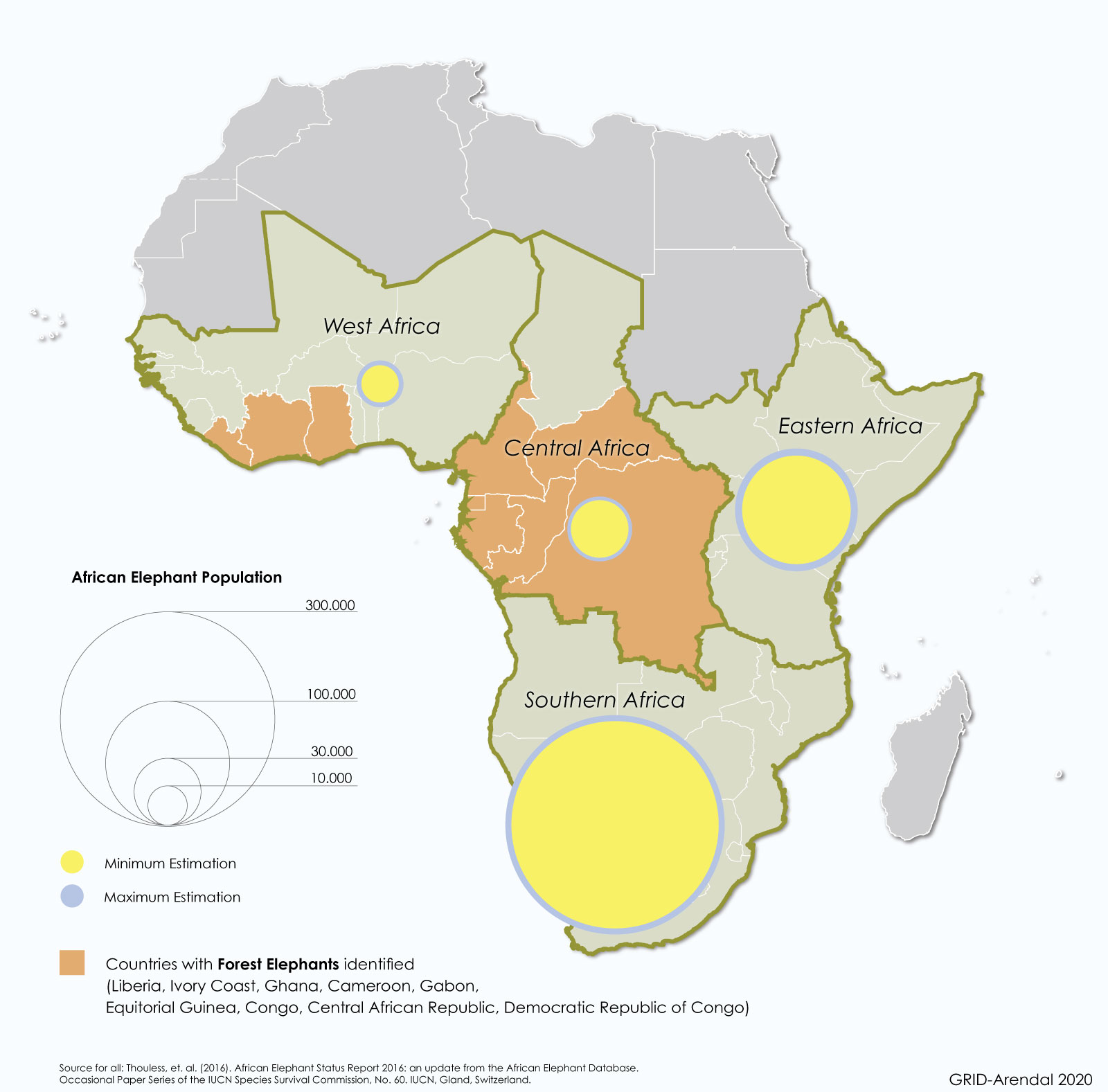
Most people outside central Africa are unaware of the existence of these forest elephants. When people think of African elephants, they picture those of a different species, elephants that roam the savannas. Except for dedicated local conservationists and the biologists who study these animals, African forest elephants have few advocates.
This situation could change dramatically if the valuable service these forest elephants provide were more widely understood. Although there is virtually no ecotourism in the central African rainforests, for both geographic and political reasons, African forest elephants contribute something of tremendous social and market value. As it turns out, these elephants fight climate change by contributing significantly to natural carbon capture.
Elephants as environmental engineers
This process, which has only recently been documented by biologists, is extraordinary.
As African forest elephants make their way through the rainforests and forage for food, they thin out young trees that are competing for space, water, and light—by stepping on some and consuming others. Elephants are large and have big appetites, which means that they dramatically reduce the density of the vegetation wherever they go. The trees that are left behind unbroken and unconsumed, however, have a huge advantage over other trees in the forest. They have much better access to water and light, thanks to the elephants’ thinning of the surrounding vegetation, which means that they grow taller and larger than other trees in the rainforest. Wherever forest elephants roam, therefore, they promote the growth of larger, taller trees.
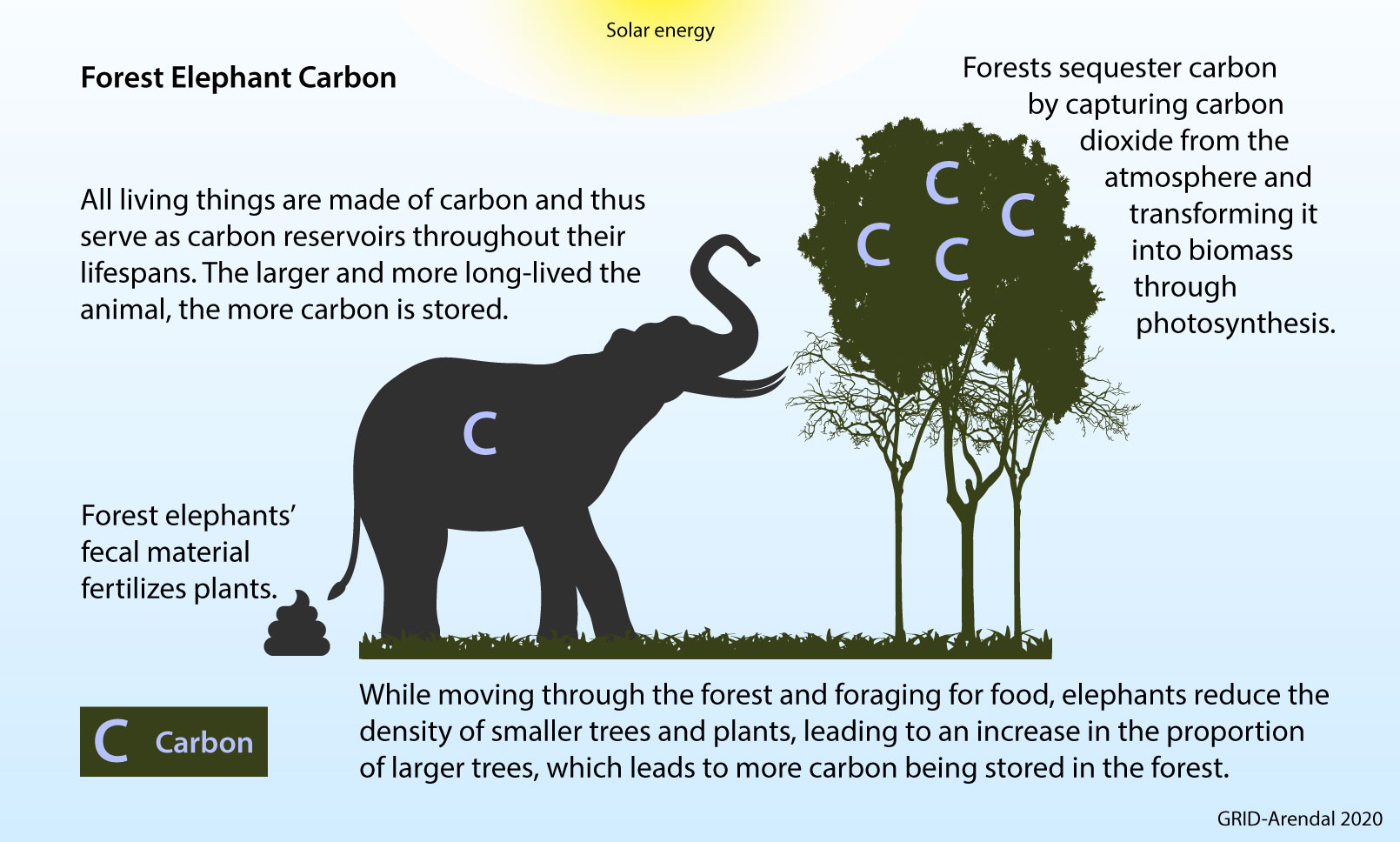
These trees—which biologists call late-succession trees—store more carbon in their biomass than the trees that would have grown in their place. All trees capture carbon in their tissue—the equivalent of about 50 pounds a year, on average—but because of the greater size and height of late-succession trees, there is simply more tree biomass capturing more carbon in these trees than in those that would have grown and dominated the rainforest canopy. Forest elephants thus actually increase the amount of carbon stored by the rainforest by tilting the biological balance in favor of certain types of trees. In short, elephants are environmental engineers (see Chart 2).
The increase in carbon storage caused by forest elephant activity is huge—as well as valuable. Biologists estimate that if the population of African forest elephants returned to its former size and they recovered their former range, it would increase carbon capture by 13 metric tons (1 metric ton = 1,000 kg) per hectare (10,000 square meters). Since the former range of African forest elephants was 2.2 million square kilometers, each of which comprises 100 hectares, and forest elephants are now at about 9 percent of their pre-poaching population, carbon capture from a recovery of these elephants could be equivalent to more than 6,000 metric tons of carbon dioxide per square kilometer. That is the same amount of carbon dioxide captured by over a quarter of a million trees, or 14 times what is captured by trees in New York City’s Central Park.
If we multiply this increase in carbon dioxide captured by the 2.2 million square kilometers of rainforest affected by a rebound in elephant populations by the average market price of a metric ton of carbon dioxide—just under $25 in 2019—we get a total present value of over $150 billion for the carbon-capture services of African forest elephants.
If we then take the total value of the service provided by African forest elephants and divide it by their current population, we find that each elephant is responsible for service worth more than $1.75 million (see Chart 3). On the other hand, the ivory of an elephant killed by poachers fetches only about $40,000, so it is clear that the benefits from a healthy and thriving elephant community are substantial.
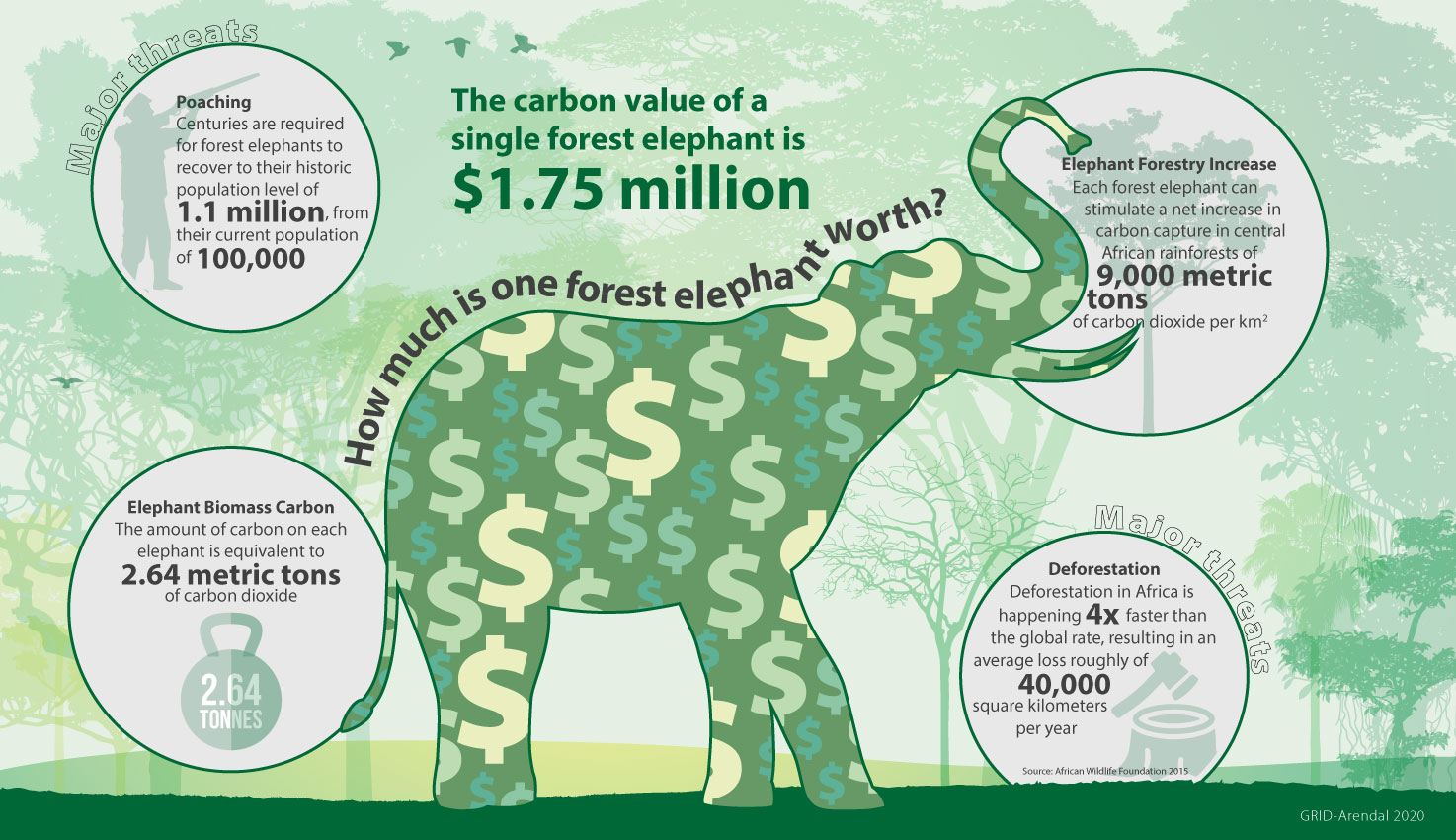
Unfortunately, these elephants are fighting an existential threat, with poaching and deforestation pushing them to extinction.
Valuation inspires action
We have developed a framework for natural resource valuation that directly addresses the fundamental collective action problem in environmental protection (Chami and others 2020).
Every day, certain types of valuations inspire millions of people to invest their savings in risky long-term assets and projects, while other valuations fail to do so. The valuations that lead to investment are based on believable stories about specific ways that assets or projects will generate cash or other income for their owners, which in turn leads to credible projections of future returns that can be summarized in present monetary value. When the present monetary value of these future returns exceeds the cost of the asset or project, profit-seeking investors will take advantage of these opportunities.
This cost-benefit approach can also be used to protect, invest in, and ultimately put our ecosystems on a sustainable path. If we can reliably identify and measure the market-value services provided by natural resources—such as recreation, tourism, and carbon sequestration—we can then compare the present monetary value of these benefits with the cost of investing in them, just as we do for other assets.
The resulting valuations can effectively motivate environmental investment for several reasons. First, they show exactly what concrete services society currently receives from our stock of natural resources—as we have shown with the elephant example—which helps people understand the relevance of these resources to their lives. In addition, expressing the benefits of preserving natural resources in monetary terms allows for a dollar-to-dollar cost-benefit comparison, which is important because people are more comfortable making decisions when the stakes are expressed in financial terms. And finally, the value embodied in these natural assets can be very large—not only justifying the cost of preserving them but also causing surprise and capturing the imagination of people who learn about the valuations. Behavioral economics research shows that people are more likely to purchase products or make investments that inspire these feelings.
Win-win opportunity
Valuing the benefits of individual natural resources such as elephants and of a healthy ecosystem in general—when coupled with a legal framework that appoints stewards of these resources and establishes their rights and obligations—allows for win-win opportunities among stakeholders: government, the private sector, local communities, and global partners. With a proper legal framework in place, the economic benefits from natural resources may be claimed and distributed. These benefits can be used as incentives for public-private partnerships, supported by nongovernmental organizations and global institutions, that yield direct dividends—and, as a result, ownership—for local communities.
One such example, the United Nations Development Programme Financing Solutions for Sustainable Development initiative, includes debt-for-nature swaps. Under this financial contract lenders agree to reduce a developing economy’s debt or debt payments in exchange for a commitment from the debtor country to protect specific natural resources. For example, many countries that are home to forest elephants are highly indebted and could substantially benefit from a debt-for-nature swap. The amount of debt relief is determined by the value of the elephants’ services, using market prices. The money the countries save would be devoted to elephant conservation but could also facilitate the creation of public-private partnerships that help build markets, such as tourism and insurance, around investing in and protecting the elephants. These markets would provide steady employment and income in local communities, leading to ownership and sustainability of conservation efforts.
Nongovernmental organizations and international financial institutions could provide the necessary capacity development for public-private partnerships and insurance markets centered around natural resources. The example of debt-for-nature swaps shows that valuing nature for its benefits can support a virtuous cycle, directing investment and enterprise along a more regenerative and sustainable path.
The COVID-19 pandemic, attributed to a virus that originated in a local wet market, demonstrates that nature can have a macrocritical impact of global proportions. A worldwide alarm has been sounded, calling for a course correction. Human destruction of the natural world not only leads to severe volatility in our economic systems but threatens our very existence. On the other hand, vibrant, intact ecosystems that include healthy populations of forest elephants and great whales, mangroves, and sea grass are vivid examples of how valuing and investing in the protection of nature can generate a more sustainable blue-green economy, help mitigate climate change, and realign economies toward inclusive and nature-friendly economic growth.

RALPH CHAMI is an assistant director in the IMF’s Institute for Capacity Development.

CONNEL FULLENKAMP is professor of the practice of economics and director of undergraduate studies in the Duke University Economics Department.

THOMAS COSIMANO is professor emeritus at the University of Notre Dame’s Mendoza College of Business.
FABIO BERZAGHI is a researcher at the Laboratory of Climate and Environment Sciences in Gif-sur-Yvette, France.
Graphics produced by GRID-Arendal as part of the United Nations Environment Programme’s Blue Forests Project.
Opinions expressed in articles and other materials are those of the authors; they do not necessarily reflect IMF policy.
References:
Berzaghi, F., M. Longo, M. Ciais, and others. 2019. “Carbon Stocks in Central African Forests Enhanced by Elephant Disturbance.” Nature Geoscience 12:725–29. https://doi.org/10.1038/s41561-019-0395-6.
Chami, R., T. Cosimano, C. Fullenkamp, and S. Oztosun. 2019. “Nature’s Solution to Climate Change.” Finance and Development 56 (4): 34–38.
Chami, R., C. Fullenkamp, F. Berzaghi, S. Español-Jiménez, M. Marcondes, and J. Palazzo. 2020. “On Valuing Nature-Based Solutions to Climate Change: A Framework with Application to Elephants and Whales.” Economic Research Initiatives at Duke Working Paper 297, Duke University, Durham, NC. https://ssrn.com/abstract=3686168 or http://dx.doi.org/10.2139/ssrn.3686168.