





Improving sub-Saharan Africa’s logistics could be the key to successful vaccine delivery
Sub-Saharan Africa still has too few vaccines for too few people. Delivering more inoculations to the region deserves top priority in the effort to stamp out new variants that could further derail a global recovery. However, policymakers and the international community will likely have one other hurdle to overcome to successfully deploy vaccines: the region’s poor trade and logistics quality.
No journey is more critical to determining the fate of a pandemic than the distance a vaccine must travel from the production line to a person’s arm. In sub-Saharan Africa, the last mile of this important race is all-important.
Data from the World Bank’s Logistics Performance Index (LPI) Database—a good proxy for transport and distribution logistics—show that Africa’s LPI score is only about 2.5 on average. The score ranges from 1 to 5, with higher scores representing better performance on logistics—the network of services that support the physical movement of goods both within and across a country’s borders. The region’s score trails all major regions of the world in six key categories of logistics performance, including timeliness and tracking. For more than a decade, its negative impact on the region’s trade has been well documented. For instance, delays at customs are estimated to add 10 percent to the cost of imported goods, which is higher than the average impact of tariffs in some cases.
But it is also now becoming clear just how much poor transport logistics could derail already slow attempts to vaccinate the region’s population and do so quickly. Once fully thawed, some vaccines have a short shelf life. This raises the risk of destroying perfectly good doses when the region’s logistics challenges are factored in. Looking closer at the reasons cited for vaccine destruction, the common thread is poor logistics and transport infrastructure. In Malawi, for instance, health authorities cited the short time between delivery and expiration of vaccines and the need to reduce hesitancy as the rationale for incinerating close to 20,000 doses of AstraZeneca vaccine.
Addressing vaccine hesitancy is critical to a successful mass vaccination campaign, and overcoming logistics challenges plays a large role. Skeptical individuals have little incentive to get a jab if they must travel miles and spend hours to reach the nearest vaccination centers—often lacking confidence that temporary health workers will themselves show up. Places that are poorly connected by road also tend to have limited access to information and telecommunications technology, making access to official information about vaccines difficult. In addition, while bringing vaccine manufacturing closer to Africa to speed up supply is important for building capacity in the region, it matters less in the short term whether vaccines are shipped from Germany or South Africa to, say, the Democratic Republic of the Congo if, at the last mile, the distribution chain is broken by gaps in transport and logistics.
Before vaccines were deployed globally, a World Health Organization (WHO) assessment conducted to gauge global COVID-19 inoculation readiness showed that Africa has an average preparedness score of 33 percent for the COVID-19 vaccination program, far below the desired benchmark of 80 percent in key areas, including logistics quality and performance. Emerging data appear to confirm that logistics performance quality is positively correlated with the COVID-19 vaccination rate across Africa (see chart).
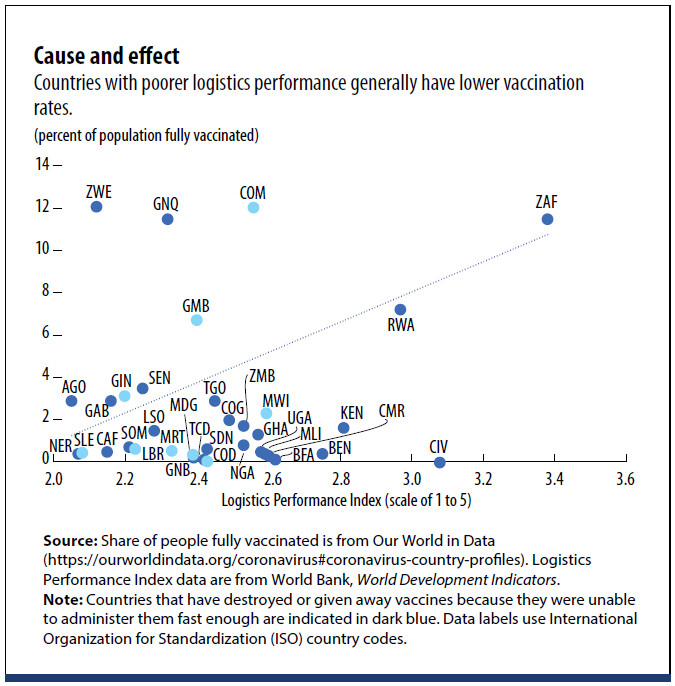
In this regard, it is interesting to compare vaccination rates of countries with a relatively low LPI (such as the Democratic Republic of the Congo) with those that have a relatively higher LPI (such as South Africa). The Democratic Republic of the Congo’s low LPI score of 2.43 reflects its problem with a very poor transport network. This has made the delivery of vaccines to remote areas difficult and in part explains why close to zero percent of the population is fully vaccinated. In addition, the Democratic Republic of the Congo and the other landlocked African countries are naturally challenged by geography and economies of scale when it comes to connecting to global supply chains. This has led to logistics-induced delays in transportation and distribution, leaving Malawi, South Sudan, and the Democratic Republic of the Congo unable to deploy and administer vaccines on short notice. In contrast, South Africa, with a score of 3.38, stands out as the top performer, thanks to its large economy (which allows for economies of scale in supply chain connections), superior and much wider network of health services, access to the sea, and proximity to major transportation hubs.
On the other hand, Zimbabwe, Equatorial Guinea, and Comoros have relatively better vaccination rates but lower LPI scores, suggesting that other factors contribute to the uptake of vaccines in Africa. For instance, when authorities in Zimbabwe announced that those who refuse COVID-19 vaccines could be denied public sector jobs and services, the vaccination rate increased significantly in big cities. It made Zimbabwe one of the African countries with the highest vaccination rates in spite of its poor logistics performance.
Covering the last mile
After addressing the issue of vaccine supply, closing gaps in logistics performance that persist across the continent is critical to altering the current course of the pandemic in Africa. In the short term, measures to substantially increase vaccine delivery and uptake are essential. The good news is that useful lessons can be found within the region. For example, when Côte d’Ivoire started its vaccination drive, centers equipped to vaccinate 300 people a day were struggling to inoculate 20 a day. Then the government adopted innovative means to overcome the last-mile challenge. It deployed mobile clinics and medical buses that traveled to the busiest areas to vaccinate people, albeit at a significant cost. There are now fixed or mobile vaccination centers across 113 districts, and nearly all are operating close to capacity. Ghana has done the same. This could be replicated across the region in the short term with support from development agencies.
The region can also leverage digital platforms for registration and information about vaccine availability—drawing lessons from South Africa. A new e-appointment system allows citizens to schedule their own COVID-19 vaccination appointments at a convenient time and at a center close by. This is expected to increase the vaccination rate by reducing commuting distance and allowing families to schedule appointments together. Vaccine campaigns should target large cities and densely populated areas where transmission risks are more significant and disruption to economic activities is severe in the event of a mass lockdown.
In the medium term, it is critical to develop the infrastructure inputs to the supply chain that affect logistics performance, particularly in cold-chain capacity. The COVID-19 vaccine requires special treatment and handling in transit and when being administered. The AstraZeneca vaccine can be stored safely in refrigerated conditions for up to six months. Both the Pfizer and Moderna vaccines require temperatures of –20 degrees Celsius or less. It is therefore quite concerning that a WHO survey of 34 countries found widespread gaps in cold-chain refrigeration capacity in Africa. About 30 percent of countries surveyed have gaps in cold-chain refrigeration capacity in more than half of their districts. Only 28 percent of health facilities in sub-Saharan Africa are estimated to have access to a reliable power supply. This presents logistical hurdles in storing vaccines in most districts. Addressing these structural issues should be a development priority in the medium term.
Poor-quality transport and distribution logistics stifle trade and competitiveness and, as is now apparent, will also be a major impediment to pandemic vaccination once the current supply constraints are resolved. The COVID-19 crisis presents Africa with an opportunity to leverage financial assistance from the IMF and other multilateral institutions for investment in infrastructure and trade facilitation measures that support strong logistics performance. These investments will also improve trade and competitiveness and strengthen health systems to deal with current and future shocks.

EUGENE BEMPONG NYANTAKYI is chief research economist at the African Development Bank.

JONATHAN MUNEMO is a professor of economics at the Perdue School of Business at Salisbury University, Maryland.
Opinions expressed in articles and other materials are those of the authors; they do not necessarily represent the views of the IMF and its Executive Board, or IMF policy.