Examining income inequality
But what about the distribution of income, instead of mortality?
How did global income inequality change during the pandemic? Well, global
inequality in incomes can be understood in at least three ways: first is
the question of what happened during COVID-19 to the distribution of GDP
per capita among countries—labeled “Concept 1” global inequality by Branko
Milanovic. In a recent paper, Nobel laureate Angus Deaton shows that, on
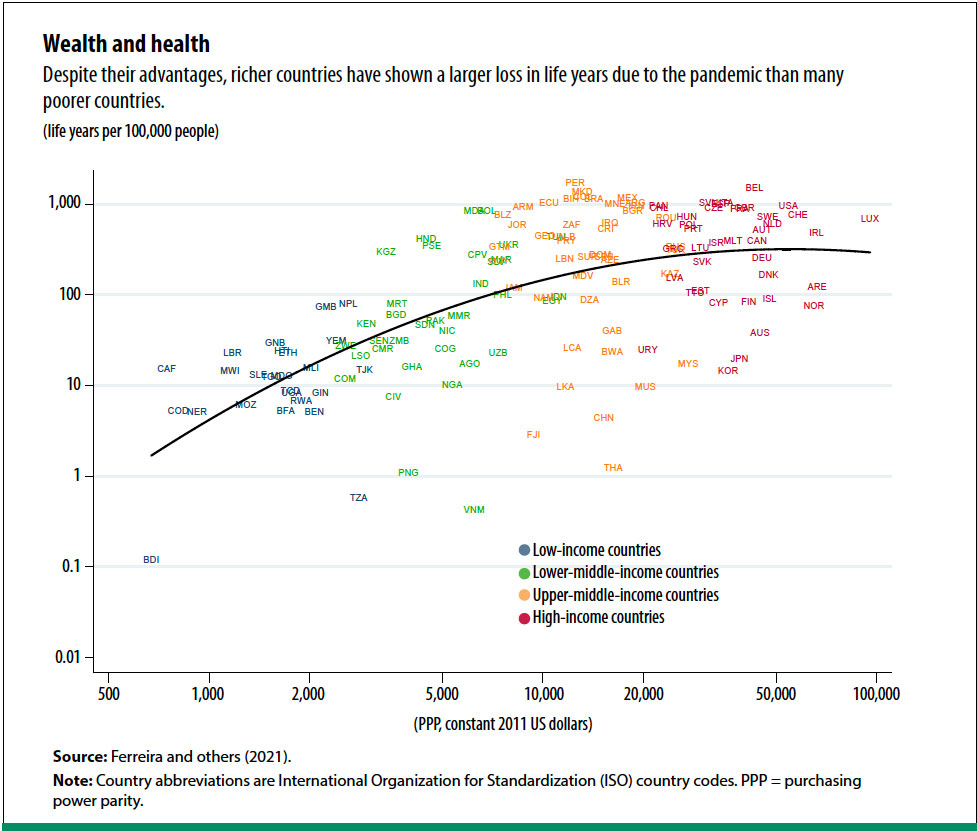
average, richer countries also experienced larger economic
contractions than poorer countries in 2020 (Deaton 2021). And although by
itself this result does not necessarily imply a decline in inequality
between countries, it turns out that the actual pattern of income declines
did indeed lead to a reduction in (unweighted) inequality between
countries during 2020, whether it is measured by the Gini coefficient, the
Theil index, or the coefficient of variation. This represents a
continuation of the trend since the turn of the millennium, when Concept 1
global inequality began to fall, owing in large part to the rise of China
and India. But Deaton argues that, if anything, the pandemic accelerated the decline.
This calculation takes countries as the unit of measurement and thus
attaches the same weight to Luxembourg as to China. One might ask,
alternatively, what happened during COVID-19 to the distribution of GDP per
capita among countries when these are weighted by population. That
approach is the same as measuring inequality in an imaginary distribution
of all individuals in the world, where all people are assigned their
country’s GDP per capita—Milanovic’s “Concept 2” global inequality.
When differences in GDP per capita are weighted by population, inequality
between countries increased during 2020—which Deaton argues can be
attributed to the pandemic. More specifically, it can be attributed to the
sharp economic contraction in India, which suffered a great deal both in
terms of mortality and economic performance—even before the massive second
wave in 2021. Although China’s positive growth (and far fewer deaths) helps
offset India’s decline, China is now too close to the global average income
to completely compensate for India’s economic losses. When India is omitted
from the calculation, Concept 2 inequality continues to decline, as it had
been doing since the 1990s. Through India, the pandemic did
contribute to a reversal in the previous pattern of falling weighted
inequality between countries.
Of course, people are very far from earning the same income within any
given country. Concept 3 global inequality refers to the inequality among
all the world’s individuals when they are assigned their own
incomes. This is arguably the most interesting of Milanovic’s three
concepts of global inequality, and it is the only one that takes inequality within countries into account. For many “good” inequality
measures, this Concept 3 inequality is just the sum of (appropriately
weighted) inequality within countries and Concept 2 inequality between
countries.
Since Concept 2 inequality appears to have risen in 2020, it would be
enough for “average” inequality within countries also to have risen for us
to conclude that global inequality among individuals has grown during the
pandemic, in conformance with what most people suspect. Unfortunately, it
is too early to tell whether or not that is the case: data on individual
incomes come from household surveys and administrative sources that are
simply not yet available for 2020. For most countries, it will be at least
a year, and typically more, before data on income inequality within
countries become available.
For the moment, though, it certainly seems plausible that inequality within
many countries is on the increase, given evidence of rising poverty and
rising billionaire incomes. There are good reasons to expect that the
pandemic both created new inequalities and exacerbated preexisting income
gaps within countries. There is long-standing evidence from many countries
that people entering the labor market during a severe recession earn less
than the cohorts just before and after them—and that those differences
linger for many years. By inducing a massive global recession, COVID-19 has
certainly created new inequalities among cohorts of young people.