
As girls, we were raised with the belief that we could accomplish anything,
and that no barrier was insurmountable. Yet, for so many women, the reality
doesn’t quite meet their aspirations. Things weren’t exactly equal in the
relatively conservative middle-class society in India where we both grew
up. But we thought of gender inequality as largely an issue of social
justice. It was only after we started delving into the topic that we came
to realize that it is an equally significant economic issue.
Women make up almost half of the world’s working-age population of nearly 5
billion people. But only about 50 percent of those women participate in the
labor force, compared with 80 percent of men. Not only is female labor
force participation lower, but women who are paid for their work are
disproportionately employed in the informal sector—especially in developing
economies—where employers are subject to fewer regulations, leaving workers
more vulnerable to lower wages and job losses. Furthermore, even in the
formal sector, women doing the same work and having the same level of
education earn less than their male counterparts. And, because women
generally spend less time in the paid labor market, they have lower
pensions and face a higher risk of poverty in old age. Among those who do
work, few rise to senior positions or start their own businesses. Women
also shoulder a higher share of unpaid work within the family, including
childcare and domestic tasks, which can limit their opportunity to engage
in paid work and constrain their options when they do.
The IMF’s research highlights how the uneven playing field between women
and men imposes large costs on the global economy. Early IMF studies on the
economic impact of gender gaps assumed that men and women were likely to be
born with the same potential, but that disparities in access to education,
health care, and finance and technology; legal rights; and social and
cultural factors prevented women from realizing that potential. In turn,
these barriers facing women shrank the pool of talent available to
employers (Kochhar, Jain-Chandra, and Newiak 2017). The result was lower
productivity and lower economic growth. The losses to an economy from
economic disempowerment of women were estimated to range from 10 percent of
GDP in advanced economies to more than 30 percent in South Asia and in the
Middle East and North Africa.
More recent research suggests that the economic benefits of bringing more
women into the labor force exceed previous estimates. This is because women
and men may have the same potential, but they bring different skills and
ideas—that are economically valuable—to the table (Ostry and others 2018).
Gender differences may reflect social norms and their impact on upbringing,
social interactions, risk preferences, and response to incentives. For
instance, studies have found women to be more risk averse, reflecting
greater fear of failure, and less competitive. Women’s greater caution has
benefits: gender-balanced corporate boards improve firm performance,
especially in high-tech manufacturing and knowledge-intensive services.
Gender diversity on boards of banking supervision agencies is also
associated with greater financial stability (Sahay and Čihák 2018).
Similarly, banks with higher shares of women board members have thicker
capital buffers, a lower proportion of nonperforming loans, and greater
resistance to stress, possibly because having more women in executive
positions contributes to diversity and complementarity of thought, leading
to better decision-making.
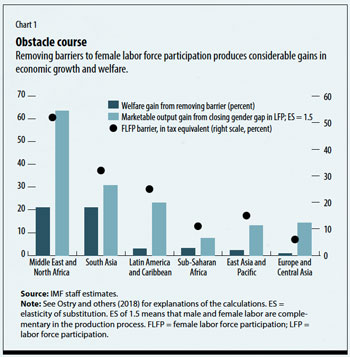
Drawing on macroeconomic, sectoral, and firm-level data, a recent IMF study
(Ostry and others 2018) suggests that men and women complement each other
in the workplace in terms of different skills and perspectives, including
different attitudes toward risk and collaboration. As a result, increasing
women’s employment boosts growth and incomes more than previously
estimated, exceeding the improvement that comes simply from adding workers.
Among countries where gaps in participation rates are the largest, closing
them adds 35 percent to GDP, on average. Four-fifths of the gains come from
adding workers to the labor force, but fully one-fifth arises from the
boost to productivity brought by greater gender diversity. The study also
shows that increasing women’s labor force participation produces large
gains in economic welfare, which account for changes in consumption goods,
home production, and leisure time; these gains exceed 20 percent in South
Asia and the Middle East and North Africa (see Chart 1).
Another important finding: when more women participate in the labor force,
men also benefit. Why? Because women’s complementary skills raise
productivity, boosting wages for everyone. This increase in productivity
more than makes up for the decline in wages that might be expected when
more workers are competing for jobs.
But simply bringing more women into the workforce may not be enough. A
recent IMF study sounds a cautionary note on the challenges women face in a
rapidly changing labor market (Brussevich and others 2018). Digitalization,
artificial intelligence, and machine learning are hollowing out jobs that
involve routine and repetitive tasks while increasing the value of jobs
involving management and cognitive skills. Hard-won gains from policies to
increase the number of women in the paid workforce and close wage gaps may
be quickly eroded if women are overrepresented in jobs at high risk of
automation. Indeed, the study finds that women perform more routine tasks
than men across all sectors and occupations, although there is significant
variation across countries.
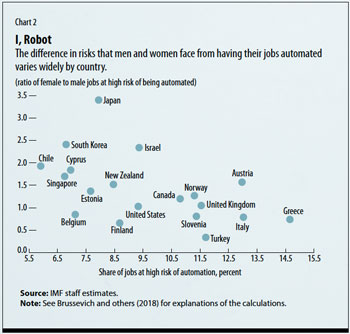
The risk of displacement is particularly high for less-educated women,
those aged 40 and above, and those in low-skill clerical and sales jobs.
Meanwhile, women across sectors and occupations are underrepresented in
professional and managerial positions that are at lower risk of
displacement by technology. Globally, women hold fewer than 20 percent of
board seats in banks and bank supervision agencies (Sahay and Čihák 2018)
and account for fewer than 2 percent of bank CEOs. In the fast-growing tech
sector, women are 15 percent less likely than men to be managers and
professionals and 19 percent more likely to be clerks and service workers
(see Chart 2).
Given the current state of technology, the study estimates that 26 million
women’s jobs in 30 countries (28 countries in the Organisation for Economic
Co-operation and Development plus Cyprus and Singapore) have a greater than
70 percent chance of being displaced by technology within two decades. On a
global scale, this suggests that 180 million women’s jobs are at risk.
While more men than women are at risk of being displaced by automation, the
number of female jobs lost represents a larger proportion of the female
labor force.
What can be done? Because gender inequality is so multifaceted, there is no
single remedy, and the best policy approach will vary across countries,
depending on the level of economic development, existing gender gaps, and
the speed at which the new technology affects the economy. Three broad
areas can be highlighted:
First, policies to bring more women into the workforce:
A range of institutional, legal, regulatory, and fiscal policy levers have
been shown to boost female labor force participation. While there is no
one-size-fits-all solution, policies should seek to foster opportunity and
remove barriers. Policies and infrastructure that make it easier for women
to reconcile work and family life are particularly effective.
Emerging market and developing economies should
● Invest in infrastructure.
In rural South Africa, for example, electrification increased female labor
force participation by 9 percent. In India, building adequate sanitation
facilities narrowed gender gaps in education and in female labor force
participation. Mexico introduced public buses exclusively for women to
ensure that they could travel safely.
●
Support female entrepreneurs by increasing their access to finance.
Women often face more restrictive collateral requirements, shorter maturity
of loans, and higher interest rates than men (see “Banking on the Future of
Women” in this issue of F&D). Initiatives such as
Malaysia’s Women Entrepreneur Financing Programme and Chile’s simplified
deposit accounts have helped close the gender gap in borrowing rates.
● Promote equal rights for women.
Measures include addressing laws governing inheritance and property rights.
Malawi, Namibia, and Peru revised their legal frameworks to reduce gender
discrimination; in the decade that followed, female labor force
participation rates increased substantially in all three countries.
Advanced economies should
●
Push for greater parity between maternity and paternity leave.
In Sweden, this has helped mothers return to work more rapidly and has
shifted underlying gender norms about parenting.
● Promote access to affordable, high-quality childcare.
An example is Japan, which expanded childcare leave benefits from 50
percent to 67 percent of salary. Research shows that cutting the cost of
childcare by half could increase the number of young mothers in the labor
market by 10 percent. There is also considerable evidence that women are
more responsive to specific tax policies than men. These include policies
that do not penalize the secondary earner, who is still most likely to be
female, by replacing family taxation with individual taxation, as Canada,
Italy, and Sweden have done. Tax relief measures for low-income families
have also been found to increase employment rates for women. The reason:
tax relief reduces the tax burden and increases after-tax earnings for
women, thus increasing the incentive for women to join, or remain in, the
labor force. Examples include the earned income tax credit in the United
States and a combination of tax credits and transfers in Belgium, Germany,
and the United Kingdom.
Second, policies to provide women with the right skills and to empower
women in the workplace:
Gender parity in investments in education and health are necessary to
ensure that women can obtain quality jobs. In India, for instance, IMF
research suggests that female labor force participation would rise by 2
percentage points if Indian states increased education spending by 1
percent of GDP. Building skills early would also provide the most important
safeguard against displacement by technology and allow women to benefit
from new work opportunities.
For those already in the workforce, fiscal instruments such as tax
deductions for training in the Netherlands and portable individual learning
accounts in France can remove barriers to lifelong learning. Countries
could also consider subsidizing training by private companies via dedicated
payroll taxes and public grants. Concerted efforts are needed to provide
women with more opportunities to rise into managerial and leadership roles
by setting relevant recruitment and retention targets for organizations,
setting promotion quotas as was done in Norway, and creating mentorship and
training programs.
Large gender gaps persist in access to the digital technology that creates
new job opportunities: 60 percent of the global population, mostly women in
emerging market and developing economies, still have no access to the
internet; 250 million fewer women are online than men. Public and private
investment will be essential to support technological adoption and close
digital gender gaps. Finland’s approach to ensuring universal access to
broadband connectivity, digital education for all, and digital access to
business and government services is a good example of a comprehensive
approach to closing the gender digital divide.
Third, easing transitions for displaced workers:
Given that female workers face a particularly high risk of being displaced
through automation, it will be essential to ensure equal support for
displaced men and women through labor market policies to improve skills,
connect workers with jobs, and promote job creation. Social protection
systems will also need to adapt to more flexible forms of work, such as
telework. To address deteriorating income security associated with rapid
technological change, some advanced economies may consider expanding
noncontributory pensions and adopting basic income guarantees.
Recent decades have seen considerable progress in leveling the playing
field for economic opportunities, but much more work remains to be done.
The good news is that countries across the globe have embraced the
imperative for gender equality. Policymakers, governments, and corporations
now recognize the benefits for economic growth and development of giving
women equal opportunities, and they are seeking to improve their policies
and practices in this area. The IMF is committed to working with other
international organizations, governments, civil society organizations, and
the private sector to reduce barriers to gender equality by providing
policy advice and analysis.