

Finance & Development, March 2019, Vol. 56, No. 1 PDF version
IN THE TRENCHES
Pursuing Stability
Elvira Nabiullina explains how bold policy action helped Russia avert a deeper recession and reform the banking sector
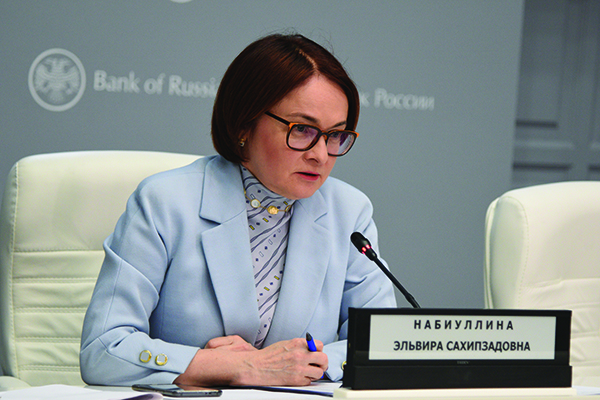
Within a few short months after taking up her post as governor of the Central Bank of Russia in 2013, Elvira Nabiullina faced a growing economic crisis brought on by plunging oil prices, geopolitical tensions, and sanctions. By December 2014, the exchange rate and the banking system were under severe pressure, and the economy was heading into recession. A decisive response was needed, and the central bank chose to float the exchange rate, announce an immediate move to inflation targeting, and step up the pace of banking reform. These bold policies have yielded significant positive results.
The first female governor of the Central Bank of Russia, Nabiullina was named 2015’s Central Bank Governor of the Year by Euromoney magazine and 2016’s Best Central Bank Governor in Europe by The Banker. She has also appeared on Forbes’ list of the world’s most powerful women. In September 2018, she delivered the Michel Camdessus Central Banking Lecture at the IMF.
In this interview with Olga Stankova of the IMF’s Communications Department, Nabiullina, who previously served as Minister of Economic Development, discusses her experience leading Russia’s central bank during this challenging period.
F&D: Inflation targeting—that is, when a central bank announces a target for inflation and manages inflation expectations through its policy actions—is often considered fairly complex and demanding for emerging market economies. What was the rationale for adopting this policy in Russia?
Looking at the experience of other countries, we saw inflation targeting as a policy that makes it possible to reduce inflation and maintain it consistently at a fairly low level. Of course, this policy can be challenging for emerging markets, because their financial markets are relatively shallow and – what is probably more important – inflation targeting requires the management of inflation expectations. This is challenging in an emerging market where the public has lived through periods of high inflation, grown accustomed to high inflation, and does not believe that low inflation can be achieved over the longer term.
Of course, there were many critics of the decision to adopt inflation targeting, because Russia relies heavily on revenue from the extraction of natural resources. Many believed that this feature of our economy would limit the effectiveness of inflation targeting. But I believe the decision was timely and warranted; indeed, the need for a transition became obvious after the 2008 crisis.
We, in any event, did not make an abrupt switch to inflation targeting. We had already begun to prepare for it after the 2008-2009 crisis. First, we developed the tools needed to refinance banks, and those tools made it possible to use interest rate policy—through the transmission mechanism—to manage inflation. Second, we gradually moved to a more flexible exchange rate: from a fairly strictly managed rate to a floating rate. Third—and very importantly—inflation targeting depends on the quality of models, projections, and analysis, so we also developed that capacity. I think that these three elements were crucial to ensuring that—in introducing inflation targeting—we were able to achieve the effects that we had promised the public.
Now, after four years of inflation targeting, I believe that this policy framework suits countries such as Russia—that is to say, emerging market economies. Many have adopted this policy, and I don’t know any examples of countries that officially switched from inflation targeting to different policies.
F&D: The exchange rate was floated at the peak of the crisis in late 2014. Were there any other good choices in that situation? And was managing the exchange rate for a while longer an option?
EN: Indeed, we had to move to a floating exchange rate during a period of elevated risks to financial stability. I am convinced, however, that this was not a reason to put off the decision. We would have simply spent some part of our gold and forex reserves and then would have needed to float anyhow.
In my view, the floating exchange rate has worked well to absorb external shocks and has facilitated a rapid adjustment of the balance of payments. We saw that again during the following cycle, in 2016. You will recall that in early 2016, oil prices fell, and thanks to the floating exchange rate, the effects on the financial markets as a whole were unremarkable.
F&D: You worked on the exchange rate policy before adopting inflation targeting. Would you advise countries looking at your experience to move to a floating exchange rate earlier in the process?
EN: We floated the exchange rate gradually. Before I came to the central bank, the corridor had already been widened, allowing increased flexibility of the exchange rate.
There is one issue that I would like to highlight: it is true that we floated the exchange rate during a period of financial stress, and at that moment, it was important to actually float it—not just talk about floating. All countries have a fear of floating, and during a difficult period of instability, that fear increases.
F&D: What has the CBR done to broaden public support for the policies you followed? And what was the role of communications during the crisis and the subsequent transition period?
EN: Communication was very important during the transition from one policy to another, both to explain to society what was happening and to demonstrate the benefits of the new policy. This was especially true because the transition to inflation targeting was accompanied by an unpopular measure—raising the policy rate—and the floating exchange rate also frightened people.
Inflation targeting, of course, requires a qualitatively higher level of communications with the market than other policies, as inflation targeting is based on the management of expectations and on forecasts. It was thus critically important for us to establish the needed communications. We greatly expanded our communications toolkit, starting with announcing the dates of Board meetings a year in advance, which had not been done before. We also began to hold press conferences and provide more analytical materials, reports, interviews, and surveys, as well as arrange meetings with investors and analysts.
In addition, we also worked with the regions, where we met with business, analysts, and the regional leadership to make sure that our policies were understood. But the most fundamental element of our communications has been achieving our announced target. Only then do people start believing what you say, and your forecasts.
I want to mention one more important aspect of communications. At first, the focus was on ensuring that analysts and market professionals understood what we did. What is important now is to communicate with a broader business audience and the public, to build trust in our policy, and to give people greater confidence as they make their life and business plans, allowing them to rely on the fact that inflation is under control.
F&D: There has been fairly serious pressure on the central bank, including from business, to reduce the rate faster than you would like. What does it take to withstand that pressure?
EN: We have just consistently followed our policy. Our task was to show in practice that high interest rates were curbing inflation, and that interest rates in the economy would come down along with inflation. This is what started to happen in 2016-2017. We see that mortgage lending, for example, began to develop; and the inflation outlook is very important for that type of lending. We are trying to show the business community that our policy is in its interest, and notably that it is needed lengthen the planning horizon.
These changes have of course not always easy for business. It is one thing when high inflation allows you to shift your costs into constantly rising prices, and another thing entirely when your ability to do this is more limited. In order to be competitive, you need to make efforts to raise labor productivity and lower costs.
This is a challenge for business, but we believe that low inflation is by now one of the structural factors that will change the model of economic development, enhance productivity.
Now we experience a temporary increase in inflation mostly because the VAT rate was increased, and we raised the key rate to prevent inflation from upward spiraling. We expect it to reach as much as 5.5-6% by the end of Q1, and then it will start decreasing. Once again, we’ve faced critics because of key rate, but we also see how fast people started to take low inflation as normal, how much they are concerned about its growth. And this helps to set our priorities straight: low inflation is important for everyone, we’ll do what’s needed to keep it within the target in spite of critics.
F&D: In retrospect, how do you assess the results of adopting inflation targeting in Russia? Are there some things that you might have done differently with the benefit of hindsight?
EN: I think that inflation targeting, like the floating exchange rate, has been working.
First, we are now able to actually achieve inflation targets. Sometimes we are told that we are attaining our goal of reducing inflation by raising interest rates too high and suppressing economic growth. However, our calculations show that this is not really the case, because the present economic growth rate is close to the potential growth rate of 1½ to 2 percent. The historically low level of unemployment is further evidence of this. In addition, raising economic growth using monetary policy when output is close to potential is not possible; one needs to make structural changes.
Inflation targeting is indeed accomplishing its central objective, which is to reduce inflation. Along with the floating exchange rate, inflation targeting has made the economy more resistant to external shocks. Our policy has made it possible for both business and the public to have more confidence in ruble assets: that they will not be devalued, and that the purchasing power of the ruble will be maintained. One indicator of this, among others, is de-dollarization of deposits. Regulatory measures have, of course, also played a role. In sum, I am confident that strategically we have taken the right decision, even if some fine-tuning might have been possible.
When some people talk about what happened in 2014, they say that everything should have been done earlier. But a month or two earlier would have changed little. A few years earlier? Yes, possibly that would have been better.
There is also the opposite criticism, which holds that when we raised the interest rate and floated the exchange rate, it was a mistake not to intervene in the foreign exchange market. The critics point to the risks to financial stability at that time and claim that, in the end, we let the exchange rate overshoot too much.
However, I believe it was absolutely necessary to go through that stage. To bring about a change in policy, it was important for people to see that the exchange rate was in fact floating and, therefore, that it should find its equilibrium level in the market. If we had intervened, we would have continued to waste gold and foreign exchange reserves while stoking expectations of further devaluation.
F&D: You also reformed the banking sector. What were the economic and political considerations behind your course of action?
EN: Stable economic growth requires a stable, strong financial system. A weak financial system cannot support economic growth. Our banking system had accumulated a range of problems that we have been tackling in recent years.
First, the banking system lacked sufficient genuine capital. You will recall that the banking system emerged very quickly in the early 1990s, and without capital. Even afterward, capital did not flow into the system in any significant amounts. Second, as a result of the crises of 2008 and then 2014-2015, the quality of banks’ assets deteriorated. Those assets remained on banks’ balance sheets, and it was necessary to deal with them. Another reason is that banks were often used for unscrupulous practices. Their owners used them to finance their own business, with poor risk management, and there was money laundering.
It became obvious that the banking system had to be restructured, as it could not support growth, and it would continue to require large financial infusions to survive a crisis. It is clear why it was necessary to provide such support in 2008 and 2014: it was impossible to let the banking system collapse, as this would have immediately led to a domino effect and contagion. We had to take measures on improving health of banking system to avoid new infusions in future.
We revoked about 400 licenses from unstable and fraudulent banks, and moreover
we had to restructure three large banks, and this led to an increase in the share of state ownership in the banking sector. We are trying to build regulation and supervision that treats banks equally, regardless of whether the state holds their shares. We recognize that the market would like to see a reduction in the share of state ownership; we certainly intend to put banks in which we are temporarily holding a share back on the market as soon as there is an opportunity.
F&D: In 2013 you also assumed responsibility for nonbank financial institutions, and the central bank became a “mega-regulator.” Has that reform proven worthwhile, and how do you assess the results?
EN: It is probably quite rare for a central bank to be responsible not just for monetary policy and bank regulation and supervision, but also for the non-bank sector. Moreover, the functions of a securities commission have also been assigned to the central bank.
One feature of our economy is that our largest banks are part of groups that include insurance companies and private pension funds, and the risks are commingled. Seeing the full picture is difficult looking at the banking sector on its own. One also needs to look at the relationships between banks and other members of a financial group.
In our view, the mega-regulator approach has many benefits that became evident—for example, when we began to restructure the three large groups. We were able to take a consolidated view of an entire group and identify the risks within it, and that allowed us to understand the scale of the problems in those groups. A holistic view of financial regulation also reduces regulatory arbitrage and makes it easier to ensure uniform approaches and standards.
It is likely that there are also some drawbacks to a mega-regulator. The central bank, on the one hand, issues money and implements monetary policy, while on the other hand it supervises banks, which includes the revocation of licenses. It makes room for the public demand for the mega-regulator to solve banks’ problems by issuing money as we couldn’t prevent their collapses. And the mega-regulator has to survive under this pressure and should build walls between, for example, banking supervision and monetary policy.
But in spite of some controversies, I think that the idea of a mega-regulator is in my view very promising given the way the financial markets are developing. The boundaries between financial institutions are becoming blurred; there is digitalization of the financial system, ecosystems and platform solutions are emerging. It is frequently said that bank regulation grew much tougher after the 2007 crisis, and that risks moved to other, less regulated parts of the financial sector. A consolidated approach helps us better oversee the shadow banking system.
F&D: You are seen as a very independent central banker. How did you manage to overcome pressure and criticism?
EN: Well, we have not quite overcome it yet.
F&D: At least you stayed the course.
EN: When serious changes are being made, there are always a lot of critics. That said, surveys showed for many years that inflation was the number one problem for people, but it has now dropped far down the list. For us, this is an important policy outcome. Low inflation has a positive effect on people’s social well-being. For business, low inflation allows for a reduction in interest rates— over the long-term and not just as a one-off result. This is very different from giving someone cheap money, reducing rates, and afterwards rates rise dramatically, because inflation has spiraled up.
F&D: You are now viewed as a very successful central banker. Is this the result of your analytical approach and correct calculations, or was there some luck involved?
EN: I think that it is important to simply implement policy in a consistent way. The goal of transitioning to inflation targeting was already announced before I came to the central bank, and much preparatory work had already been done. It was important to be consistent during turbulent times, rather than panicking and flailing about. It was also vital not to put off necessary decisions. The problems facing central banks usually do not simply “go away.” A late decision carries high costs for society. And a populist monetary policy has negative consequences even if it seems easier.
F&D: What leadership qualities are essential for success as a central banker?
EN: First, find professionals you can rely on and do not be afraid to surround yourself with strong people. Stimulate debate, so people are not afraid to express their opinion. And then, on this basis, take a decision, and do not deviate from it.
It is important for people who work at a central bank to understand that they are working for the public good, for long-range goals. We need to deliver on our promises to society. That is a key principle for me and for our staff.
In any policy, including monetary policy, it is not possible to avoid compromises. However, it is important to understand that there are limits to compromise.
PHOTO: COURTESY OF THE CENTRAL BANK OF RUSSIA
Opinions expressed in articles and other materials are those of the authors; they do not necessarily reflect IMF policy.