




Economists and policymakers need a wake-up call to root out racial discrimination
The recent widespread protests in the United States and across the world against police brutality and systemic racism have stirred our collective conscience. As staff working in a multilateral institution that represents 190 countries, we have a moral duty to speak out against racism and discrimination. As economists, we also have a professional duty—we need to expose how discrimination harms people’s livelihoods and economies, and how freeing the world of bias would also help address many of our economic challenges, to the benefit of all.
Yet, if we are to live up to these responsibilities, we have a long way to go.
Wrong side of history
The field of economics has been far from immune from discrimination and racism. George Stigler, a 1982 Nobel laureate, argued in 1965 that Black people were inferior as workers and that the solution was in fostering “the willingness to work hard” (Stigler 1965). This was not an exception: it reflected biases of economists and economic institutions of the time. Indeed, as Howard University’s William Spriggs points out, economics has “a deep and painful set of roots that too few economists acknowledge” (Spriggs 2020).
The economic debate has progressed since Stigler’s 1965 piece. Gary Becker, a 1992 Nobel laureate, demonstrated in his 1971 Economics of Discrimination that discrimination from several factors, including race, reduces the real income of both its target and the perpetrator. More recently, Harvard economist Raj Chetty and coauthors found that it is much harder for Black children in low-income US households to reach higher income brackets than for white children, and that environmental conditions, such as racial bias, account for this finding (Chetty and others 2020).
Despite the progress, economists still pay scant attention to race relative to other topics. We have compiled data on every article in the top 10 economics journals over the past 10 years (see chart). Only 0.2 percent of those top 7,920 articles cover issues of race, racial inequality, and racism. This is minuscule compared with the share of articles devoted, for example, to monetary policy (7.4 percent). While it could be argued that a focus on “mainstream” fields, such as monetary economics, is warranted, coverage of race is also several times lower than other inclusion-related topics, such as income distribution (2.0 percent), poverty (1.4 percent), and gender (0.8 percent).
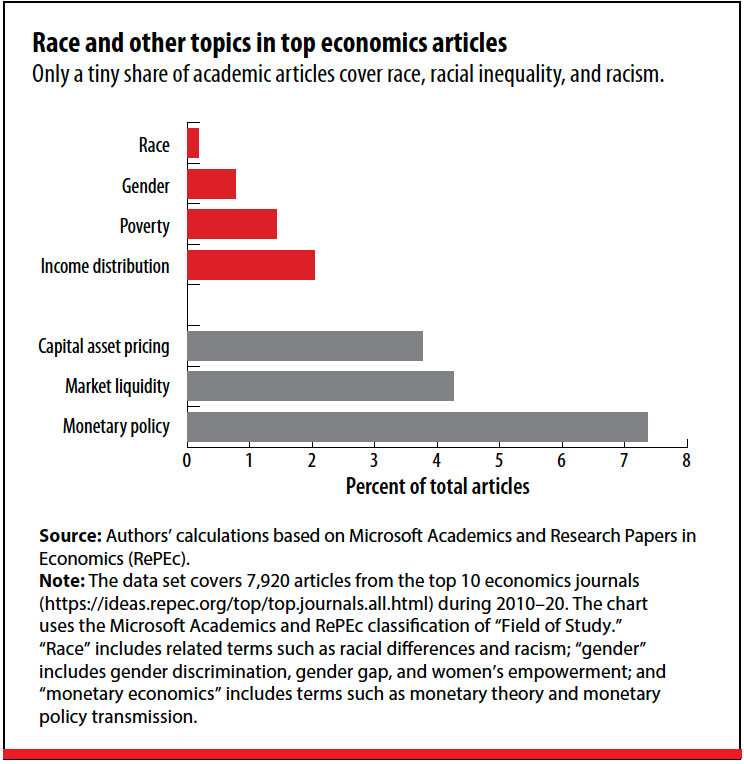
This imbalance may partly reflect underrepresentation of minorities among economists. A global analysis is difficult due to lack of comparable data, but the American Economic Association provides illustrative data in the Report of the Committee on the Status of Minority Groups in the Economics Profession. Just 4 percent of economics PhDs awarded in the United States in 2018 went to Black economists, and Black representation in economics decreased from 6 percent in 1995 to 3 percent in 2019, while their representation in the US population remained about 13 percent. Black representation in economics was lower than in science, technology, engineering, and math (and the same was true for minority populations other than Black).
Still, the burden of conducting rigorous analysis on race must not fall only on those adversely affected. How can we transition to the right side of history?
Right side of history
In economic institutions—academic and policymaking alike—the first step is to create a safe environment to talk about racism, raise awareness, and provide mandatory bias training—including in those that are unconscious.
Rooting out discrimination starts by acknowledging that a problem exists. Ijeoma Oluo argues in her 2019 New York Times bestseller, So You Want to Talk about Race, that we filter information through our own experiences to assess the validity of biases. But race is not a universal experience, which makes another person’s racial experience difficult to assess. While the fundamental solution lies in correcting systemic discrimination, silence at the individual level is deadly, as it perpetuates that system.
Motivated proponents can be inspired to focus more on the topic of race in their economic work, while skeptics can be persuaded to lessen pushback, fuel constructive discussion, and generate support. In turn, as the body of work on race grows, others will be encouraged to follow suit. Combating discrimination is not a zero-sum game: research shows that, overall, it improves the economy’s performance (for example, Sahay and others 2018).
To make progress, economists need to further broaden their perspective. Harvard sociologists Mario Small and the late Devah Pager have argued that economists need to adopt more sociological perspectives on racial discrimination and begin to examine institutional discrimination and the forms of everyday interpersonal discrimination that can be highly consequential for economic outcomes (Small and Pager 2020).
Increasing diversity in the economics profession, including racial diversity, is an important part of the solution. Evidence suggests that instructors’ demographics influence Black participation not only early on in the pipeline, but at all stages in the profession, including admissions, job market placement, hiring, and promotion decisions. As noted by John Rice in his June 2020 article for the Atlantic, “The Difference between First-Degree Racism and Third-Degree Racism,” it is a fallacy to argue that there is a trade-off between increasing racial diversity and maintaining the excellence-based “meritocracies” that have made organizations successful. Leveling the playing field for minorities at each step goes a long way in addressing discrimination and making organizations more productive.
Proactively recruiting qualified minorities, who do not have the networks to get a foothold, is critical, as is developing and supporting them as they rise through the ranks. For instance, the American Economic Association’s Committee on the Status of Minority Groups in the Economics Profession runs several initiatives designed to encourage minorities to study economics and pursue an academic career. And if the supply of diverse candidates is lacking, then society needs to dig deeper to address where biases begin—health services, education opportunities, or access to housing.
As IMF staff members, we recognize that addressing biases begins at home. For more than half a century, men from Europe and the United States made up the majority of the IMF’s senior managerial positions. Starting in the mid-1990s, as efforts were made to promote diversity, we began to see some progress on improving the representation of women and staff from underrepresented regions such as East Asia, the Middle East, and sub-Saharan Africa. Since 2003, benchmarks have been set for gender and regional diversity. The regional benchmarks seek to broadly align the proportion of staff from a region with the financial contribution of the countries in the region to the IMF’s resources as well as the use of these resources by them. These benchmarks were not intended to address racial inequity, even if many consider them to be imperfect proxies for race. While we have achieved steady progress against these benchmarks, gaps remain in the shares of underrepresented staff and their promotions to managerial positions.
The good news is that IMF management has expressed its commitment and is taking concrete actions to further promote inclusion of diverse staff and eliminate all forms of discrimination, including racial inequities. The IMF will enhance training on unconscious biases and microinequities, refocus recruitment efforts, improve the promotion process, introduce a program of sponsors for underrepresented staff, and collect data on diversity dimensions, including by race and ethnicity, by asking staff members to voluntarily self-declare their identity. We look forward to all IMF member countries adopting the same principle—that inclusion begins at home.
The Black Lives Matter movement has given a new impetus to raising awareness, learning, and empowerment. Research suggests that more economically inclusive organizations, cities, and societies tend to be more resilient and more prosperous. Economists have a role to play in the action for change to help build inclusive systems for the benefit of all—but first we must all, individually and collectively, look within.

MARTIN ČIHÁK leads the macro-financial unit in the IMF’s Strategy, Policy, and Review Department.
MONTFORT MLACHILA is the IMF’s senior resident representative in South Africa.
RATNA SAHAY is a deputy director of the IMF’s Monetary and Capital Markets Department.
References:
Chetty, Raj, Nathaniel Hendren, Maggie Jones, and Sonya Porter. 2020. “Race and Economic Opportunity in the United States: An Intergenerational Perspective.” Quarterly Journal of Economics 135 (2): 711–83.
Sahay, Ratna, Martin Čihák, Papa N’Diaye, Adolfo Barajas, Srobona Mitra, Annette Kyobe, Yen Mooi, and Reza Yousefi. 2018. “Women in Finance: A Case for Closing Gaps.” IMF Staff Discussion Note 18/05, International Monetary Fund, Washington, DC.
Small, Mario, and Devah Pager. 2020. “Sociological Perspectives on Racial Discrimination.” Journal of Economic Perspectives 34 (2): 49–67.
Spriggs, William. 2020. “Is Now a Teachable Moment for Economists?” Federal Reserve Bank of Minneapolis, Minnesota.
Stigler, George. 1965. “The Problem of the Negro.” New Guard (December): 11–12.
Opinions expressed in articles and other materials are those of the authors; they do not necessarily reflect IMF policy.