The economics of digital innovation
Although the pandemic will leave major economic damage and inequality in
its wake, it will help drive the adoption of digital technologies that
enable financial inclusion and economic opportunity. But these technologies
will not succeed on their own. To understand how digital technology and
policies can help, it is helpful to look first at the underlying economics.
At the heart of digital innovations stand a few technological enablers.
First are mobile phones and the internet, connecting individuals and
businesses with information and providers of financial services. A second
enabler is the storage and processing of large volumes of digital data.
Finally, advances like cloud computing, machine learning, distributed
ledger technology, and biometric technologies play a role.
But at the core of all these innovations is the ability to gather
information and reach users at a very low cost. Economists have assessed
the range of specific costs that decrease with digital technologies
(Goldfarb and Tucker 2019). Two economic features of digital technology
help show why these factors have been so powerful and what risks they pose.
First, digital platforms are highly scalable. Platforms can be thought of
as “matchmakers” that help different groups of users find one another. For
instance, a digital wallet provider like PayPal brings together merchants
and clients who want to make secure payments. The more clients use a
particular payment option, the more attractive it is for merchants to
accept it, and vice versa. This is an example of economies of scale, which
allow providers to grow quickly.
Similarly, Big Techs such as Amazon or China’s Alibaba can serve as
matchmakers to help buyers and sellers of goods find one another, but they
can also link merchants with providers of credit and other services.
Because of the range of services provided (including nonfinancial), they
have information that can be very valuable for their financial offerings.
This exemplifies economies of scope, which give the advantage to providers
with multiple business lines.
Second, digital technologies can improve risk assessment, benefiting from
the same data that are the natural by-product of their business. This is
particularly relevant for services such as lending, as well as investment
and insurance. Credit scores based on big data and machine learning can
often outperform traditional assessments, particularly for “thin-file”
borrowers, people or small businesses with little or no formal
documentation.
Research by BIS economists and coauthors shows that almost a third of
borrowers served by Mercado Libre, a Big Tech lender in Argentina, would
have been unable to access credit from a traditional bank (Frost and others
2019). Moreover, firms that borrowed from Mercado Libre enjoyed greater
sales and product offerings in the year after they borrowed. Research with
data from Ant Group suggests that, by relying on big data, Big Tech lenders
have less need for collateral (Gambacorta and others 2019). This can open
up access to lending for borrowers who have no house or other assets to
offer as collateral, and make loans less sensitive to asset price changes.
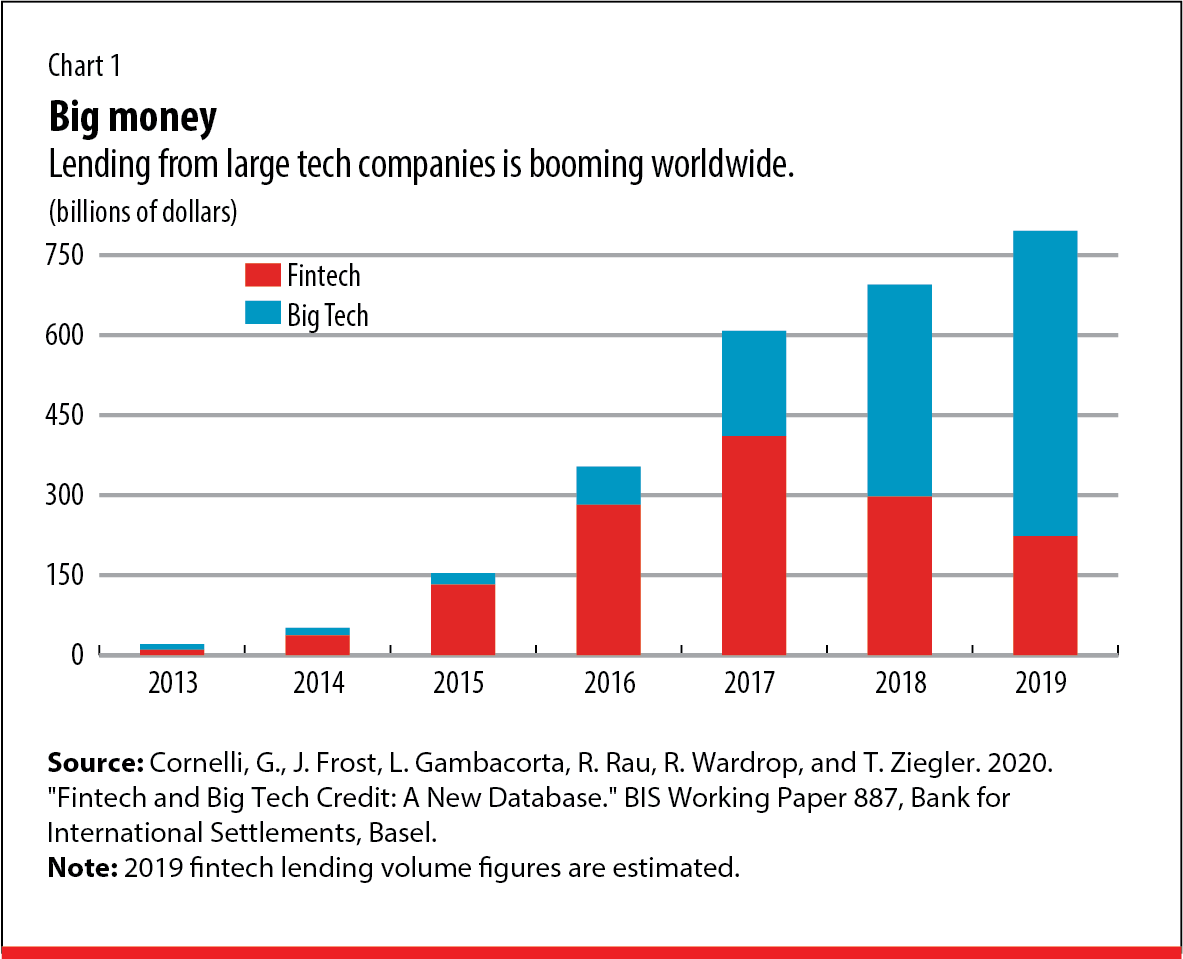
Such economies of scale and scope, together with improvements in predictive
power, can drive financial inclusion forward by leaps and bounds. Indeed,
Big Tech credit has boomed worldwide in the past decade, rising to an
estimated $572 billion in 2019 (see Chart 1). Such lending is particularly
important in China, Kenya, and Indonesia, compared with traditional credit
markets. It is also growing rapidly elsewhere and may even have ticked up
during the pandemic as some Big Techs helped distribute government lending
to companies.
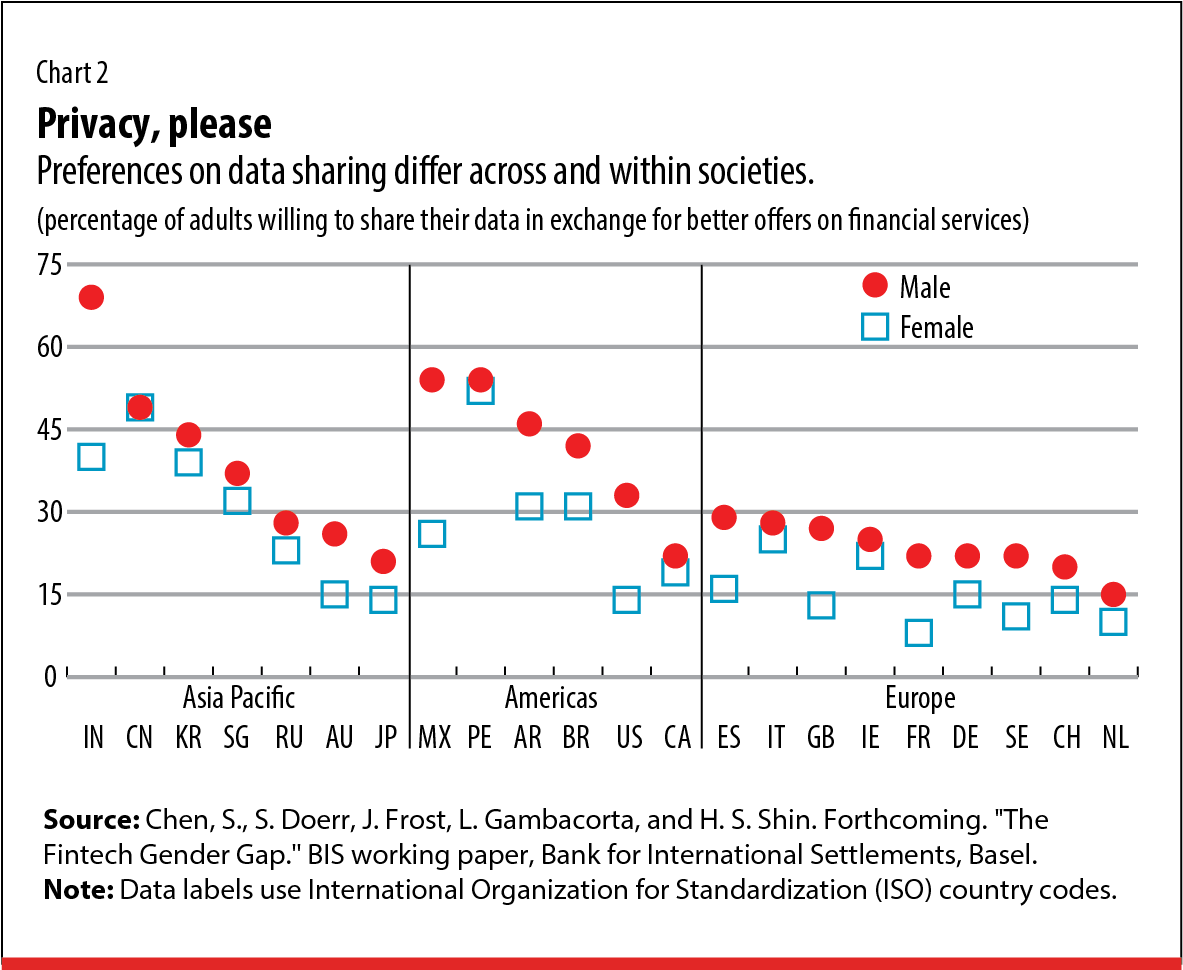
However, every silver lining has a cloud, and the advances made possible by
big data have drawbacks—in particular, the tendency toward monopolies. In
some economies, Big Tech payment providers and lenders have become
systemically important (“too big to fail”). The tendency to buy up
competitors may choke off innovation. Finally, there is a serious risk that
sensitive data will be misused and privacy violated. Smart public policies
are needed to mitigate these risks, while allowing the potential of digital
technologies to be fulfilled.