Going forward
Our findings show the value of real-time data during a rapidly unfolding
crisis. Such data have been useful in confirming the pandemic’s effect on
widening disparities among women and men, rich and poor. But how can
real-time data be harnessed to inform policies going forward? If anything,
it gives us a glimpse of what may come in the future and how to target
support in the present.
Unsurprisingly, the biggest hits were in sectors that were mostly or
completely shut down, such as hospitality, restaurants, tourism, and
personal services. As a result of this falloff, these sectors’ shares of
overall job postings were down substantially. Conversely, job postings in
health care, social services, and education have been rising as shares of
total postings. The question is whether these trends will continue. The
answer will depend on the evolution of the pandemic and the path of
economic recovery.
Although coverage of Indeed data is centered mainly on advanced economies,
job posting data patterns for Brazil, Mexico, Poland, and the United Arab
Emirates also show stark declines in labor demand during the pandemic.
Because emerging market and developing economies have large informal
sectors, declines in online job postings, which capture mostly formal
employment, may not reflect the full extent of the damage on labor
outcomes. Women in emerging market and developing economies are also likely
to bear a disproportionately larger burden than men, and the effects of
temporary school closings on women’s education could have detrimental
long-term consequences. As in advanced economies, the priority in emerging
market and developing economies is to contain the pandemic while cushioning
income losses for people and firms. In the long term, policies for
developing and emerging market economies need to address the setback in
human capital accumulation and increase in inequality and tackle
informality while promoting formal employment.
If these changes are permanent, the real-time data are a harbinger of
substantial labor reallocation that could be painful for many workers,
especially those whose skill sets are for sectors less in demand and who
are harder to retrain. The uncertainty only reinforces the need for more
support and protections for the vulnerable. To address especially hard-hit
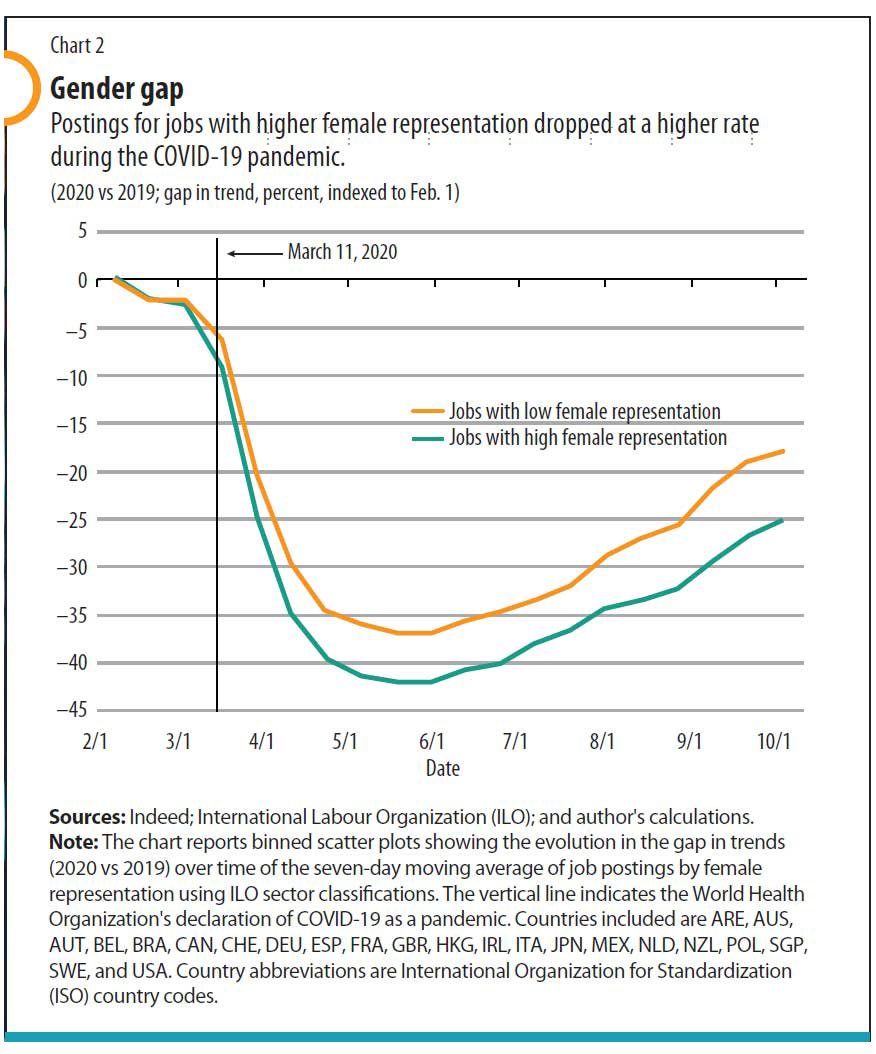
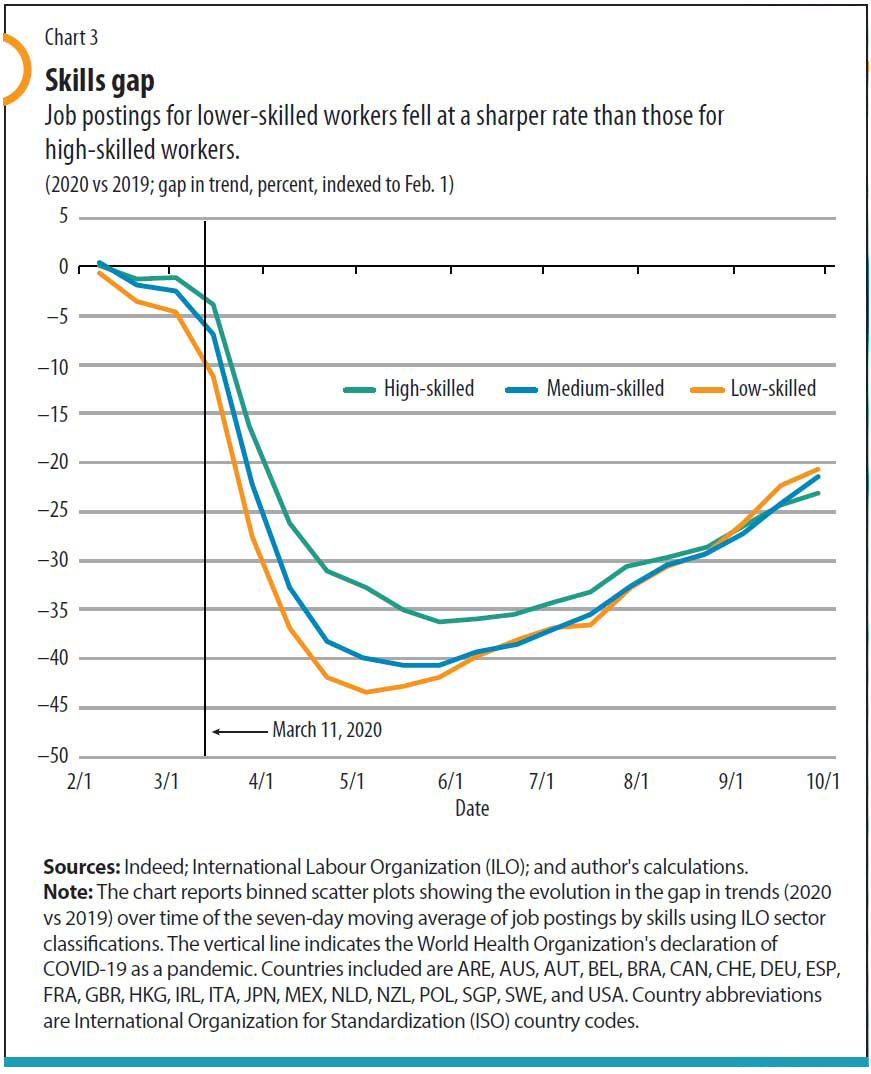
groups such as female and lower-skilled workers, policies should include
incentives for balancing work and family care responsibilities; better
access to health care, childcare, and family planning; and expanded support
for small businesses and the self-employed. Programs offering worker
(re)training and hiring subsidies targeted at workers who face greater risk
of long-term unemployment should be explored.
These data are only the tip of the iceberg as the world comes to grips with
the pandemic’s societal impacts. What they have made clear is a widening
gap between genders and classes. They also reaffirm the value of policies
such as investing in education and infrastructure, subsidizing childcare,
and offering paid parental leave. These policies are not only crucial to
lifting constraints on women’s economic empowerment, they are necessary to
promote an inclusive post–COVID-19 recovery.