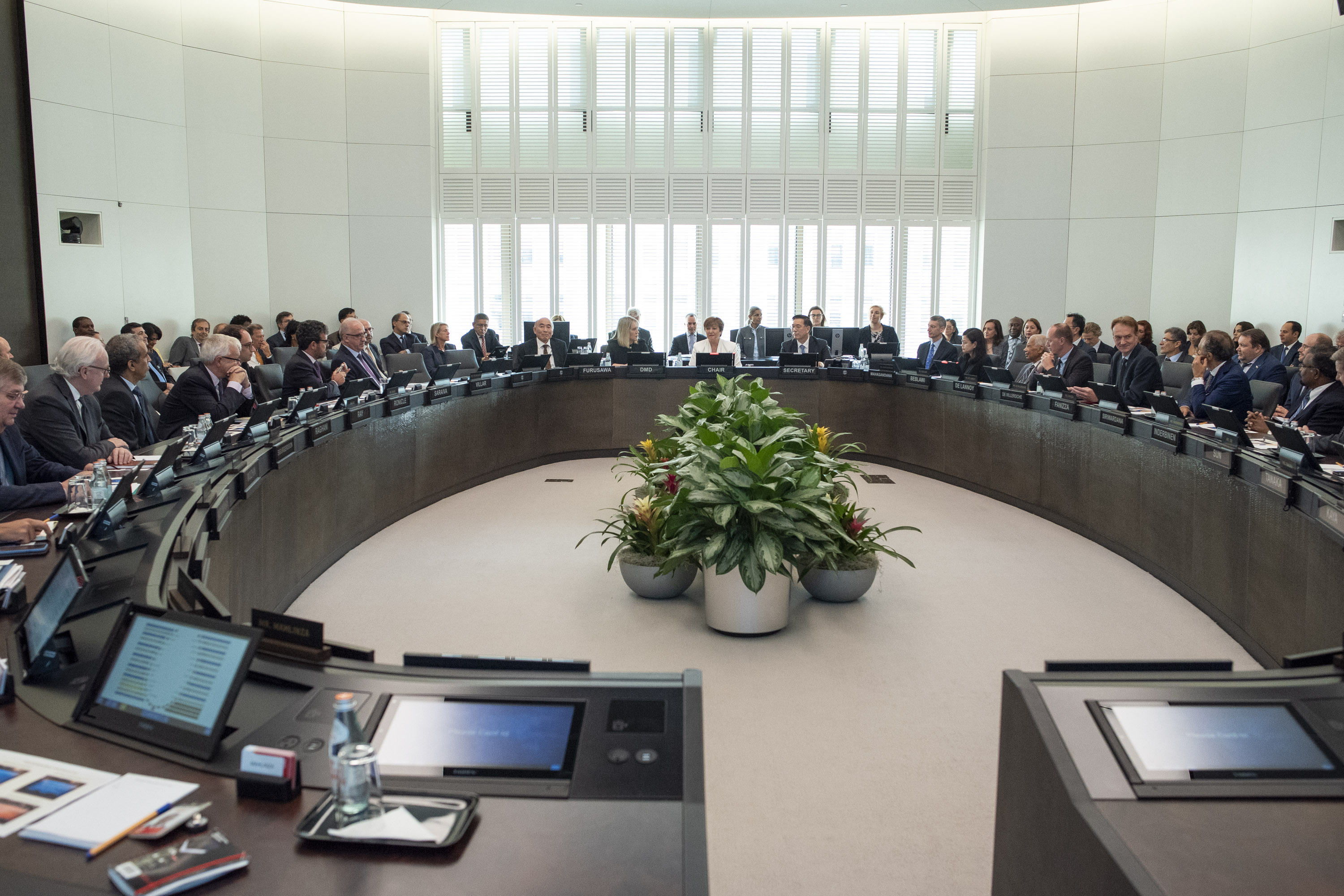
IMF Executive Board Approves a US$390 Million 42-month Arrangement Under the Extended Credit Facility for Togo
IMF News, March 1, 2024
Source details
- Canonical URL
- IMF Executive Board Approves a US$390 Million 42-month Arrangement Under the Extended Credit Facility for Togo
Other formats
Bibliographic details
- Published: March 1, 2024
Arrangement and financing
- 42-month arrangement under the Extended Credit Facility (ECF).
- Financing of SDR 293.60 million (about US$390 million).
- Immediate disbursement of SDR 51.38 million (about US$68.3 million).
- Arrangement size equals 200 percent of quota.
Context and challenges
- Recent shocks: COVID pandemic, terrorist attacks, spikes in global food and fuel prices.
- Ongoing headwinds: policy tightening in advanced economies, challenging security situation at the northern border, persistent food insecurity compounded by climate change.
- Fiscal and debt dynamics: fiscal deficits and debt have increased, reversing debt reduction achieved during the 2017–20 ECF-arrangement; erosion of fiscal space and buffers to absorb shocks; contribution to regional vulnerabilities in the West African Economic and Monetary Union (WAEMU).
- Financial sector risks: two undercapitalized banks (one state-owned, the other recently privatized) pose risks to financial sector stability and associated fiscal risks.
Program objectives and key policy pillars
- Primary aims:
- Help maintain macroeconomic stability.
- Accelerate poverty reduction.
- Catalyze further external financing, benefitting Togo and contributing to macroeconomic and external stability in WAEMU.
- Key policy pillars:
- Make growth more inclusive while strengthening debt sustainability.
- Conduct structural reforms to support growth and limit fiscal and financial sector risks.
- Strengthen social spending and the social safety net.
- Large fiscal consolidation underpinned by ambitious fiscal revenue mobilization.
- Banking sector reform, including recapitalization of the remaining state-owned bank.
Policy recommendations and program measures
- Social policy and inclusion:
- Strengthen social spending and social safety nets.
- Implement an investment program to improve living conditions in the Savanes region and neighboring regions to complement military responses with civilian responses.
- Substitute generalized fuel subsidies with more targeted and cost-effective measures to protect the vulnerable, including through cash transfers.
- Fiscal policy and debt sustainability:
- Continue growth-friendly fiscal consolidation to create space for development spending while strengthening debt sustainability.
- Raise tax revenue by an ambitious 0.5 percent of GDP every year.
- Broaden the tax base by streamlining tax expenditures.
- Structural and financial sector reforms:
- Enhance the business environment, including strengthening governance, anti-corruption, and AML/CFT frameworks.
- Reform the remaining state-owned bank; provision of budget resources for recapitalization to zero regulatory capital is a first step.
- Strengthen public financial management.
Medium-term fiscal framework and anchors
- Dual fiscal anchor:
- First element: reduce the overall risk of debt distress from high to moderate (PV of public debt below 55 percent of GDP) by end-2026.
- Second element: lower the fiscal deficit to 3 percent of GDP by 2025 to avoid overtaxing the regional market’s ability to provide financing, in line with the (currently suspended) regional convergence framework.
- Commitment to raising revenue by an ambitious 0.5 percent of GDP each year to create space for priority spending.
Expected role of the program
- Provide and catalyze concessional financing for budget purposes to ease trade-offs between enhancing inclusion through higher social spending and strengthening debt sustainability.
- Help maintain macroeconomic and external stability in the WAEMU.
Togo: Selected Economic Indicators (Estimates and Projections)
- National Income and Prices (percentage change)
- Real GDP: 2022 — 5.8; 2023 — 5.4; 2024 — 5.3; 2025 — (no value for 2025 in source table header—values presented through 2024 in table).
- Real GDP per capita: 2022 — 3.3; 2023 — 2.9; 2024 — 2.8.
- Consumer price index (average): 2022 — 7.6; 2023 — 5.1; 2024 — 2.7; 2025 — 2.0.
- Money and Credit
- Credit to nongovernment sector: 2022 — 10.7; 2023 — 2.6; 2024 — 9.2; 2025 — 6.8.
- Broad money (M2): 2022 — 14.9; 2023 — 8.2; 2024 — 8.8; 2025 — 8.6.
- Central Government Finance (percent of GDP)
- Revenue: 2022 — 15.1; 2023 — 15.5; 2024 — 16.3; 2025 — 16.9.
- Tax revenue: 2022 — 13.9; 2023 — 14.4; 2024 — 15.4.
- Total expenditure and net lending: 2022 — 26.0; 2023 — 24.9; 2024 — 23.3; 2025 — 21.4.
- Overall balance (cash basis, incl. grants): 2022 — -8.3; 2023 — -6.6; 2024 — -6.4; 2025 — -3.0.
- Basic primary fiscal balance (excl. banking sector operations): 2022 — -4.5; 2023 — -2.5; 2024 — -0.5; 2025 — 1.2.
- External Sector
- Current account balance: 2022 — -4.2; 2023 — -3.3; 2024 — -3.6; 2025 — -3.5.
- Terms of trade (percent change; deterioration = –): 2022 — 9.7; 2023 — 1.6; 2024 — -2.2; 2025 — -1.5.
- Public Debt
- Total public debt: 2022 — 66.5; 2023 — 67.4; 2024 — 68.8; 2025 — 66.9.
- External public debt: 2022 — 26.2; 2023 — 25.6; 2024 — 26.9; 2025 — 27.1.
- Domestic public debt: 2022 — 40.3; 2023 — 41.8; 2024 — 41.9; 2025 — 39.8.
IMF press release, March 1, 2024 — Executive Board approval of a 42-month ECF arrangement for Togo (SDR 293.60 million; immediate SDR 51.38 million).