IMF World Economic Outlook (WEO), April 2015: Uneven Growth: Short- and Long-Term Factors
World Economic Outlook, April 7, 2015
Source details
- Canonical URL
- IMF World Economic Outlook (WEO), April 2015: Uneven Growth: Short- and Long-Term Factors
Other formats
Bibliographic details
- Published: April 7, 2015
- Series: World Economic Outlook
Overview
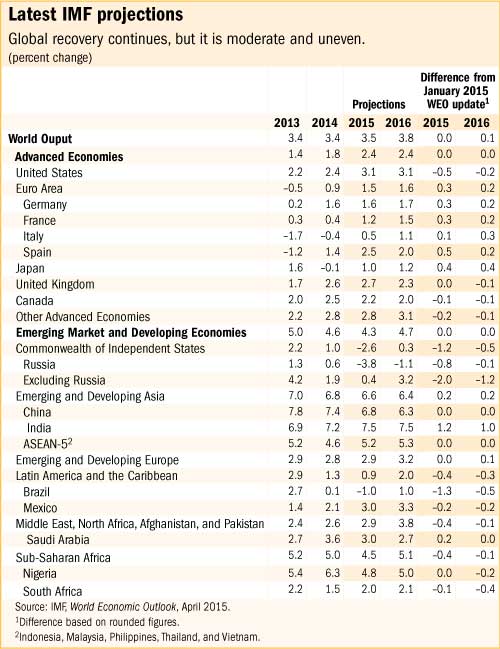
- Global growth is projected to be 3.5 percent in 2015, in line with forecasts in the January 2015 World Economic Outlook (WEO) Update.
- Global growth in 2014 was 3.4 percent.
- Relative to last year, the outlook for advanced economies is improving, while growth in emerging market and developing economies is projected to be lower, primarily reflecting weaker prospects for some large emerging market economies and oil-exporting countries.
- The report emphasizes complex forces shaping the outlook: medium- and long-term trends, global shocks, and many country- or region-specific factors.
Key Global Projections and Risks
- Global growth forecasts:
- 2014: 3.4 percent
- 2015: 3.5 percent
- 2016: 3.8 percent
- Distribution of risks:
- The distribution of risks to near-term global growth has become more balanced relative to the October World Economic Outlook but is still tilted to the downside.
- The decline in oil prices could boost activity more than expected.
- Geopolitical tensions continue to pose threats.
- Risks of disruptive shifts in asset prices remain relevant.
- In some advanced economies, protracted low inflation or deflation also pose risks to activity.
Chapter 1 — Recent Developments and Prospects
- Main findings:
- Global growth in 2014 reflects a pickup in growth in advanced economies and a slowdown in emerging market and developing economies.
- Growth is projected to be stronger in 2015 relative to 2014 in advanced economies, but weaker in emerging markets.
- Topics covered:
- Recent developments and prospects for the world economy.
- Potential risks (downside and upside) and policy recommendations.
- Special feature: Commodity Market Developments and Forecasts, with a Focus on Investment in an Era of Low Oil Prices.
- Special scenarios and boxes:
- Scen.1: The Global Impact of Lower Oil Prices
- Scen.2: Global Implications of Exchange Rate Movements
- 1.1 The Oil Price Collapse: Demand or Supply?
- 1.2 Understanding the Role of Cyclical and Structural Factors in the Global Trade Slowdown
Chapter 2 — Country and Regional Perspectives
- Regional outlook summary:
- Global growth is forecast at 3.5 percent in 2015 and 3.8 percent in 2016, with uneven prospects across the main countries and regions.
- The chapter provides region-by-region outlooks and notable country developments for 2015.
- Regional headlines:
- The United States and Canada: A Solid Recovery
- Europe
- Asia and Pacific: Moderating but Still Outperforming Other Regions
- Latin America and the Caribbean: Another Year of Subpar Growth
- Commonwealth of Independent States: Oil Price Slump Worsens Outlook
- The Middle East, North Africa, Afghanistan, and Pakistan: Oil, Conflicts, and Transitions
- Sub-Saharan Africa: Resilience in the Face of Headwinds
- Data tables include country- and region-level indicators for Real GDP, Consumer Prices, Current Account Balance, and Unemployment.
Chapter 3 — Where Are We Headed? Perspectives on Potential Output
- Main findings:
- Potential output growth across advanced and emerging market economies has declined in recent years.
- In advanced economies, the decline started as far back as the early 2000s and worsened with the global financial crisis.
- In emerging market economies, the decline began only after the crisis.
- Potential output growth in advanced economies is likely to increase slightly from current rates as some crisis-related effects wear off, but to remain below precrisis rates in the medium term.
- In emerging market economies, potential output growth is expected to decline further due to aging populations, weaker investment, and lower total factor productivity growth.
- Analytical focus:
- Potential Output: A Primer
- How potential growth evolved before and during the crisis
- Determinants of potential output growth and policy implications
- Annexes and methodologies:
- Multivariate Filter Methodology
- Estimating Trend Labor Force Participation Rates
- Data Sources and Country Groupings
Chapter 4 — Private Investment: What’s the Holdup?
- Main findings:
- Private fixed investment in advanced economies contracted sharply during the global financial crisis, and there has been little recovery since.
- Investment has slowed more gradually in the rest of the world.
- Business investment accounts for the bulk of the slump; the overriding factor holding it back has been the overall weakness of economic activity.
- In some countries, contributing factors include financial constraints and policy uncertainty.
- Policy implication:
- Addressing the general weakness in economic activity is crucial for restoring growth in private investment.
- Analytical topics and methods:
- Is There a Global Slump in Private Investment?
- Firm-level analyses of financial constraints and policy uncertainty
- Accelerator model estimations and robustness checks
- Data downloads and statistical appendix covering private and business investment
Data, Assumptions, and Resources
- The publication includes:
- Assumptions and Conventions
- Further Information and Data
- World Economic Outlook Databases and Data Tools, including IMF Data Mapper® v3
- Lists of tables covering world output, components of GDP, inflation, fiscal balances, trade volumes and prices, current account balances, financial account balances, external debt, and medium-term baseline scenarios
- Classification and methodological materials:
- Classification of Countries and World Economic Outlook Groups
- Box A1. Economic Policy Assumptions Underlying the Projections for Selected Economies
IMF World Economic Outlook, April 2015: Uneven Growth: Short- and Long-Term Factors — web landing page overview.
Content in this bundle
- New040715aa (PDF)
- New041415aa (PDF)
- Suma (PDF)
- Texta (PDF)
- Texta (PDF)
- 040715c (PDF)
- Sumc (PDF)
- Textc (PDF)
- Textc (PDF)
- Sumf (PDF)
- Textf (PDF)
- Textf (PDF)
- Sumj (PDF)
- Textj (PDF)
- Textj (PDF)
- Fig110pdf (PDF)
- Fig111pdf (PDF)
- Fig112pdf (PDF)
- Fig113pdf (PDF)
- Fig114pdf (PDF)
- Fig11pdf (PDF)
- Fig121pdf (PDF)
- Fig122pdf (PDF)
- Fig123pdf (PDF)
- Fig124pdf (PDF)
- Fig12pdf (PDF)
- Fig13pdf (PDF)
- Fig14pdf (PDF)
- Fig15pdf (PDF)
- Fig16pdf (PDF)
- Fig17pdf (PDF)
- Fig18pdf (PDF)
- Fig19pdf (PDF)
- Fig1s1pdf (PDF)
- Fig1s2pdf (PDF)
- Fig1sf10pdf (PDF)
- Fig1sf11pdf (PDF)
- Fig1sf12pdf (PDF)
- Fig1sf1pdf (PDF)
- Fig1sf2pdf (PDF)
- Fig1sf3pdf (PDF)
- Fig1sf4pdf (PDF)
- Fig1sf5pdf (PDF)
- Fig1sf6pdf (PDF)
- Fig1sf7pdf (PDF)
- Fig1sf8pdf (PDF)
- Fig1sf9pdf (PDF)
- Fig21pdf (PDF)
- Fig22pdf (PDF)
- Fig23pdf (PDF)
- Fig24pdf (PDF)
- Fig25pdf (PDF)
- Fig26pdf (PDF)
- Fig27pdf (PDF)
- Fig28pdf (PDF)
- Fig29pdf (PDF)
- Fig310pdf (PDF)
- Fig311pdf (PDF)
- Fig312pdf (PDF)
- Fig31pdf (PDF)
- Fig321pdf (PDF)
- Fig32pdf (PDF)
- Fig331pdf (PDF)
- Fig332pdf (PDF)
- Fig333pdf (PDF)
- Fig33pdf (PDF)
- Fig341pdf (PDF)
- Fig34pdf (PDF)
- Fig351pdf (PDF)
- Fig35pdf (PDF)
- Fig36pdf (PDF)
- Fig37pdf (PDF)
- Fig38pdf (PDF)
- Fig39pdf (PDF)
- Fig3annex21pdf (PDF)
- Fig3annex31pdf (PDF)
- Fig3annex41pdf (PDF)
- Fig3annex42pdf (PDF)
- Fig3annex51pdf (PDF)
- Fig410pdf (PDF)
- Fig411pdf (PDF)
- Fig412pdf (PDF)
- Fig413pdf (PDF)
- Fig414pdf (PDF)
- Fig41pdf (PDF)
- Fig42pdf (PDF)
- Fig43pdf (PDF)
- Fig44pdf (PDF)
- Fig45pdf (PDF)
- Fig46pdf (PDF)
- Fig47pdf (PDF)
- Fig48pdf (PDF)
- Fig49pdf (PDF)
- Fig4annex31pdf (PDF)
- Fig4annex51pdf (PDF)
- Fig4annex52pdf (PDF)
- 3sumpdf (PDF)
- 4sumpdf (PDF)
- Annexpdf (PDF)
- C1pdf (PDF)
- C2pdf (PDF)
- C3pdf (PDF)
- C4pdf (PDF)
- Exesumpdf (PDF)
- Forewordpdf (PDF)
- Frontpdf (PDF)
- Infopdf (PDF)
- Prefacepdf (PDF)
- Seltoppdf (PDF)
- Statapppdf (PDF)
- Sum (PDF)
- Tblpartapdf (PDF)
- Tblpartbpdf (PDF)
- Text (PDF)
- Textpdf (PDF)
- 040715r (PDF)
- Sumr (PDF)
- Textr (PDF)
- Textr (PDF)
- Sums (PDF)
- Texts (PDF)
- Texts (PDF)
- 2015weo Pbi (XLSX)
- Fig1 1 1 (CSV)
- Fig1 1 2 (CSV)
- Fig1 1 3 (CSV)
- Fig1 1 (CSV)
- Fig1 10 (CSV)
- Fig1 11 (CSV)
- Fig1 12 (CSV)
- Fig1 13 (CSV)
- Fig1 14 (CSV)
- Fig1 2 1 (CSV)
- Fig1 2 2 (CSV)
- Fig1 2 3 (CSV)
- Fig1 2 4 (CSV)
- Fig1 2 (CSV)
- Fig1 3 (CSV)
- Fig1 4 (CSV)
- Fig1 5 (CSV)
- Fig1 6 (CSV)
- Fig1 7 (CSV)
- Fig1 8 (CSV)
- Fig1 9 (CSV)
- Fig1 S 1 (CSV)
- Fig1 S 2 (CSV)
- Fig1 Sf 1 (CSV)
- Fig1 Sf 10 (CSV)
- Fig1 Sf 11 (CSV)
- Fig1 Sf 12 (CSV)
- Fig1 Sf 2 (CSV)
- Fig1 Sf 3 (CSV)
- Fig1 Sf 4 (CSV)
- Fig1 Sf 5 (CSV)
- Fig1 Sf 6 (CSV)
- Fig1 Sf 7 (CSV)
- Fig1 Sf 8 (CSV)
- Fig1 Sf 9 (CSV)
- Fig2 1 (CSV)
- Fig2 2 (CSV)
- Fig2 3 (CSV)
- Fig2 4 (CSV)
- Fig2 5 (CSV)
- Fig2 6 (CSV)
- Fig2 7 (CSV)
- Fig2 8 (CSV)
- Fig2 9 (CSV)
- Fig3 1 1 (CSV)
- Fig3 1 2 (CSV)
- Fig3 1 (CSV)
- Fig3 10 (CSV)
- Fig3 11 (CSV)
- Fig3 2 1 (CSV)
- Fig3 2 (CSV)
- Fig3 3 1 (CSV)
- Fig3 3 2 (CSV)
- Fig3 3 3 (CSV)
- Fig3 3 (CSV)
- Fig3 4 1 (CSV)
- Fig3 4 (CSV)
- Fig3 5 1 (CSV)
- Fig3 5 (CSV)
- Fig3 6 (CSV)
- Fig3 7 (CSV)
- Fig3 8 (CSV)
- Fig3 9 (CSV)
- Fig3 Annex2 1 (CSV)
- Fig3 Annex3 1 (CSV)
- Fig3 Annex4 1 (CSV)
- Fig3 Annex4 2 (CSV)
- Fig3 Annex5 1 (CSV)
- Fig4 1 1 (CSV)
- Fig4 1 2 (CSV)
- Fig4 1 3 (CSV)
- Fig4 1 (CSV)
- Fig4 10 (CSV)
- Fig4 11 (CSV)
- Fig4 12 (CSV)
- Fig4 13 (CSV)
- Fig4 14 (CSV)
- Fig4 2 (CSV)
- Fig4 3 (CSV)
- Fig4 4 (CSV)
- Fig4 5 (CSV)
- Fig4 6 (CSV)
- Fig4 7 (CSV)
- Fig4 8 (CSV)
- Fig4 9 (CSV)
- Fig4 Annex3 1 (CSV)
- Fig4 Annex5 1 (CSV)
- Fig4 Annex5 2 (CSV)
References
- Uneven Global Recovery, Complex Underlying Currents
- Blog: Four Forces Facing the Global Economy
- Podcast: Uneven Global Economic Growth for 2015
- Lower Potential Growth: A New Reality
- Blog: No Puzzle About Weak Business Investment: It's the Economy!
- World Economic Outlook Reports
- World Economic Outlook Databases
- IMF DataMapper
- WEO Discussion Forum
- April 2015
- Podcasts
- Discussion Forum
- Frequently Asked Questions
- Subscribe
- Ordering Information
- Disclaimer
- Overview of the World Economic Outlook Projections
- https://www.imf.org/en/home